|
November/December 2025
Check out what’s new and noteworthy in Special Collections.
Friday, November 7, 10am–12pm
North Regional Library
Learn how to archive, organize, and preserve the records of your organization or group for the future. Led by the our Special Collections archivist, this class is designed for staff and volunteers from any type of community group and anyone who has an interest in preserving local history. Leave class knowing how to store and preserve documents, photos, digital files, recordings, and more, and be prepared to organize your group's history.
Books are a small part of the joy that libraries bring to communities, especially for children. Since 1889, our library system has touched the lives of countless children each year through story times, magic and puppet shows, author visits, festivals, summer reading programs, indoor play spaces, and so much more. Take a journey to the past and learn how Hennepin County Libraries have adapted to serve our youngest patrons.
This online exhibit is in partnership with the Friends of the Hennepin County Library, as part of the Treasures of Special Collections series.
Our Digital Collections have grown over the years to contain a large number of documents and publications for which we use optical character recognition (OCR) software to make their text searchable. Handwritten materials have presented a challenge for us since OCR does not work with script. Manuscript materials such as the James Smith WWII Letters were transcribed, manually, by a volunteer—a tedious process. We have also worked with voice dictation tools, having volunteers read text aloud into the computer microphone—but the results have required significant formatting and editing. Handwritten text-recognition software has been around for a while, but only in recent years has it significantly improved using AI and a wide range of script models.
Last month, we began a subscription to Transkribus, an Austria-based text-recognition tool that features custom AI training to improve accuracy. To begin, we’re working on the Lord Family WWII Correspondence, a set of over 1,000 letters between Staff Sergeant Harry Holmes Lord, Jr. of the United States Marine Corps, and his family in Minneapolis (only about 400 are handwritten). Digital images of the handwritten letters are uploaded to the Transkribus site. Each page is “read,” and a transcript is generated:
 |
The example above shows the unedited transcript generated by the Transkribus “bot”. As you can see, there are very few errors.
Staff give a quick review of the transcript for any errors, then load the text to the metadata for that letter in our Digital Collections. Read the complete letter from Marine Sergeant Harry Lord, Jr. to his younger brother Charles, from May 26, 1943. Click “Transcript” below the image to view the text from Transkribus.
Transcriptions can allow for easier reading of challenging handwriting, but more importantly, they allow for greater discoverability of the information in the text through keyword searching.
Staff have just begun using this new product and only about 10 letters have been transcribed so far. Many more handwritten pages are on the way from this collection and others!
 These collections have been recently organized and rehoused, with finding aids now online:
-
Aeon Records – Documents, photographs, audio and video material created or compiled by Aeon, previously known as the Central Community Housing Trust of Minneapolis (CCHT), a nonprofit, affordable housing developer and property manager. Materials in this collection are from the mid-1980s to early 2000s.
-
Holly Marcotte View-Master Slides – (pictured above) View-Master reels with photos of local events, including Aquatennial, Minnesota State Fair, St. Paul Winter Carnival, and local golf competitions from 1954 to 1958. Includes plug-in View-Master viewer to see images in 3-D.
-
Marcy-Holmes Neighborhood Association Records (Accrual) – Board of directors meeting minutes, notes, memos, fliers, membership information, administrative and financial documents, correspondence, project and subject files, print photographs, VHS cassettes, and publications created or compiled by the MHNA. In 2024, MHNA merged with nearby neighborhoods to create the East Bank Neighborhoods Partnership.
-
Milwaukee Avenue Homeowners Association Records – Association documents, committees, communications, facilities, financials, meeting materials, Seward West, subject files, and media created or compiled by the Milwaukee Avenue Homeowners Association. The Association is a non-profit made up of Milwaukee Avenue residents that was formed in 1978 to manage common areas and to preserve the architectural integrity of the buildings on Milwaukee Avenue.
-
Nicollet Island-East Bank Neighborhood Association Records – Board of directors’ policies and meeting minutes, articles and bylaws, correspondence, administrative and financial documents, membership information, programming proposals, funding, and contracts documenting the neighborhood from 1974-2021.
-
Whitter Alliance Records Digital Files – Digital files originally on floppy disks, CDs, and DVDs have been removed from their original media and added to the collection. Contents include photographs and documents from the 2000s and 2010s.
The following new donations were recently received in Special Collections. These collections are unprocessed, but available for research:
-
Ann Lynch Lyndale Farmstead Photographs – Print photographs and negatives of events in Lyndale Farmstead Park from 1995 to 2016. Many events were sponsored by the Minneapolis Park and Recreation Board.
-
Clara Williams and Adyline Johnson Felsted Papers – Personal papers and photographs of Clara Williams and Adyline Johnson Felsted. Clara Williams and Adyline Johnson were both accomplished vocal teachers at MacPhail. Johnson was Williams' student.
The Special Collections department houses more than just local history. We have 11 rare book collections, including the Kittleson WWII Collection, notable for its posters, regimental and unit histories, and published material contemporaneous with the war. We have been working on a year-long review of this collection.
As part of this process, many manuals and handbooks that were previously part of a vertical file collection have been cataloged and placed in archival enclosures. They are now discoverable in the hclib.org online catalog.
Check out some highlights from the collection:
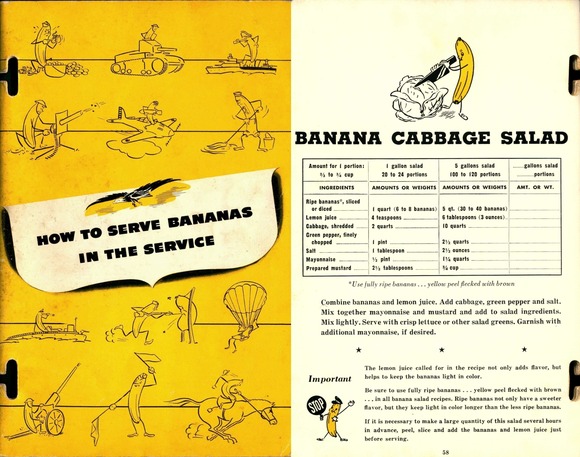 |
How to Serve Bananas in the Service, Home Economics Department, Fruit Dispatch Company, c1940-1945.
Features nutrition facts about bananas and a bunch of banana recipes for breakfast, lunch, and dinner. Bananas are easily digested, a quick energy source, and contain vitamins which prevent night blindness (A) and scurvy (C) and help keep nerves steady (B1). Try a banana cabbage salad with ripe bananas, cabbage, green pepper, lemon, salt, mayonnaise, and mustard!
Winter Draws On, prepared by the Safety Education Division of Flight Control; Illustrated by Walt Disney, 1943.
Meet the Spandule, a close relative of the Gremlin. These little fellows come down from high altitudes in winter weather, wreaking havoc on airplanes and causing problems for pilots. Only a pilot who’s on his toes can prevent a run-in with them. Walt Disney’s Spandules look like something straight out of the film Fantasia, which was released just a few years prior.
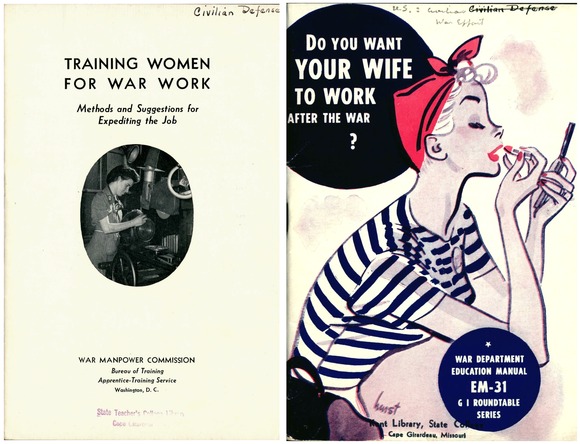 |
Training Women for War Work: Methods and Suggestions for Expediting the Job, War Manpower Commission, Bureau of Training, Apprentice-Training, 1943.
Do You Want Your Wife to Work After the War? War Department, 1944.
These two manuals work well side-by-side. The first, compiled by training specialist Mary Curran, outlines the great need for womanpower and provides tips for training the “totally inexperienced.” Curran stresses the importance of hiring woman counselors to work as liaisons between the workers and management.
A year later, the War Department published a manual for men aimed at provoking discussion around the issue of whether women should continue working. It contains facts, figures, and a summary of the various arguments and ultimately asks, “what will the women want?” and “how can a man decide?”
 |
Can War Marriages Be Made to Work? War Department, 1944.
Another from the G.I. Roundtable Series (which produced Do You Want Your Wife to Work After the War?), comes a discussion around the success of wartime marriage. Many war marriages are hasty marriages. Think before you act. Find out what makes her tick, but don’t try to change her. Meet the girl’s parents…study them! Think in terms of growth and change. And somewhat surprisingly, suggests discussing the topic with both men and women as both points of view will increase the value of the thought given to this problem.
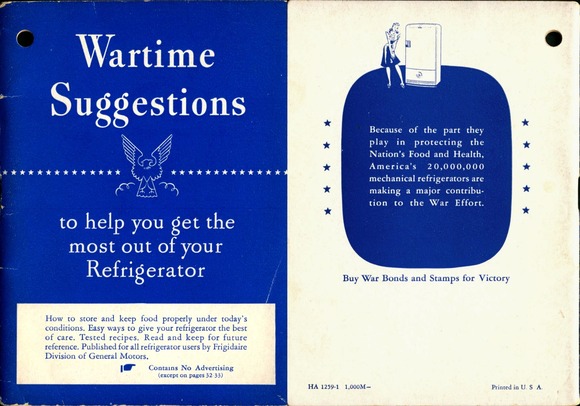 |
Wartime Suggestions to Help You Get the Most Out of Your Refrigerator, Frigidaire Division, General Motors, 1943.
Part advertisement, part instructional manual, this booklet emphasizes the importance of refrigerators to the war effort. By refrigerating food at home, you can reduce food waste so our fighting men can be properly fed. It includes tips for caring for and maintaining your fridge and over 140 suggestions for utilizing leftover food in a variety of attractive dishes.
James K. Hosmer Special Collections
Minneapolis Central Library
300 Nicollet Mall
Minneapolis, MN 55401
Hours: Monday - Thursday, 9am - 4:30pm.
Appointments are not necessary, but you do need to call Special Collections or check-in at the 4th floor reference desk upon arrival for department access. You can speed up your visit by requesting materials be pulled in advance. Photocopier and scanners are available. Please bring a flash drive to store your scanned images.
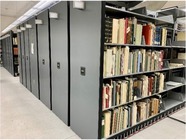
Photo: Inside the climate-controlled Special Collections vault, where rare books, negatives, and AV materials are stored.
Email specialcoll@hclib.org or visit hclib.org/specialcollections for more information.
|
|