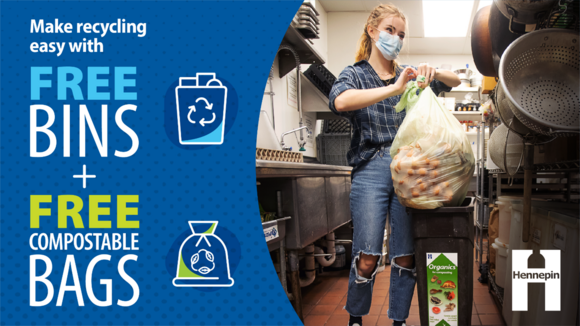
Grants are available for schools to start or improve programs to reduce waste and keep recycling and organic materials, including food and non-recyclable paper, out of the trash. Eligible organizations include preschools, K-12 schools, colleges and universities in Hennepin County. Schools can apply for up to $15,000.
Grant funding can be used to fund staff time for project implementation as well as to purchase equipment and supplies including recycling and organics recycling containers, sorting stations, reusable food service ware, and bulk condiment dispensers.
Application deadline is November 5
For application materials, submit a school recycling and waste reduction inquiry form.
Bat Week is an international, annual celebration to raise awareness about the need for bat conservation. Read on to learn more about bats in Hennepin County and a bat resource to give your audiences.
 Bats are an important part of our ecosystem as they eat up to half their body weight in insects every night. Not only do they eat mosquitoes, they also contribute billions of dollars' worth of agricultural production by eating pests.
Hennepin County is home to seven species of bats, including the federally endangered northern long-eared bat. These species depend on decaying trees, caves, mine shafts, and bat houses to raise their pups in the summer and to shelter in for the winter.
Bats in our area are struggling due to disease, habitat loss, climate change, and development, but you and those you teach can make a difference!
Share these easy ways to help bats with your audiences:
- Leave dead trees standing.
- Manage forests in the winter, when bats and nesting animals are less likely to be disturbed.
- Protect wetlands and other sources of freshwater.
- Don’t use pesticides. They can poison or kill bats, who are natural pest controllers.
- Keep cats indoors.
Educate your audiences about bats
Resources for adult and high school audiences
- Use Hennepin County’s building and maintaining your bat house pamphlet to educate about the benefits of bats, how to build and maintain a bat house, and other ways to help bats. Consider integrating this pamphlet as a take-home resource after night hikes.
-
BatsLive offers free resources including videos and lesson plans to teach about bat biology and conservation.
Resources for audiences in grades 3-8
-
BatsLive offers free resources including videos and lesson plans to teach about bat biology and conservation.
-
Project WILD offers a self-paced course to train educators with bat-focused lessons.
Resources for audiences in grades K-5
-
Batweek.org has fun activities like color pages, crafts, and printable booklets.
If you find a sick or injured bat
A safety note about bats: a very small percentage of bats (less than 1%) have been reported to carry rabies in Minnesota, according to the Minnesota Department of Natural Resources.
- Due to the small risk of rabies, do not pick up an injured bat if you find one. Contact the Wildlife Rehabilitation Center of Minnesota (info@wrcmn.org or 651-486-9453).
- Report sick or deceased bats to the Minnesota Department of Natural Resources (state.mn.us/reportbats).
My NASA Data webinar series
Join My NASA Data for a series of professional development webinars held Tuesdays at 6 p.m. These sessions highlight tools and resources to enhance Earth Science learning in grades 3-12. Dive into the features and educational materials available through the My NASA Data website and learn how to integrate them into your classroom.
- Exploring lesson plans: Tuesday, November 4
- A deep dive into data visualization: Tuesday, November 18
Register for a My NASA Data webinar.
Justice, equity, diversity, and inclusion in environmental education
This 8-week course through the Minnesota Association for Environmental Education is designed to foster and support practices of racial justice, equity, inclusion, and diversity in the outdoors and environmental work. This course focuses on the right for individuals to experience, lead, or value outdoor learning and environmental education, regardless of race or ethnicity, gender identity, sexual orientation, background, disability, economic status, or any other aspect of identity or circumstances.
Learn more and register by December 31, 2025. The first course meeting will be held January 5 via Zoom.
Learn more
hennepin.us/environmentaleducation
Environmental education network Facebook group
|