|
The 2026 hazardous waste licensing process will begin the first week in November. If you are a portal administrator for a hazardous waste generator that is licensed as a VSQG, SQG or LQG, you will receive an email in early November with instructions to update/submit your 2026 hazardous waste management plan summary (MPS). Operations that are currently licensed as minimal generators (MIG) are not subject to the annual license renewal process.
Updating/submitting 2026 MPS
The portal administrator must ensure that someone representing the operation is reviewing all required fields on the electronic MPS form and making adjustments that accurately reflect the waste management practices and quantities generated during calendar year 2025. With respect to reporting waste quantities, report wastes produced from January 1, 2025 through the end of 2025. Since the 2026 MPS due date is December 15, 2025, it is encouraged that the operation report the estimated quantity of waste to be generated in those final weeks. After all required fields have been reviewed and updated, the portal administrator is responsible for submitting the MPS on behalf of the operation, certifying that the information has been reviewed and updated as necessary. Any field that has not been updated will prevent the portal administrator from being able to submit the MPS for final approval.
Invoice creation/payment
License fees for the 2026 license period will be calculated in mid-February 2026 using the most current information that has been reported and approved by Hennepin County staff. Invoice payments will be due March 31, 2026. The portal administrator and an operation’s billing contact (if the operation has identified an optional billing contact) will first receive invoice notifications in mid-February, 2026.
License creation
Once an operation has returned the 2026 MPS and remitted an invoice payment, the operation will be eligible to receive its license. Payments require 14 days to clear the bank before the eligibility begins, regardless of the payment type (electronic or check). The portal administrator will receive the license by email, based on the license schedule below:
Payment posted on or before March 31:
- License created mid-April
Payment posted April 1 to 16:
- License created first working day in May
Payment posted after April 17:
- Licenses continue to be created for eligible generators each week
334 inspections without a violation
Hennepin County wants to recognize generators and facilities that have a hazardous waste program that is in full compliance with hazardous waste rules and regulations.
In the past year, the county conducted 334 inspections where no violations were observed, and the operations were deemed to have been in full compliance. The listing below shows that it is possible for any size generator or facility to be in full compliance at the time of inspection and it also shows that this happens quite frequently.
Click here for a printable list (PDF) of the generators without a violation. This list also identifies the operation size.
Enforcement outcomes
The following is a list of enforcement outcomes from recently resolved civil and criminal cases, including fines and penalties assessed by the U.S. Environmental Protection Agency, the Minnesota Pollution Control Agency (MPCA) or Hennepin County. All cases involve hazardous waste generators, hazardous waste facilities or tank operators located in Hennepin County.
This list is intended to reinforce the importance of compliance with hazardous waste and tank regulations.
Aludec USA, Eden Prairie
- Violations: Failure to conduct and document hazardous waste personnel training
- Generator size: LQG
- Outcome: Citation; $828.00 fine and corrective actions
Andpak Midwest, Brooklyn Park
- Violations: Failure to document weekly container inspections; Failure to label container with the words “Hazardous Waste” and clear, descriptive name
- Generator size: SQG
- Outcome: Citations; $828.00 fine and corrective actions
Custom Fab Solutions, Chanhassen
- Violation: Failure to store hazardous waste in an adequate container
- Generator size: LQG
- Outcome: Citation; $828.00 fine and corrective actions
Renewed Hardwood Floors, Brooklyn Park
- Violation: Failure to evaluate waste
- Generator size: MIG
- Outcome: Citation; $828.00 fine and corrective actions
Sea Pearls, Brooklyn Park
- Violations: Failure to evaluate waste; Failure to operate to prevent a release; Failure to document weekly container inspections; Used oil spills
- Generator size: VSQG
- Outcome: MPCA Administrative Penalty Order; $8,785.00 fine and corrective actions
The Sierra Company LLC, Minnetonka
- Violations: Failure to label container with the words “Hazardous Waste” and clear, descriptive name; Failure to label container with an accumulation start date; Failure to close hazardous waste container
- Generator size: LQG
- Outcome: Citations; $1,178.00 fine and corrective actions
Specialty Tape Converting, St. Anthony
- Violation: Failure to make records easily available
- Generator size: SQG
- Outcome: Citation; $278.00 fine and corrective actions
TKI Intermodal LLC, Minneapolis
- Violation: Failure to operate to prevent a release
- Generator size: VSQG
- Outcome: Citation; $828.00 fine and corrective actions
Whole Woman’s Health of Minnesota, Bloomington
- Violation: Failure to evaluate waste
- Generator size: VSQG
- Outcome: Citation; $828.00 fine and corrective actions
Zel Skin and Laser Specialists, Edina
- Violations: Failure to label container with the words “Hazardous Waste” and clear, descriptive name
- Generator size: VSQG
- Outcome: Citation; $328.00 fine and corrective actions
Click here for a printable version (PDF) of these enforcement outcomes.
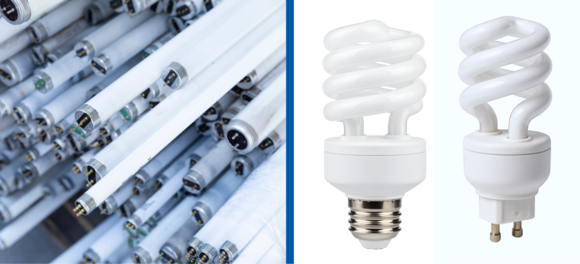
Starting January 1, 2026, Minnesota will ban the sale of certain mercury-containing fluorescent lamps to reduce environment and health risks from mercury exposure. For more information on lamps recycling requirements, please see the Selling fluorescent lamps factsheet (PDF) from the Minnesota Pollution Control Agency.
 What’s being banned?
The ban applies to new and unused lamps in original packaging:
- Pin-based or screw-based compact fluorescent lamps (CFLs)
- Linear fluorescent lamps (including straight tubes and U-bend shapes)
These lamps will no longer be allowed for sale in Minnesota, whether sold individually, in a kit or already installed in fixtures. This includes sales by:
- Businesses
- Nonprofits
- Private individuals
- Online sellers
- Out-of-state sellers shipping to Minnesota
What’s not banned?
If you already own mercury-containing lamps, you can continue to use them. The ban only affects new sales. The ban doesn’t include mercury-containing sodium vapor or metal halide lamps, or specialty fluorescent or mercury vapor lamps designed only for image capture or projection, disinfection, ozone generation, tanning, quality inspection, industrial processing, or scientific applications.
Recycling still required
All mercury-containing lamps, including those not banned, must be recycled when discarded. They cannot go in the trash or be crushed. Manage them as universal waste and learn more from the Minnesota Pollution Control Agency’s fact sheet (PDF).
EPA’s hazardous waste electronic manifest (e-Manifest) system is part of the RCRAInfo Industry Application. To use it, each person must register for their own account. How to register for e-manifest access.
Starting January 22, 2025, Large and Small Quantity Generators (LQGs and SQGs) must:
- Register and maintain an account with Site Manager or e-Manifest Certifier permissions
- Use the system to:
- Access final signed manifests from receiving facilities.
- Submit post-receipt data corrections requested by regulators.
- Starting December 1, 2025, submit exception reports electronically.
Additional information from the EPA.
Minnesota Safety Council offers classroom training at their location in Saint Paul and on-site customized training at member locations on over 50 different occupational safety and health topics. A few examples are hazardous waste operations and emergency response (HAZWOPER), transporting hazardous materials and dangerous goods, CPR/AED/First Aid and more, see the schedule for upcoming trainings.
The new Food waste recycling compliance for businesses webpage offers information to help businesses meet the standards set by the county’s recycling ordinance (Ordinance 13).
Included on the web page
- Overview of what businesses are required to comply
- Inspection and enforcement information
- Compliance requirements
- Best practices for compliance
- Resources including guides, online information, and newsletters
- Recycling compliance forms: variance request, beneficial use application, and anonymous complaint
Boost your business’ recycling and organics recycling efforts with free bins and compostable bags
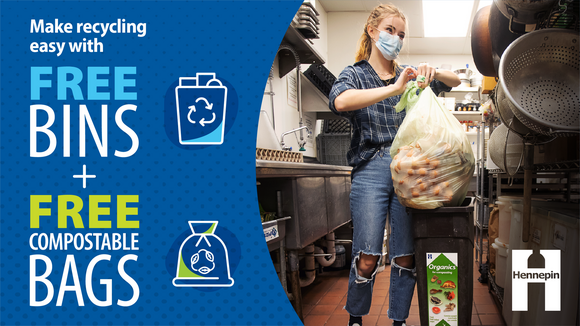 Hennepin County offers free help to small businesses and nonprofits to improve recycling and start organics recycling programs. Participants get up to $3,000 worth of containers and compostable bags.
Start the application process by submitting a business recycling information online request form.
Small business environmental assistance loans from the Minnesota Pollution Control Agency
Environmental assistance loans provide financial assistance to accelerate the application and/or improvement of environmental processes and technologies in Minnesota by providing assistance for the capital costs (machinery and equipment) of eligible projects. Eligible projects include: green chemistry, pollution prevention, source reduction, recycling and organics recycling. Environmental assistance loan details, application documents, and instructions.
Program Contact
612-348-3777, ask for the environmentalist on call
hwgsupport@hennepin.us
Resources
• Hazardous waste licensing portal
• Hazardous waste training and resources
|





