The goal of fire prevention month is to raise awareness and help ensure your home and family are protected. Child foster care licensing requires home safety inspections at each annual review and relicensing meeting.
Fire extinguishers
Foster care licensing requires providers to use a fire extinguisher with a minimum 2A:10B:C rating. The 2A10BC fire extinguisher requires yearly testing and inspection in the month that it was initially purchased. Inspections that meet foster care guidelines are generally not offered at the fire station, and you must use a certified inspection provider.
|
Inspection
At the first extinguisher inspection, the inspector will place a tag on the extinguisher that will indicate the month and year of the inspection. At each annual review of the fire extinguisher, the tag will either be replaced or have new dates written on the tag. Extinguishers have an expiration date of six years, meaning the extinguisher needs to be recharged by a certified company or replaced at that time.
There is an annual inspection fee for the certified inspectors. Please check with your licensor about certified inspectors that will assist individuals.
If you are in need of a new extinguisher, they can usually be found at larger retail stores. Please make sure you are purchasing the correct model that meets the minimum rating.
Smoke and carbon monoxide (CO2) detectors
Smoke detectors are also tested at each annual review and relicensing meeting. Foster parents should plan to take them down during the home safety check for date verification. If detectors are located on a high ceiling, foster parents must have a way to access them. Licensing can accept date stamped videos of testing if the detectors are not easily accessible. All foster parents are expected to know and understand how smoke detectors operate, how to change the battery, and have extra batteries. An expired detector will still make the noise when tested, however the chemical that detects smoke has a shelf life.
Per the MN Fire Marshal:
- Smoke alarms are required by the fire code to be replaced when they exceed 10 years from the date of manufacture. The manufacture date is located on the detector. If there is no date, the smoke alarm is over 10 years old.
- Replace when the smoke alarm fails an operability test.
- Smoke alarms shall be replaced with the same type of power supply. This does not prevent replacing battery powered alarms with electrically powered alarms with battery backup.
A helpful tip to track the dates is to take photos of the backs of the detectors and put a reminder on your calendar annually. It's also good time to replace the batteries. Some detectors may have a place to write the date on the device.
MN Fire Marshal recommendations:
- Smoke alarms shall be tested once a month using the testing method recommended by the manufacturer. Typically, this is accomplished by pushing the test button on the alarm.
- Replace batteries annually (or when the alarm chirps warning the batteries are nearing the end of their life) unless the smoke alarm uses long-life batteries. Long-life smoke alarms with batteries sealed inside shall be replaced immediately when the alarm chirps warning batteries are nearing end of life.
More inspection requirements
A fire inspection may be required of the home in certain circumstances including:
- Mobile home manufactured prior to 6/15/76
- Free standing solid fuel heating appliance - wood or corn stoves, etc.
- Foster child is sleeping in room 50% or more below ground level, per rule or statute requirement,
- Reasonable cause by the agency
- Capacity of four or more foster children in a foster home
- If a hazard is identified
For more information, visit the MN Department of Public Safety.
 |
|
Questions? Call or email us today!
- 612-348-5131
- checkups@hennepin.us
|
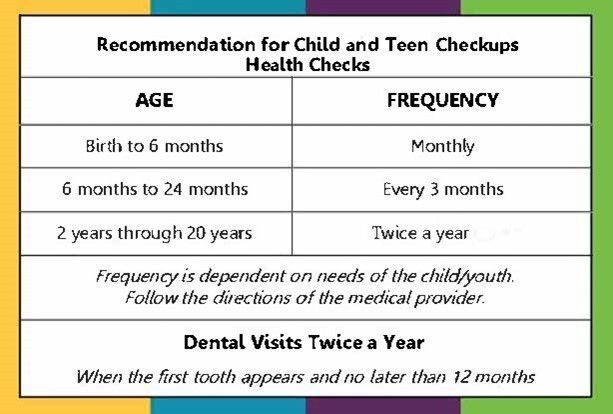
We can help! The Child and Teen Checkups staff are experienced in finding medical and dental clinics. We can help schedule appointments and set up transportation or interpreters when needed.
Strong relationships begin here
Talking and listening as a foster parent
Being a foster parent means knowing how to talk and listen well, but it can be hard to build trust with a child who has been hurt by other adults in the past. Many kids in foster care do not trust adults right away. They may feel like adults never cared about how they felt. That’s why it’s important for you as a foster parent to show you care and can be trusted.
You can help your child feel safe by saying things like:
- “I know it’s hard getting used to new things.”
- “I’m here whenever you’re ready to talk.”
How to show you care
To build trust, you need to show empathy — that means trying to understand how your child feels. Here are some ways to show empathy:
- Acknowledge their feelings. Let them know it’s okay to feel sad, angry, scared, or confused.
- Tell them when you’re proud or thankful for something they did.
- Stay with them when they feel upset and help them work through those moments.
- Ask about things they like and want to do. Explore their hopes and dreams with them.
- Seek to understand them and meet them where they’re at.
Why listening matters
Listening is a big part of building trust. When you listen closely to your child in foster care — both to their words and how they act — you show them you care. Listening helps you learn what your child likes, what they’ve been through, and what they need. The more you listen and try to understand, the stronger your bond will grow.
When kids feel heard and understood, they’re more likely to trust you. And trust is where strong relationships begin.
 |

As foster parents, you know that most children in foster care return home to their families. Some are adopted by relatives or by their foster parents.
When these options aren’t possible, kids need loving and supportive adoptive families. Many waiting children in Hennepin County are school-age or teens, or part of a sibling group. Help us spread the word and find permanent families for these youth. We are in need of loving families, like yours, who are willing to be a mentor, respite provider, foster family, or adoptive resource for these youth.
J.J. (7) is a kind, funny, and engaging youth. He laughs easily and cares for those around him. JJ enjoys imaginative play and being creative. He has his own cooking set and baking toys he uses to whip up pretend meals. J.J. likes playing games on his tablet and watching videos. He is active and especially enjoys playing outdoors. J.J. loves swimming, going to the park, and riding his bike.
A home with or without children is acceptable if caregivers can give J.J. the supervision and one-on-one attention he needs. An ideal home location would have ease of access to medical and educational services. If a home has pets, caregivers will need to feel comfortable providing age-appropriate reminders and supervision. Caregivers will need to feel comfortable maintaining and supporting ongoing contact with birth families.
Please reach out to fosteradopt@hennepin.us if you are interested in learning more about J.J.
|
|

Hennepin County licensor Mailee Lor interviewed providers J.P. Leider and Katy King.
What initially inspired you to become a foster parent?
We both grew up in really community-oriented families and had, independently it turns out, decided that we wanted to provide foster care from a pretty young age.
J.P.: My family has done foster care since I was a teenager, and had helped many kids reunify and find good fits with new families. I thought it was important to help if I could.
Katy: I have always felt like helping the youngest members of the community is the best way to invest in the future, plus I have always been interested in child development and taking care of children.
What do you find most rewarding about fostering?
We find it rewarding to be able to be a safe space and a fun space for kids when they're going through some of the hardest times in their young lives. It's fun to figure out what kids are interested in and help support that, to see them learn and grow and just be kids. It is also very rewarding to be able to give their adult family members the space and support to work through what they need to work through.
How has fostering impacted your family dynamic?
While people have a general style of parenting, we find that every placement is different and so are we as foster providers and guardians. Kids need different things, and so we have to meet them where they are. That gives us a lot of room for growth as parents. It has also taught us about other cultural traditions, relationship dynamics, and norms.
Do you feel like you are making a difference in the lives of the children you foster?
For us, it is less about 'feeling' and more that we can see it. We see when kids come in on maybe their worst day, we see them get used to their new space and dynamics and play and have fun, and we see them grow and learn.
What support system do you rely on to manage the demands of fostering?
We rely heavily on each other, and reach out to our families, too. Other parent friends that share our values are critical too; it can be very challenging. Also very important is support from the children's community.
What are the most important things you try to provide for the children in your care?
The most important thing is a safe place - not just physically, but where kids know they can make mistakes. We also focus on fun, and try to provide a place to learn, grow, and explore interests. Play is a big part of that, including science, art, math, and reading.
Do you have any advice for someone considering becoming a foster parent or to newly licensed foster parents?
JP: As readers probably know, the first question a foster parent is inevitably asked is whether it's hard to let kids go when they reunify. Obviously, it is incredibly hard. It can be more challenging to know up front. Another hard truth: that we are part of a process where we have relatively little control and may disagree with decisions that are made by the courts or child protection. We don't have the information they do, nor the same constraints that they operate under. It can be very frustrating. So, the advice is to make sure that you can be comfortable being a cog in that machine, and recognize your job is not to be the judge but to be the parent while kids are in your care. You should be there to support them, care for them, and advocate for them, but that’s about as far as things can go – make sure that works for you.
Katy: It can be hard to figure out everything you need from CPS to support the kids. You may need to apply for funding for activities, significantly in advance, to figure out what is reimbursable (or can be paid for by the county). Make sure you have a few people to ask how to obtain resources (e.g., case manager, social worker, CASA). All of the service providers on the case have many cases they are covering, while your job is to focus on a single case exclusively; it is helpful to know what types of things the county is supposed to support (e.g., equine therapy, severe lice mitigation) above and beyond the basics that every case gets.
|
|
Confidentiality and protecting the privacy of foster children
Foster parents must be careful to protect the privacy of children in foster care and their families. Information about children in foster care and their families is protected by the Minnesota Government Data Practices Act.
Details about your rights and responsibilities related to confidentiality are included in the Foster Parent Guide.
Helpful reminders
- Foster parents must not share information about a child in foster care or their family with neighbors, friends, family members or the media. This includes discussing specific case details, where children in foster care attend school, or family information.
- Foster parents must not share information about children in foster care or their family on social media. This includes posting photos and videos or identifying a child in foster care in a social media post or elsewhere on the internet.
- Foster parents can share information about children in foster care with agency-approved service providers.
If you are unsure about whether you can share information with someone, you should discuss it with your child’s placing worker.
|

Annual training requirements
Each year after the initial license foster parents are required to complete a minimum of 12 training hours that must include:
- 5 hours minimum from the in-person training options listed on the training calendar
- 1 hour minimum of mental health
- 1 hour minimum of fetal alcohol spectrum disorder
- Mandated reporter
Car seat resources
If you have completed car seat training within the last five years and need a backless booster seat for a child you are fostering, please contact your licensing worker. The training coordinator has a limited number of backless booster seats available on a first come, first served basis.
Visit the child foster care license website created for foster parents to learn about training requirements and to view the training calendar.
Send all your questions and requests for training registration to fostercare@hennepin.us
|
|
Once you have read Essentials, take the Essentials quiz to earn one hour of training credit. We will forward the completed quiz to your licensing worker once we have received it.
|