|
July/August 2025
Check out what’s new and noteworthy in Special Collections.
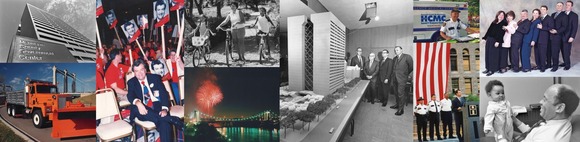
More than 9,000 photographs taken by the Hennepin County Communications Department are now available in the Digital Collections.
The department has been known by several names including the Hennepin County Communication and Engagement Services Department and the Department of Public Affairs. The department provides information about county services, facilitates public engagement, ensures effective communication with county residents, and fosters community relationships.
The photographs in this collection highlight a broad representation of the activities of county agencies and personnel, including events, programs, buildings, projects and other initiatives primarily from the 1960s to mid-2000s.
Digitization of this collection is ongoing, thanks to funding by Friends of the Hennepin County Library. Many people in these photographs are unidentified. If you see someone you know, let us know!
The Book Arts and Fine Press Collection, one of 11 rare book collections in Special Collections, includes hundreds of artists' books and zines by contemporary local and regional book artists. Artists' books are limited edition works of art that utilize the form or concepts of the book.
They may be hand-crafted, letterpress printed, or computer-generated and come in many sizes, shapes, and structures. Also included in the collection are older fine press and small press books, books about printing history, and books on bookmaking components and techniques, including binding, papermaking, paper decoration, and typography.
Minneapolis boasts a rich history in book arts and small press publishing. The library’s Book Arts and Fine Press Collection helps to preserve this history, supports the local artist and bookmaking community, and makes these works available to the public for handling and exploring.
The collection is regularly viewed by art classes at the University of Minnesota and MCAD and is exhibited throughout the HCL system. Here are a few recent acquisitions to the collection.
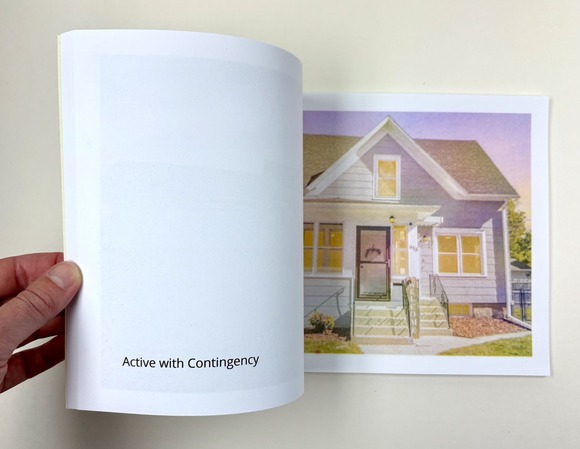
How to Change Day to Dusk by Louise Fisher, 2024.
A photo book inspired by Louise’s experience shopping for her first home in the post-pandemic housing market. The photographs were appropriated from Zillow, all selected by Louise for their ubiquitous cut-and-paste Photoshop edits which add artificial light and color to the sky, windows, and/or light fixtures, in effect romanticizing the property. The photographs were risograph printed in yellow, blue, fluorescent pink and black.

Famous Last Words by Erica Spitzer Rasmussen, 2025.
This book is a tribute to the artist’s brother, Mark, who died in 2023 of a rare cancer. The last words he spoke to Erica are documented here, in addition to the parting words of numerous other luminaries from across time and around the world. The paper was made using Mark's oncology report and is bound to look like a cremation urn.
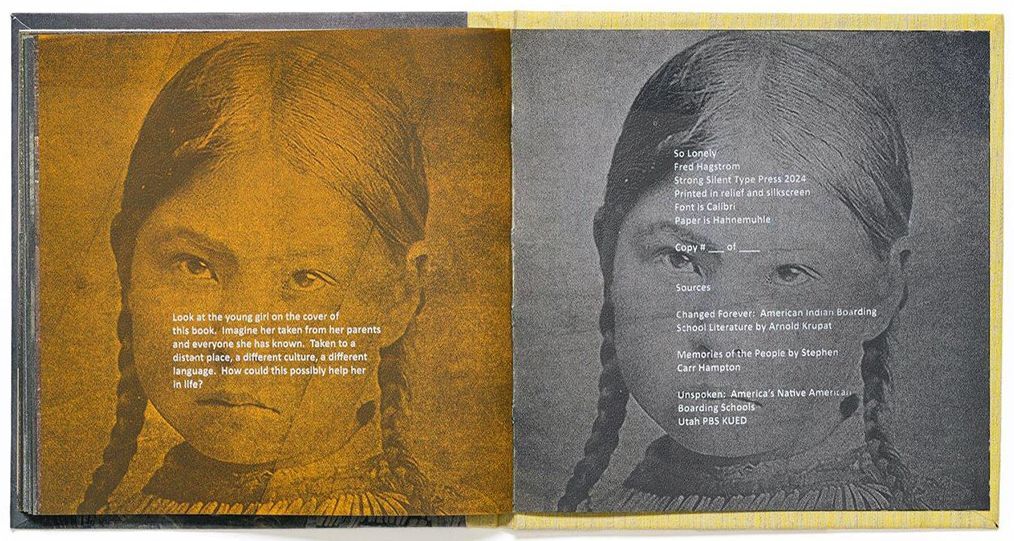
So Lonely by Fred Hagstrom, 2024.
The book documents the lives of young Native Americans who were in the system of Indian boarding schools. A joint effort by the U.S. Government and church institutions, the schools aimed to re-educate Native children away from their culture; they were often highly regimented and cruel.
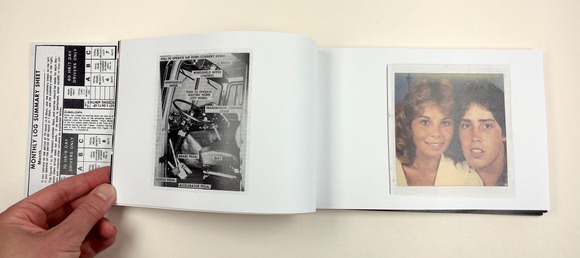
Road Song by Justin D. Allen, 2025.
Using snapshots pulled from his family photo albums, newly-created images, and text excerpts from a larger memoir written by Justin, Road Song tells a personal history of his family in Iowa as it relates to the passing of his father, a long-haul truck driver, who died from skin cancer in 2009. The book takes the form of Justin's father's daily log books that he used to document his working hours as he traversed the country.
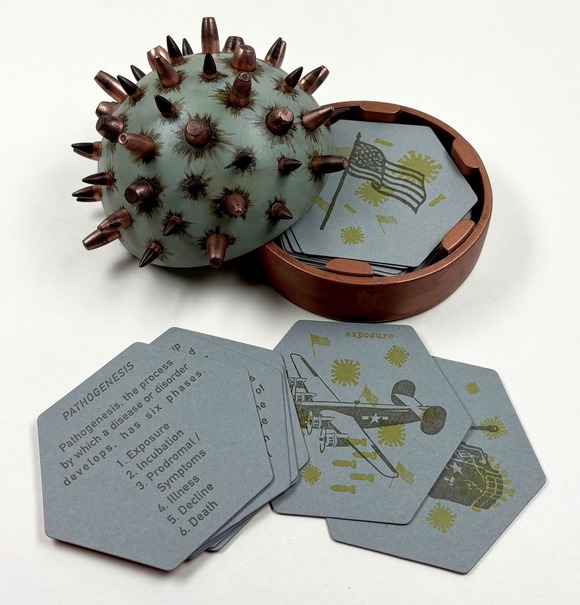
Pathogenesis by Todd Thyberg, 2025.
This multi-dimensional book looks at gun violence in America through the lens of disease: Exposure, Incubation, Prodromal/Symptoms, Illness, Decline, Death. The book is bound in a 3-D printed pathogen with a bullet casing tray to hold the letterpress-printed pages together. The binding is hand-painted and fitted with four different caliber slugs.
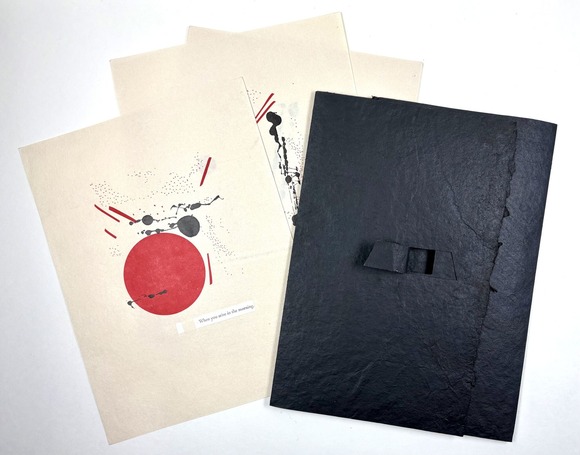
When We Arise by CB Sherlock, 2025.
In a year of personal chaos, CB takes a moment to stop, take a breath, and pause—finding ways to explore printing spontaneously and in the moment. A quote by Marcus Aurelius is literally woven through the five loose black-and-red prints, directing us all to breathe, pause, and reflect.
 The following new donations were recently received in Special Collections. These collections are unprocessed, but available for research in Special Collections:
East Side Neighborhood Partnership Records – Minutes, agendas, financial records, and administrative files of the Marcy-Holmes Neighborhood Association and Nicollet Island-East Bank Neighborhood Association.
East Town Business Partnership – Digital records of East Town Business Partnership, including minutes, foundational documents, and administrative files. Founded in 1979 as the Elliot Park Business and Professional Association, the group was known as the East Downtown Council from 1999 to 2017. It disbanded in 2025.
NuLoop Partners Records – Digital files of NuLoop Partners, including subject files and administrative files. Topics include housing, I-94 reconstruction, Root District planning, Twins Ballpark (Target Field) planning, and North Loop development.
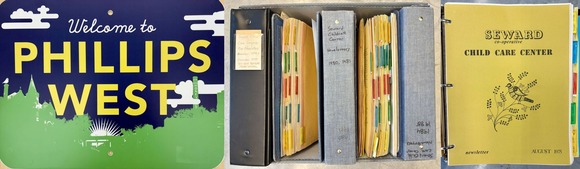
Phillips West Neighborhood Organization Records – Administrative files, subject files, event files, street signs, oversize maps, and other materials created or compiled by Phillips West Neighborhood Organization.
Powderhorn Park Neighborhood Association Records – Minutes, administrative files, newsletters, subject files, financial records, and other materials created or compiled by the Powderhorn Park Neighborhood Association.
Seward Child Care Center Records – Newsletters, minutes, policy manuals, administrative documents, and photographs. Founded in 1973 in the Seward neighborhood of Minneapolis, Seward Child Care Center is a cooperative daycare center serving children aged 16 months to 5 years.
 These collections have all been recently organized and rehoused, with finding aids now online:
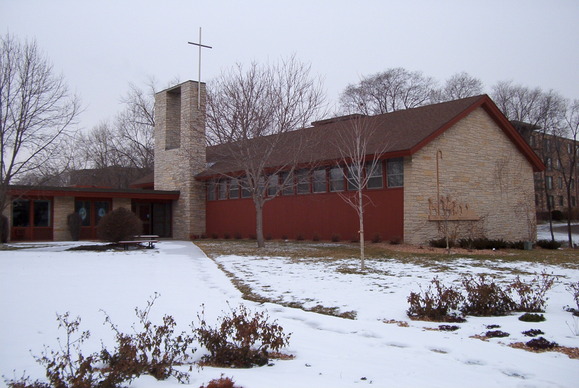
Mizpah United Church of Christ Records – Minutes, annual reports, newsletters, membership records, newspaper clippings, subject files, and other administrative records of Mizpah United Church of Christ. The collection also includes photos, negatives, and video recordings of church events, sermon audio, oral interviews, and a small box of memorabilia. Mizpah United Church of Christ (originally Mizpah Congregational Church) served the Hopkins, Minnesota, community from 1888 until its last service on September 25, 2022.
Pratt Council Records – Communications, community education, meeting materials, tax forms, subject files, realia, and media created and compiled by the Pratt Community Council. Pratt Council is a non-profit organization of volunteers who provide influence and advice on the use of the Minneapolis Public School's Pratt Community Education Center and Village Green Park in the Prospect Park neighborhood.
Minneapolis RiverCurrent Email Newsletter – Electronic newsletters of events and updates near the Mississippi Riverfront in Minneapolis. Minneapolis RiverCurrent (and its predecessor Minneapolis River Forum) was a weekly email newsletter detailing events, activities, development updates, and information resources in the Mississippi riverfront area of downtown Minneapolis. The newsletter ran from 2002 to 2025.
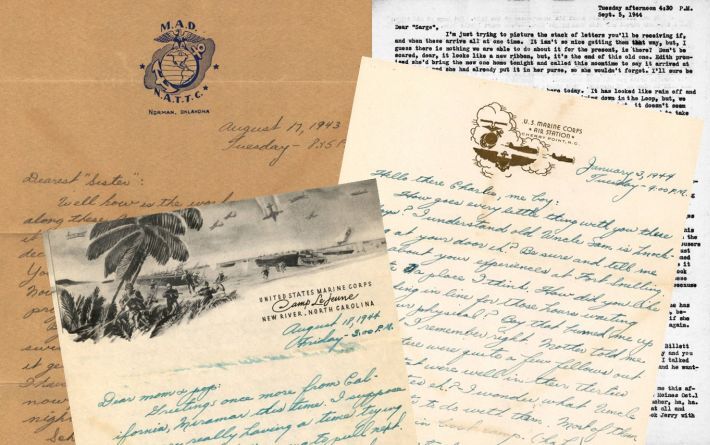 Read the two-way WWII correspondence between Staff Sergeant Harry Holmes Lord, Jr. of the United States Marine Corps, and his family in Minneapolis.
Lord was stationed in the South Pacific during World War II. Before his posting, he trained at several bases in the United States, including Naval Air Station North Island in California, the Naval Air Technical Training Center in Oklahoma, and the Marine Corps Air Station and Camp Lejeune in North Carolina.
His parents, Harry Sr. and Grace Lord, lived at 5112 Russell Ave. S during the war. The letters from Grace Lord are carbon copies she kept of her typewritten letters to her son.
The typed correspondence is keyword searchable. Transcription of the handwritten correspondence is forthcoming.
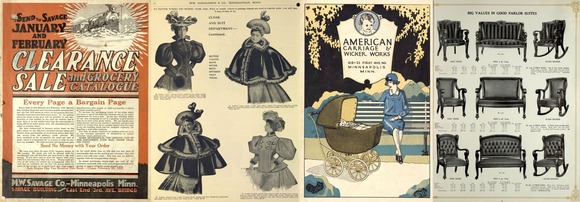 Two more of our collections previously only available in the Minnesota Digital Library were updated and migrated to the Library’s Digital Collections. You can now view dozens of annual reports from early Minneapolis social service organizations, health care agencies, and charities and over 120 catalogs from Minneapolis businesses from the 1880s to the 1920s in the Digital Collections. The catalogs advertise all variety of products from clothing and jewelry to hardware and building materials.
James K. Hosmer Special Collections
Minneapolis Central Library
300 Nicollet Mall
Minneapolis, MN 55401
Hours: Monday - Thursday, 9am - 4:30pm.
Appointments are not necessary, but you do need to call Special Collections or check-in at the 4th floor reference desk upon arrival for department access. You can speed up your visit by requesting materials be pulled in advance. Photocopier and scanners are available. Please bring a flash drive to store your scanned images.
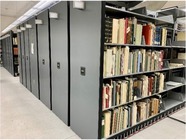
Photo: Inside the climate-controlled Special Collections vault, where rare books, negatives, and AV materials are stored.
Email specialcoll@hclib.org or visit hclib.org/specialcollections for more information.
|
|