|
November 2024
Thank you for subscribing to Thrive, a newsletter highlighting Hennepin County's community development efforts and initiatives. In this edition, read about the following:
- A catalyst for community: County’s support for affordable commercial space, community institutions
-
Love Local campaign celebrates local businesses
-
Program updates and partner resources
Spotlight on county's support for affordable commercial space, community institutions
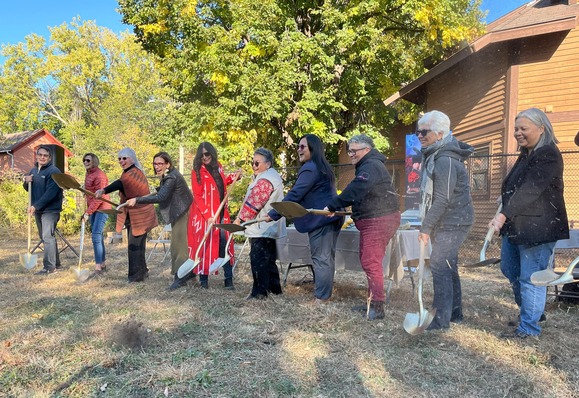 (Above) Hennepin County Chair Irene Fernando joins Indigenous Peoples Task Force (IPTF) and other community leaders at a recent groundbreaking celebration for Mikwanedun Audisookon in south Minneapolis.
Hennepin County has invested in transit-oriented communities (TOC) for over 20 years. The understanding of TOC, and what the Hennepin County program has funded has evolved over this time. Since 2020, the county has placed greater emphasis on supporting a range of projects that contribute to vibrant, walkable, mixed-use, and human-centered communities. These projects include community institutions providing critical services and programming, and developments that offer affordable commercial space for local small businesses.
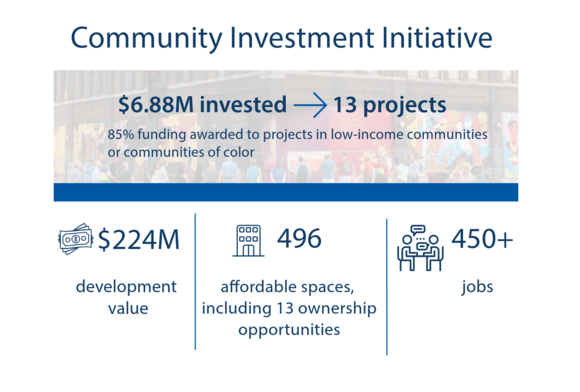
In 2022, the county created a one-time program dedicated to funding such efforts, the Community Investment Initiative (CII). The CII was designed to advance economic recovery and increase long-term economic opportunity in Hennepin County communities most significantly impacted by the pandemic.
Five community-driven development projects embodying these goals have broken ground in recent weeks: the Indigenous Peoples Task Force’s new arts and wellness center Mikwanedun Audisookon, Artspace’s NKB Lofts, Pillsbury Creative Commons, the Unity Project and NEON's Collective Kitchens.
The Brookings Institute recently released a report addressing the “chicken and egg confusion” that complicates community redevelopment in low and moderate income (LMI) neighborhoods. Helping community leaders Buy Back the Block examines three commercial corridors in Detroit, Baltimore and Cleveland and provides a playbook to address the “fundamental mismatch” that allows capital sources to overlook smaller, locally led investment opportunities.
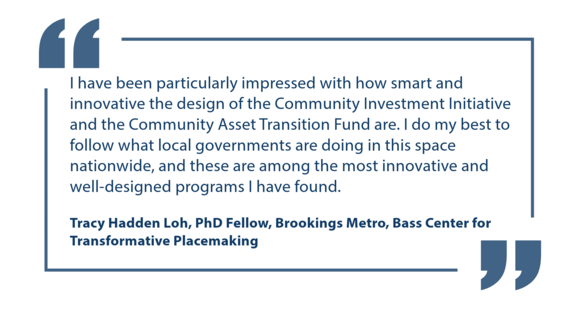
The report also lays out the case for locally led investing, identifies barriers for capital to flow to majority-Black neighborhoods and offers four recommendations for how government can work with the nonprofit and philanthropic sectors to increase capital for commercial real estate. One of the recommendations is to “adopt hyperlocal, place-based economic development strategies and capital flow structures.” Hennepin County’s Community Investment Initiative (CII) was intended to do just that. A previous Brookings report by one of the co-authors, identifies Hennepin County’s CII as a particularly innovative strategy to tackle the challenges of community-led redevelopment.
 Hennepin County supports the local business community with no-cost consulting and group-learning in Elevate Hennepin.
It also invests in business districts in cities and towns across the county by supporting affordable commercial real estate, beautification, and access via transit, bike, and walking. This holiday shopping season is the ideal time to celebrate all the local business community gives back to us as residents. Mark your calendars, November 30, 2024 is Small Business Saturday and we’re celebrating everything local business owners do with the annual Love Local campaign.
Share your favorite local business, business district with Hennepin County and inspire your neighbors to shop local by using the hashtag #LoveLocalHC all from Small Business Saturday through this season.
The Hennepin County Board of Commissioners received an overview of the county’s economic development strategy during a recent board briefing.
Our economic development mission is to advance inclusive prosperity, business growth, and thriving, resilient communitiesOur economic development strategies invest in places to align with community-supported visions, with a focus on projects located in, and driven by, communities historically excluded. Watch the board briefing.
|
Program announcements, funding opportunities

Transit Oriented Communities funding: Pending approval, applications for 2025 Transit Oriented Communities (TOC) funding will open in February 2025. Program information will be posted on the Transit Oriented Communities website in late December. The TOC program invests in walkable, mixed-use, human-centered neighborhoods around high-quality transit service.
|
Business District Initiative, Hennepin Planning Grant funding awards: Three cities will receive funding through the county’s Business District Initiative and Hennepin Planning Grants program.
-
The City of Hopkins will receive $50,000 in support through a Hennepin Planning Grant to update the Shady Oak Station Area Development Strategy to address current market conditions and help the city transform the area to a multi-use, compact, walkable neighborhood.
-
The City of Bloomington will receive funding through the Business District Initiative to continue their façade improvement program. The $50,000 award will allow them to continue to meet the demand for this program that started with a grant in 2023.
-
The City of Richfield will receive a $45,000 grant through the Business District Initiative for branding and placemaking in downtown Richfield, centered at Lyndale Avenue, Nicollet Avenue, and 66th Street.
Help set priorities for federal housing funds: Each year, Hennepin County receives around $5 million from the U.S. Department of Housing and Urban Development for suburban housing and development projects and services. To guide the use of these funds, the county solicits input to create a five-year plan for affordable housing. Provide feedback via a survey.
Active Transportation and Safe Routes to School funding: MnDOT has launched the 2024 Active Transportation and Safe Routes To School Infrastructure Solicitations. Applications are open through Friday, January 17, 2025, with project selections anticipated on or before April 30, 2025. The funding supports efforts to create safe and comfortable environments for walking and biking, connect communities and key destinations and boost public health.
Solar on Public Buildings: The Minnesota Department of Commerce’s second round of readiness assessments for its Solar on Public Building grants is open through December 2. Grants fund up to 70% of eligible project costs to install solar energy systems on public buildings. Applicants who complete a readiness assessment by December 2 will be notified of eligibility to apply for the full grant by January 13, 2025.
|