|
In some cases, children enter a placement without an adequate amount of clothing and foster parents need an initial clothing allowance to purchase the items needed. We would like to share a few reminders about a foster parents' responsibility when a clothing allowance is issued.
- A clothing allowance is issued to get you started for the season that the child moves to your home, not for the entire year. Foster parents are expected to utilize the ongoing monthly reimbursement for future clothing needs.
- If a clothing allowance is needed, it must be requested within 30 days of the child’s initial placement in your home.
- The amount of the initial clothing allowance will be determined by the child’s worker and it will depend upon the needs of the child.
- If an initial clothing allowance is approved, you will be issued a check for an appropriate amount to purchase the needed clothing.
- You are required to save the receipts and identify each item on the receipt. There may be some situations where the receipts are not requested by the worker. Regardless, please always save all receipts to document your purchases and to show that the allowance was used for the child’s clothing needs.
If you have any questions about clothing allowances, please contact your licensing worker.
 |

Hennepin County has some great resources for ensuring children are growing and meeting developmental goals and milestones: Help Me Grow and Child and Teen Checkups. These assessments are ongoing, age-appropriate and can connect children with ongoing services such as occupational, speech and language or physical therapies provided through the local school district, if needed. These assessments and services have no cost. All children in foster care should receive ongoing assessments and supports that will become a part of their social history for permanency.
Help Me Grow
Minnesota's Help Me Grow program is an interagency initiative of the Minnesota Department of Education, Department of Health, and Department of Human Services in partnership with local service agencies.
Help Me Grow serves children birth to age five. Certain concerns during specific stages of a young child’s development, often called red flags, are cause for immediate referral through Help Me Grow for early intervention services. Primary referral sources are required to refer an infant or toddler through Help Me Grow as soon as possible, but no more than seven days after a developmental concern has been identified. There are also specific requirements for referring a child under the age of three who is the subject of a substantiated case of child abuse or neglect, or who is identified as directly affected by illegal substance use or withdrawal symptoms resulting from prenatal drug exposure.
Primary referral sources include:
- Hospitals, including prenatal and postnatal care facilities
- Physicians
- Parents, including parents of infants and toddlers
- Childcare programs and early learning programs
- Local education agencies and schools
- Public health facilities
- Social service agencies
- Clinics and health care providers
- Public agencies and staff in the child welfare system, including child protection services and foster parents
- Homeless family shelters or domestic violence shelters and agencies
Intervention services are based on a child’s individual needs in order to help children learn and grow. Accessing intervention services as early as possible will ensure the best developmental outcomes for children.
Once referred, the family will be contacted by their local school district after the referral. They will discuss the parents’ concerns about their child’s development and arrange for a developmental screening or evaluation, if needed. Services are usually provided at the home and/or daycare.
Foster parents should always ensure there is parental consent via the child’s social workers for assessments and services. Parents and social workers should be included in the process, including being notified of appointments.
Child and Teen Checkups
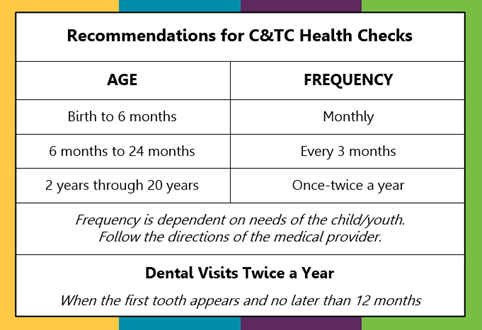
Child and Teen Checkups is a program for children and young people under the age of 21 who are on Medical Assistance.
Some families can receive this help through their clinics. Child and Teen Checkups will assist all families to find out where they can call for help. Multilingual staff and interpreters available to assist.
Parental consent is always required for all services to children in foster care, and the child’s social worker can assist with obtaining consent. When bringing a child for care, you can disclose that children are in foster care and provide their PMI (medical assistance) number found in your placement letter.
Foster parents cannot give consent for medical or dental procedures, immunizations, haircuts, or ongoing services. Please refer to the foster parent guidebook for details or when in doubt, ask before moving forward.
We can help! The Child and Teen Checkups staff are experienced in finding medical and dental clinics. We can help schedule appointments and set up transportation or interpreters when needed.
Visit Child and Teen Checkups for more information on how to participate, make a referral, appointments and checkup milestones, and a map of participating medical and dental clinics
|
 |
|
Questions? Call or email us today!
|
Some children in foster care experience trauma in the form of abuse, neglect, violence, poverty, or losing someone you care about. These tough events can lead to long-term health problems, mental illness, or problems with alcohol or drugs when they grow up.
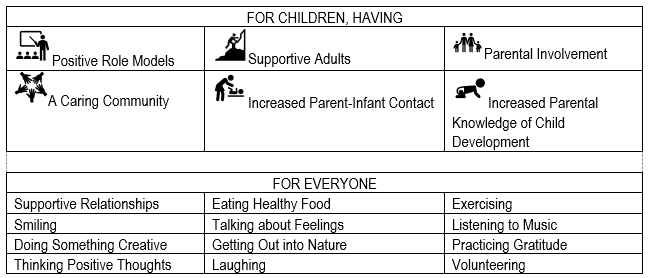
But the good news is, there are ways to balance out these negative experiences and make our brains healthier. Resilience is the ability to bounce back from hard times. It’s like being able to recover when life tries to stretch, push, or break you.
You as a foster care parent can offer activities that build resilience to mitigate stress from causing serious problems. These small positive actions can help rewire our brains to be stronger. Below are some ideas to try:
As part of ongoing efforts to enhance services and supports for children, youth, and families involved with child protection, the roles and responsibilities of adoption resource workers (ARWs) will expand to include working with child protection case managers and families where a transfer of permanent legal and physical custody (TPLPC) is the identified court-ordered permanency disposition. This includes completing and submitting the forms and documentation required for Northstar Kinship Assistance. In order to reflect this new work, the program name is changing from Adoption to Permanency, and the position title is changing from adoption resource worker (ARW) to permanency resource worker (PRW).
The Permanency team is excited about collaborating in this new role with colleagues across Children and Family Services and supporting the children, youth, and families of Hennepin County through the permanency process of TPLPC as well as adoption. The new permanency team anticipates starting in their new roles in early 2025.
For more information regarding these changes, you can contact your adoption worker.
Please note that this practice change is for non-ICWA adoption resource workers only. This change does not affect Hennepin County’s ICWA team.
 This year Michael Trimbo celebrated his 17th birthday at a bowling alley with his friends. He blew out the candles on his birthday cake and opened presents with his friends and family. It was the first birthday party he ever had.
His parents, David and Leah, had been waiting almost as long to surround a child with love. David and Leah became licensed foster parents in 2013. David was in foster care as a child and always knew that someday his family would grow the same way.
“Someday” took more than 10 years, but David and Leah never gave up hope.
“We wanted to give a kid a good home,” David said, simply. That matter-of-fact approach sustained David and Leah through many difficult years waiting for a placement. Friends and family encouraged them to keep going.
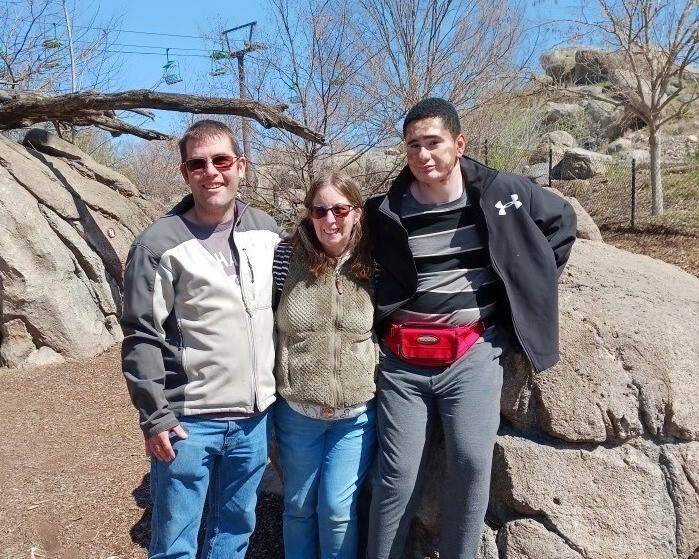
Finally, they were matched with Michael. Michael entered foster care as a toddler and was first adopted at three years old. Michael has special needs, and his first adoptive mother experienced mental health issues that kept Michael isolated from support at school and in the community. She passed away in 2022, leaving Michael with few connections.
At Michael’s first weekend visit with David and Leah, a connection was formed instantly.
“We were always family from day one,” David said. Still, David and Leah were unsure if they’d be able to adopt Michael. Because he was older than 14, Michael had to consent to the adoption.
It was a decision that, for Michael, was, “Easy to make. Very easy to make."
Michael has had many more firsts since his adoption was finalized in January. He’s learned to ride a bike, gotten his learner’s permit, traveled to other states, and danced at his first school dance.
“We’re trying to open Michael’s world up,” said David.
Michael has adapted easily to so much change. David and Leah helped Michael access an Individualized Education Plan to support his success in school, leading to him being named “student of the month” earlier this year. He also joined a school bowling league through Unified Sports – a student athletic program offered by the Special Olympics.
“I’m good at it," Michael said, in the same matter-of-fact tone as his dad.
Having grown up in Brooklyn Park, Michael now lives in Hutchinson, Minnesota, with his parents and their dog, Charlie. He’s met dozens of new family members and is looking forward to attending his first wedding later this year.
“He’s a great kid,” Leah said, with a twinkle in her eye. “We couldn’t ask for a more perfect child.”
|
Celebrating National Adoption Month
National Adoption Month has been celebrated in the United States since 1995. In recent years, focus has shifted to the adoption of teens because we know that teens in foster care wait longer for permanency and are at higher risk of aging out without permanent connections, placing them at risk for negative outcomes.
Many children waiting for permanent homes in Hennepin County are older children, teens, or part of a sibling group. Meet the children waiting for adoption, and help pave the way for healing, well-being, and long-term stability.
|
|

As foster parents, you know that most children in foster care return home to their families. Some are adopted by relatives or by their foster parents.
When these options aren’t possible, kids need loving and supportive adoptive families. Many waiting children in Hennepin County are school-age or teens, or part of a sibling group. Help us spread the word and find permanent families for these youth. We are in need of loving families, like yours, who are willing to be a mentor, respite provider, foster family, or adoptive resource for these youth.
Meet Lorenzo
Lorenzo does well with animals, thrives with attention and enjoys other people’s company. You can win Lorenzo over with video games, basketball, Sonic the Hedgehog or by offering him a variety of foods! Lorenzo is looking forward to trying out snowboarding this winter. Lorenzo's team is so proud of the progress that he continues to make!
Please reach out to foster.adopt@hennepin.us if you are interested in learning more about Lorenzo.
|
|

C.A.R.S. is transitioning to BEST - Here's what you need to know!
The car seat training curriculum C.A.R.S. (Child and Restraint Systems) has transitioned to BEST (Basic Education for Safe Travel) as of January 1, 2025.
The Basic Education for Safe Travel (BEST) training has two components:
- Online curriculum that will include a post-test and certificate upon completion
- Car seat check conducted by an approved BEST Facilitator
The new curriculum ensures the curriculum remains up-to-date by incorporating the online Car Seat Basics and an introductory e-learning course for parents, caregivers, and people who transport children maintained by the National Safety Council. Please contact your foster care training coordinator with questions.
|
Once you have read the Essentials, take the Essentials quiz to earn one hour of training credit. We will forward the quiz to your worker once we have received it.
|