 In this issue:
- Funding and support for conservation projects
- Upcoming workshops:
- Project spotlights
- Tips to protect water quality and manage buckthorn
- Creature feature: Bats
 Cost share funding available for projects in priority watersheds
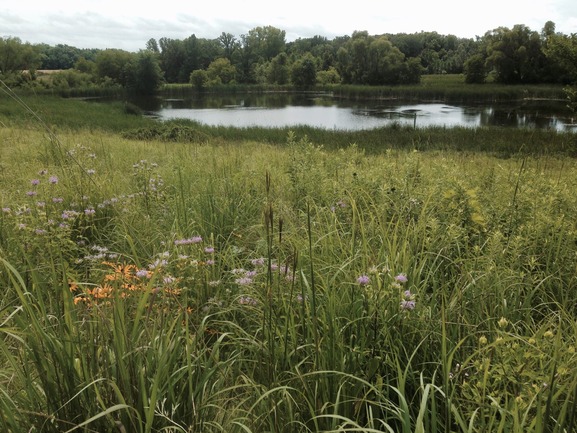
Get funds to improve water quality and reduce soil erosion on your property. Cost share funds are available to Hennepin County residents in the Lake Independence, Diamond Creek, and Rush Creek watersheds. Residents in these watersheds are eligible to be reimbursed for 90% of conservation project installation costs.
Eligible practices include wetland restorations, washout and gully repairs, livestock management, grassed waterways, soil health practices, and much more!
Learn more and see if you’re in a priority watershed and whether you’re eligible for up to 90% cost share: hennepin.us/priority-watersheds.
Think you have a potential project? Fill out our online interest form: hennepin.us/conservation-interest.
Lawns to Legumes
Want to BEE part of the change and add pollinator habitat to your yard? Consider applying for Lawns to Legumes. Minnesota residents can be reimbursed for up to $400 in costs associated with establishing native plantings and pollinator habitat. Applications for spring 2024 projects are open until November 30.
Learn more about the program and apply.
|
Good Steward Grants
Hennepin County is accepting applications for Good Steward Grants now through November 14. Funds can be used for constructing rain gardens, stabilizing stream banks, restoring native vegetation, installing vegetated filter strips, and other small-scale best management practices. See the Good Steward Grant application guidelines (PDF) for more information.
|
Fall into soil health, plant cover crops, and get free soil testing
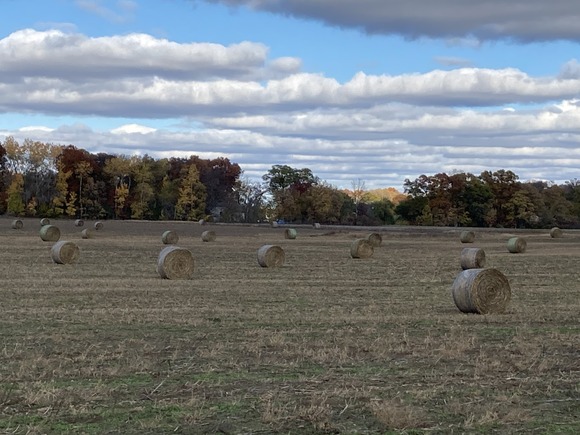 Post-harvest is a great opportunity to check in on your soil and make some preparations that will pay dividends during planting and harvest in 2024.
For farmers, planting a fall cover crop can have short and long-term benefits. Winter hardy cover crops such as cereal rye will provide a root system that will help keep soil in place over winter and help crowd out weeds in the spring.
If you would like to know more about the health of your soil, you can contact Hennepin County for a free soil test through the University of Minnesota Soil Laboratory or sign up for cover crop incentives. For more information, or to set up a time for a test, please fill out our soil test request form online.
Questions? Contact Roz Davis at rozalyn.davis@hennepin.us.
Failing septic system? Check out these low interest loans.
Homeowners don’t have to think about their septic system, until it stops working and becomes a big problem. Failing septic systems are spendy to repair, and even more expensive to replace, leaving homeowners with an unexpected bill. Leaky or failing systems are not only a nuisance for homeowners, but they also present a huge risk to the quality of nearby lakes, streams, and wetlands.
Hennepin County, in partnership with the Minnesota Department of Agriculture, offers low interest loans through the AgBMP Loan program. Septic system repairs, replacements, or municipal sewer connections are all covered under the program in addition to agricultural practices and equipment that protect and enhance water quality.
One landowner in Corcoran was recently surprised when a septic inspection revealed the bad news that her aging septic system was no longer compliant and required a repair. She was able to work with Hennepin County and a local bank to secure a loan through the program that would cover the cost of the replacement with a 3% interest rate.
To find out if your project qualifies for the AgBMP program, or to sign up for next year’s waiting list, contact Kevin Ellis at kevin.ellis@hennepin.us.
Agricultural community engagement workshops
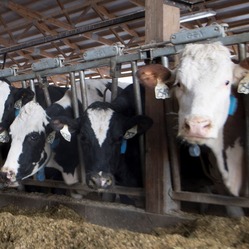
Hennepin County is facing significant loss of farmland and rural landscapes in the coming decade. Join Hennepin County Environment and Energy staff for small group discussions and provide your input for opportunities to help interested farmers and rural landowners preserve their land and land use.
Want your voice to be heard? Attend a focus group virtually or in-person.
RSVP for Agricultural community engagement workshop
Virtual option
Tuesday, November 14
6 to 7 p.m. online via Zoom (meeting link provided after registration)
In-person option
Thursday, November 16
6 to 7 p.m.
First Presbyterian Church of Maple Plain
558 County Road 110, Maple Plain, MN
Questions? Contact Roz Davis, rozalyn.davis@hennepin.us.
|
 Workshops for Hennepin County conservation partner organizations
Do you work for a Hennepin County city, nonprofit organization, park district, or watershed district that is interested in learning more about how to leverage Hennepin County habitat conservation service in your community?
Attend an in-person or virtual workshop to learn more about:
- What a conservation easement is, how to apply, the general process for establishing an easement, and how to promote conservation easements in your community.
- What assistance is available for habitat improvement projects and the process for submitting project ideas.
- How we integrate biological monitoring into habitat improvement and protection efforts, and how we can partner with you to collect biological monitoring information.
Workshops are scheduled for:
In-person option
Monday, November 6
10:30 to 11:30 a.m.
Ridgedale Library, Ladyslipper room #275
12601 Ridgedale Dr, Minnetonka, MN
Snacks and coffee provided
Virtual option
Tuesday, November 14
8:30 to 9:30 a.m. Online via Microsoft Teams (meeting link provided after registration)
Register for a workshop by contacting Matt Stasica at matt.stasica@hennepin.us or 612-235-1237.
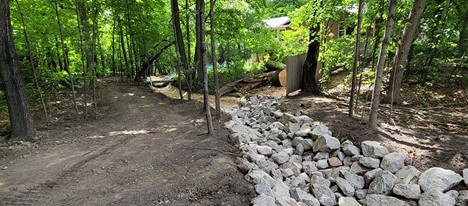
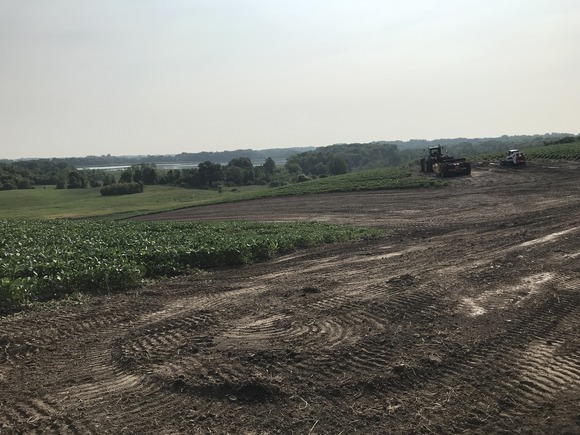 Pictured: The in-progress grassed waterway after grading was completed in 2021. Seeding occurred later in 2022 but is not shown here.
Helping farmers and protecting water quality
A farmer in Corcoran was having issues with erosion on a steep hill on his farm. It was hard to grow any crops on that area and was consistently washing sediment into nearby Jubert Lake.
By working with Hennepin County staff, the landowner was able to construct several water quality projects, including a grassed waterway that slows down water and directs it down the hill. This better retains his topsoil and reduces the need to restore gullies each spring. The rest of the hillside got planted down to a perennial hay mixture to keep roots in the soil all year long and reduce tillage. Hennepin County was able to cost share 90% of the project installation costs. Staff estimate it prevents 15 tons of sediment and 15 pounds of phosphorous from entering Jubert Lake annually.
Hennepin County is now working with the farmer to install more grassed waterways to help fight erosion in another field, and to store water in a low spot at the edge of a field before it reaches a seasonal stream. All these projects will help keep soils in place on the farm, make farming easier all while protecting an important local lake.
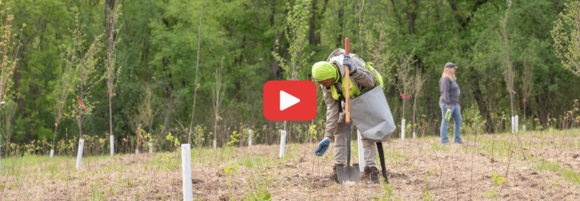 15,000 trees planted to protect habitat and fight climate change
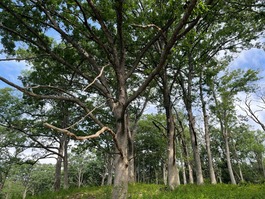
This spring, Hennepin County forestry and conservation staff planted 15,000 tree seedlings on a conservation easement in Independence. Check out this video to learn more.
The habitat restoration project involved planting 23 different tree species that will integrate with the surrounding forest, adding wildlife habitat, making our tree canopy more resilient to climate change, pests, and disease, and enhancing other benefits that trees provide.
More about conservation easements: Many of the natural areas in Hennepin County are on private lands that are likely to develop in the coming years, which is why the county works with landowners and their partners to permanently protect these lands using conservation easements. A conservation easement is an agreement between a property owner and Hennepin County or a nonprofit like Minnesota Land Trust, that includes a set of development restrictions that permanently protect habitat and open space on the property.
As trees grow they provide even greater climate benefits. This is one of the many projects Hennepin County is pursuing to act boldly on climate change. We have committed to planting 1 million trees by 2030 and acquiring 6,000 acres of conservation easements by 2040.
Interested in learning more and applying for a conservation easement? Go to land protection and restoration.
Don’t be salty, even though winter is coming
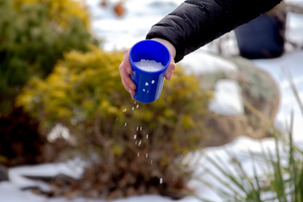
Did you know that one teaspoon of salt pollutes five gallons of water FOREVER? When salt from winter deicers (aka chloride) enters bodies of water, there is no feasible way to remove it. Chloride kills and impairs aquatic life and has negative effects on the environment, public health, and economic wellbeing.
While we all want to prioritize safety, it is critical that people understand that more salt does not always mean less ice. Help protect our environment and infrastructure by using less salt this winter.
When deicing this winter:
- Shovel as soon as possible after a snowstorm to prevent ice buildup.
- Add an ice scraper to your toolbox. These are often more effective than salt when ice has built up on sidewalks and driveways.
- At low temperatures, typically colder than 15 degrees F, regular road salt will not melt ice. Read the label on your deicer to make sure it will properly work in the current weather conditions.
- Replace salt with sand or grit.
- When you do use salt, use it sparingly. Generally, aim to have salt granules dispersed three inches apart.
Check these out for more information: Low Salt, No Salt Minnesota video, and Smart Salting Practices (Mississippi River Watershed Organization).
|
 |
Timing is everything: Know when to use manure, fertilizer, and chemicals on your land
Windows for applying manure, fertilizer, and pesticides can be short, but timing is everything. To maximize benefits to crops and minimize negative impacts on water resources, consider using best management practices:
-
Forecast: Don’t apply products on your land when rain is in the forecast, and use caution when applying to saturated soil. The Minnesota Department of Agriculture’s Runoff Risk Advisory Forecast tool can help determine the best time to apply.
-
Location: Observe all applicable setbacks (PDF) to surface waters and sensitive areas. Pay special attention to areas of your fields where water flows after rain or snow melt. Stay clear of steep slopes and surface water locations, such as rivers, streams, or sinkholes and wetlands.
-
Rate: Follow labels to ensure proper application rates. Use the University of Minnesota Extension’s manure management website to calculate the best rates for your fields.
-
Method: Reduce nutrient loss by selecting the best application method for your manure and chemicals and incorporate them into the soil immediately to decrease evaporation and runoff.
Visit the Minnesota Pollution Control Agency’s website to learn more about best management practices for land application of manure.
Fall is a great time to manage buckthorn, but make sure you dispose of it properly
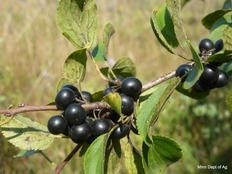
Buckthorn management is best done in fall or winter. In fall, sap starts heading to the plant’s roots, making it an ideal time for cutting and treating the plant. Buckthorn is also easily identified in fall because its leaves remain green after most other trees’ leaves have changed color or dropped.
Before you head out to control your buckthorn, you should make plans on how and where you will dispose of it. In some cases, you may scatter or slash the material on the ground. But in other cases, you may have too much material to handle.
The Minnesota Department of Agriculture advises that you keep all material on site to prevent the spread of buckthorn - especially the berries, since they contain seeds. If you do plan to move cut material off-site, make sure that the disposal location accepts buckthorn. Before departing, either cut the berries off the plants or make sure they are secured and cannot scatter.
The Minnesota Department of Natural Resources and the City of Burnsville have great websites that explain cutting and treating methods.
The last thing to remember is that controlling buckthorn can take several years. So, make a plan and do follow-up management in the years to come.
|
|
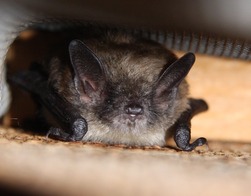
Bats are an important part of our ecosystem and eat up to half their body weight in insects every night. Not only do they eat mosquitoes, they also contribute billions of dollars' worth of agricultural production by eating pests.
Hennepin County is home to seven species of bats, including the federally endangered northern long-eared bat. These species depend on decaying trees, caves, mine shafts, and bat houses to raise their pups in the summer and to take shelter in for the winter.
Bats in our area are struggling due to disease, habitat loss, climate change, and development, but you can make a difference! Here are ways you can help bats:
- Leave dead trees standing
- Manage forests in the winter, when bats and nesting animals are less likely to be disturbed
- Protect wetlands and other sources of freshwater
- Don’t use pesticides. They can poison or kill bats, who are natural pest controllers
- Keep cats indoors
A safety note about bats: A very small percentage of bats, less than one percent, have been reported to carry rabies in Minnesota.
Due to the small risk of rabies, do not pick up an injured bat if you find one. Contact the Wildlife Rehabilitation Center of Minnesota (info@wrcmn.org or 651-486-9453).
Report sick or deceased bats to the Minnesota Department of Natural Resources (dnr.state.mn.us/reportbats).
|
Minnesota Bat Festival
Saturday, October 28
1 to 5 p.m.
Free
Minnesota Valley National Wildlife Refuge, 3815 American Blvd. E, Bloomington
Come celebrate and learn about the unique role that bats play in the environment at the Minnesota Bat Festival! Experts from the U.S. Fish and Wildlife Service, Minnesota Department of Natural Resources, University of Minnesota, and Hennepin County will share information about bat houses, bat disease research, surveying Minnesota’s native bats, and how to support bats in your backyard. Free tree seedlings and bat houses will be available while supplies last. The event is free and includes activities for all ages.
Learn more
|




