|
Dear Friends and Neighbors,
September is here, and with some gorgeous weather! September marks the official start of the Hennepin County 2023 budget season. I will keep you apprised as the board digs into study of county programming and priorities, to ensure an equitable economic recovery for our region.
The lead story this month is to share highlights of U.S. Secretary of Transportation Pete Buttigieg's visit to Lake Street. Hennepin County is the recipient of a $12 million grant from the Biden Administration for Lake Street improvements, and the Secretary wanted to see this important corridor.
Other highlights of this packed newsletter:
- France Avenue restriping update
- Community and infrastructure investments
- Zero Waste Plan update
- Accessing Monkey Pox vaccine and services
Happy Labor Day!
My best,
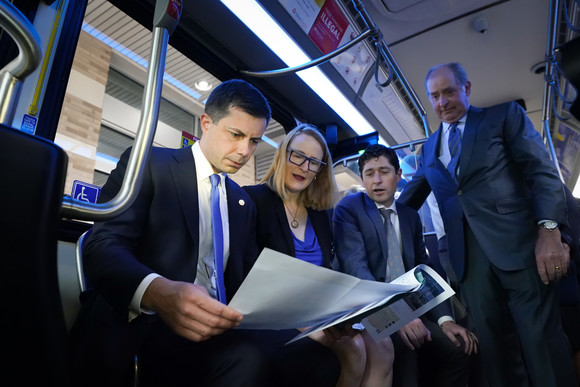
On August 25, U.S. Department of Transportation Secretary Pete Buttigieg toured the Lake Street corridor along with electeds and key staff from Hennepin County, the City of Minneapolis, Metro Transit and the Lake Street Council. He was here to celebrate the award of a $12 million grant from the federal Rebuilding American Infrastructure with Sustainability and Equity (RAISE) program to improve safety and travel time reliability on Lake Street (County Road 3). Commissioner Conley (who represents the eastern side of Lake Street) and I (I represent western Lake Street) officiated.
Hennepin County operates Lake Street, and we are collaborating with the City of Minneapolis and Metro Transit on the improvements. The three organizations share goals to enhance safety for people walking and rolling, improve transit times and reliability, reduce crashes, and enhance the overall user experience for everyone along the corridor.
Secretary Buttigieg's visit was an excellent opportunity to demonstrate the county’s investment in transit and creating safer routes that address the county’s broader goals, including reducing disparities and addressing climate change. In the photo above (taken by Glen Stubbe, Star Tribune) I am showing him a map of all the ways Hennepin County is investing in this crucial regional corridor.
See Kare 11 coverage here.
Hennepin County is getting ready to do a “mill and overlay” on France Avenue between Excelsior Boulevard and 44th Street. A mill and overlay is a surface treatment that extends the life of the roadway, and also is an opportunity to consider restriping changes to meet current and future needs of people using the corridor.
County staff completed a comprehensive review to evaluate all needs and constraints along France Avenue. Staff received public comments through a variety of means including in-person neighborhood events, an open house, an online comment form, phone calls, and emails.
Common themes that emerged included safety concerns related to vehicles speeding and pedestrians crossing, the need to preserve on-street parking, and the desire to incorporate a continuous bike facility.
As a result of the county’s evaluation and public engagement, county staff recommend only minor striping revisions along France Avenue to enhance safety and preserve on-street parking – to include painted medians and left-turn lanes at key intersections. Although on-road bike lanes were considered as an option, width constraints would prevent a continuous bike facility along the corridor. In addition, current use and upcoming transit enhancements with Metro Transit’s upcoming E Line Arterial Bus Rapid Transit project led to prioritizing accessibility and mobility for people walking and taking transit along the corridor.
Track all news on France Avenue improvements here.
In 2021, the Hennepin County Board authorized a total of $19 million of pandemic recovery funding, made possible by Federal American Rescue Plan Act, to multiple economic recovery strategies, including approximately $10 million to strengthen communities, accelerate economic recovery, and address disparities exacerbated by the pandemic.
This one-time Community Investment Initiative program released guidelines in March 2022 seeking applications from redevelopment projects that support business incubators, long-term affordable commercial space, or nonprofits providing economic recovery services to disproportionately impacted communities.
On August 16, the board approved funding for 18 projects which met these guidelines.
Funding for 13 affordable commercial and business incubator projects will provide over 330,000 square feet of affordable commercial space supporting approximately 550 small businesses, and over 760 total new or retained jobs. The total investment value of these projects is approximately $206 million.
Funding for five nonprofit community asset projects will support the expansion or creation of over 160,000 square feet of space supporting 200 total new or retained jobs at nonprofits providing economic development and recovery services to over 12,000 participants. The total investment value of these projects is approximately $67.7 million.
We are excited to see these projects move forward and appreciate the partnerships that make this funding possible.
In August, the county board acting as the Hennepin County Housing and Redevelopment Authority (HCHRA) Board approved approximately $2.2 million in transit oriented development (TOD) awards, to support infrastructure and development projects along the county’s transit corridors that enhance transit usage.
Seven projects receiving awards will leverage approximately $480 million in total investment value to create 1,241 housing units, including 369 affordable units, over 164,000 square feet of commercial and community space, 389 new or retained jobs, and improved connections to support TOD in current and planned light rail transit, bus rapid transit, and within the high-frequency bus network.
In May 2022, a Request for Proposals garnered twenty-nine applications requesting a total of over $15.6 million in funding.
Since 2003, the HCHRA has awarded approximately $40.3 million to over 153 TOD projects, creating or retaining over 9,400 housing units and 2,975 jobs, and leveraging more than $1.6 billion in development.
Funding will support 13 affordable commercial and business incubator projects, 5 nonprofit community asset projects
Project awards made Tuesday, August 16, by the Hennepin County Board of Commissioners provide capital funding for the development, redevelopment, or expansion of affordable commercial space, business incubators, and nonprofits delivering critical services to support people in gaining economic stability and opportunity.
The 18 projects will produce more than 315,000 square feet of affordable commercial space, and 161,000 square feet of nonprofit space. They will also support more than 550 local businesses or entrepreneurs and create or retain 970 jobs. The total investment value of these projects is approximately $273 million. Many of the projects will specifically serve Black, Indigenous and People of Color entrepreneurs, and several projects are led by local BIPOC developers.
The communities most impacted by the pandemic are the same communities that have experienced historic disinvestment and that continue to experience some of the starkest racial disparities of anywhere in the country. Those disparities were only exacerbated by the pandemic.
Three quarters of this funding is being invested in these low-income communities and it will produce transformational compounding benefits for decades to come. I’m also thrilled that many of these projects are led by members of the communities they will serve.
The awards are provided through the Hennepin County Community Investment Initiative (CII), a one-time, place-based program made possible by federal pandemic recovery funding.
Look for more news on the Hennepin County website.
Learn more about the awards.
Learn more about the program.
Hennepin County and the City of Minneapolis announced the formation of a Digital Equity Collaborative, an ambitious partnership to jointly leverage pandemic relief funds with the goal of eliminating the digital divide in Minnesota’s largest city.
Through this collaborative, Minneapolis will provide up to $2 million in funding to expand Hennepin County’s Digital Navigation service provided through the Hennepin County Office of Broadband and Digital Inclusion (OBDI). The City and County believe that combining funds will increase efficiency and maximize the digital equity impact.
Reducing Digital Disparities
Many services can be delivered digitally, from education to health care, but this requires computers, connectivity, and comfort with technology. The COVID-19 pandemic illustrated what many in local government, schools, and libraries already knew – the high costs of broadband and devices are a struggle for people with lower incomes. This collaborative will direct resources and support to the people most impacted by digital barriers.
Supporting Students and Families
For more than a year, the County, City, and Minneapolis Public Schools (MPS) have been working together on strategies to expand access. The collaborative formalizes this partnership to eliminate digital barriers for people living in Minneapolis.
A significant portion of Hennepin County residents who lack adequate internet access or are otherwise impacted by the digital divide live in Minneapolis. According to estimates, between 31,000-50,000 Minneapolis households do not have access to high quality internet services that can reliably be used for telehealth, remote work, distance learning, or other modern digital services. Many of these residents have lower incomes, are cost burdened by expenses, and live in areas of the City that are underserved by broadband providers.
Increasing Access and Building Skills
Collaborative priorities include supporting the families of students enrolled in MPS, encouraging qualifying households to take advantage of the federal Affordable Connectivity Program to bring down internet costs, supporting homeless and highly mobile residents, and helping digital novices build their technology life skills and online safety knowledge.
Services will be provided by Hennepin County staff and contracted community partners, and leverage county and city-owned facilities such as libraries and service centers within Minneapolis.
Work groups developing actions to accelerate Hennepin County to a zero-waste future
Work groups that include a broad diversity of community voices, industry stakeholders, and subject matter experts are currently working to identify and recommend actions for the county's Zero Waste Plan. More than 160 people registered to join a work group. Each of the seven work groups has at least 20 members that includes a balance of community members, stakeholders, and experts.
The work groups are meeting throughout July and August to learn about the county’s solid waste system and the challenges and opportunities to achieving zero waste, review and propose actions that will accelerate the county’s path to zero waste, and finalize recommended actions for inclusion in the Zero Waste Plan.
Case studies help identify gaps and opportunities for Hennepin County
To help the county understand options and opportunities for creating a zero-waste system, Resource Recycling Systems (RRS), the solid waste consultant for the Zero Waste Plan, researched how other communities have made significant progress toward zero waste. The six communities they studied were chosen based on their programs, policies, demographics, and geographies – some because they are similar to Hennepin County and others because they have programs and policies the county could learn from.
RRS also identified strengths, gaps, and opportunities for Hennepin County’s solid waste system. The gaps analysis compared best practices from communities working toward zero waste to the county’s current system to identify both areas of success and opportunities for improvement in six key areas: collection, processing, education and outreach, policy, and partnerships.
Read about the six community case studies and findings from the gaps analysis.
Next steps
Broad public engagement to gather feedback on the recommended actions will occur in September and October. Information about ways to give feedback will be shared on beheardhennepin.org and through Zero Waste Plan email updates.
The draft Zero Waste Plan will be presented to the county board in November.

Hennepin County’s Red Door Clinic is offering services for MPX, a viral disease caused by the monkeypox virus, including testing and vaccination:
Testing
- If you develop a rash (lesions) and are worried that you might have MPX or believe you have been exposed to it, we encourage you to contact your primary health care provider.
- If you don’t have a primary health care provider, you are welcome to call Red Door at 612-543-5555.
Vaccination
- The supply of vaccine is currently limited across the country.
- Under CDC guidelines, Red Door is currently prioritizing vaccination for people at highest risk for MPX infection such as people who have been exposed to MPX and people who are HIV+ positive and sexually active.
- People should visit reddoorclinic.org/monkeypox or call the clinic at 612-543-5555 for more
Learn more
To get updates about MPX and learn more about it, including symptoms, transmission, and case totals:
- Visit the MDH MPX website: About Monkeypox (MPX) - Minnesota Dept. of Health (state.mn.us)
- Sign up for MDH’s MPX newsletter: Minnesota Department of Health (govdelivery.com)
Contact us
Marion Greene
Commissioner, 3rd District
612-348-7883
Elie Farhat
Principal Aide
612-348-7125
Laura Hoffman
District Aide
612-348-0863
|