Applications are due by May 2, 2022, at 3 p.m.
Environmental Response Fund (ERF) grants are used to fund the assessment and cleanup of contaminated sites in Hennepin County.
ERF grants are awarded on a competitive basis. Priority is given to the following:
- Significantly contaminated sites
- Demonstrated project readiness
- Municipal and other public development projects
- Affordable housing projects where contamination issues preclude redevelopment
- Projects that promote economic development
- Infill brownfield properties or orphan sites that contribute to blight
- Other criteria include projects that incorporate sustainable features and activities in the project design, construction, and operation
Eligible applicants for ERF include municipalities, economic development agencies, housing and redevelopment authorities, other local public entities, nonprofit organizations, and for-profit businesses. ERF grants are not available to non-local government responsible parties.
Prior to applying for an ERF grant, contact brownfields@hennepin.us to discuss your project and funding needs.
Application materials will be available through the Supplier Portal. Questions? Visit Hennepin.us/brownfields
About the Environmental Response Fund
The Hennepin County Environmental Response Fund provides funding for the assessment and cleanup of contaminated sites where the added environmental costs hinder site improvements or redevelopment.
To date, Hennepin County has awarded 425 ERF grants totaling more than $60 million.
Learn more about the Environmental Response Fund online.
|
|
In 2022, Hennepin County is offering new programs and funding opportunities for affordable housing development and preservation while also building on the success of existing programs.
Below are updated timelines and information for upcoming affordable housing development requests for proposals.
Supportive Housing
Updated timeline: RFP posted March 10, proposals due April 14
Now in the fourth year, Hennepin County's Supportive Housing Strategy offers capital funding and technical assistance to develop long-term affordable supportive housing. This type of housing serves some of our most vulnerable residents, including those with a combination of extremely low-incomes and other conditions or challenges to stable housing.
Up to $5 million is available for supportive housing projects in 2022. Hennepin County will be seeking proposals that serve the following priority populations:
- Young adults with neuro-diverse conditions
- Young adults experiencing sexual exploitation
- Young adults with experiences in foster care
- Unaccompanied minors
Proposals will also be accepted for projects serving the priority population groups targeted in 2019 through 2021.
This extended timeline is intended to give more time to tailor proposals to the priority population groups.
Details about this RFP, including characteristics of the population groups and preferred housing types, will be posted to the Supportive Housing Strategy webpage.
Single Room Occupancy operators
Updated timeline: RFP posted March 24, proposals due April 28
Hennepin County will be looking for entities with interest and expertise in running Single Room Occupancy (SRO) housing.
As the county looks to transition properties acquired during the pandemic to serve as protective shelter into long-term SRO housing in the coming year, we are looking for partners to help model and operate SRO housing properties.
Later in 2022, additional RFPs may be issued to acquire and convert properties for SRO housing.
Affordable Housing Accelerator
Round 2 anticipated timeline: RFP posted April 21, proposals due May 12
Up to $23.75 million in American Rescue Plan funds have been made available to accelerate affordable housing development in Hennepin County. An initial $9 million was released with the Coordinated Housing Development RFP in January 2022. Round two of these funds, totaling an expected $5 million, will be made available in an RFP to be released on April 21. The remaining funds will be offered through subsequent RFPs later in 2022.
These funds are being targeted to projects:
- with greatest levels of affordability
- led by Small Business Enterprises, or women- and minority-owned businesses
- located in areas impacted by civil unrest
Naturally Occurring Affordable Housing
Round two anticipated timeline: September 2022
Up to $8.65 million is available to address rehab and maintenance of Naturally Occurring Affordable Housing (NOAH) properties that may have been postponed during the pandemic. Funding may also be used for additional nonprofit acquisition and preservation of at-risk NOAH properties.
The first round NOAH RFP, with up to $5 million available, closed in January 2022. Additional funding up to $3.65 million will be available for a second round, with a new targeted release in September 2022.
Sunset Drive (County Road 51) is a mile-long road along the West Arm of Lake Minnetonka. It serves as a link among the lakes for people to access nearby cities, like Spring Park, Mound, and Wayzata, as well as recreational areas like Lake Minnetonka, Thor Thompson Park, and the Dakota Rail Regional Trail.
As it currently exists, Sunset Drive has several issues:
-
The roadway is more than 50 years old. When a road reaches this age, it becomes more challenging to repave. Base layers and the ground underneath often need attention.
-
Utilities are almost 60 years old. At this point, pipes that supply water and handle wastewater need to be replaced. Leaving them “as is” increases the likelihood that the roadway will need to be dug up to fix issues with pipes.
-
The current layout lacks good stormwater drainage. When stormwater can’t drain properly, you see issues like standing water and – over time – erosion. In some cases, it means the same water that comes off the roadway could end up directly in the lake, carrying any chemicals, oils, or sediments with it.
-
There’s no space or features for people who may be walking, biking, or rolling. While having a good roadway is important for driving, more people are looking to use roadways to travel other ways. Not having space for people to walk, bike, or roll reduces the ability for people to access nearby destinations, trails, and local businesses. We will talk more about this when we cover Complete Streets in an upcoming Sunset Series message.
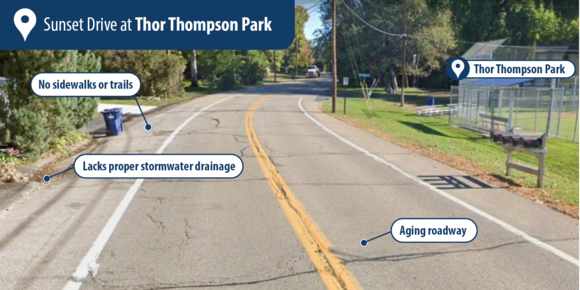 Sunset Drive at Thor Thompson Park shows signs of an aging roadway that lacks walking, biking, and rolling features. The road also lacks curbs and gutters to provide proper stormwater drainage.
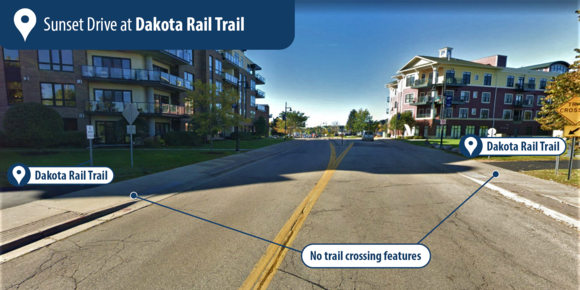 Sunset Drive at the Dakota Rail Regional Trail needs enhancements for a safer trail crossing. Updates at this location could include improved signage and medians.
If you haven’t yet shared your thoughts or ideas for a better Sunset Drive, it's not too late! We want to know what elements – like trails, sidewalks, pedestrian crossings and beacons, accommodations for people with accessibility needs, wayfinding signage, and other amenities – could make this road better for you and others.
Use our comment map
Many of you have already given our project staff insight to visualize a better Sunset. Thank you. But if you haven’t yet, you can share your ideas and thoughts about creating a better Sunset Drive by using our interactive comment map.
Our next steps include working on an initial design using your input and sharing our project goals this spring. Ultimately, we want to make Sunset Drive a safe, convenient, and comfortable way to travel for users of all ages, abilities, and modes of transportation.
By David Chanen, Star Tribune
Hennepin County is now expected to commit $10 million for a comprehensive gun violence plan that will include a violence reduction and prevention coordinator.
Officials are tapping federal pandemic relief dollars to fund the initiative. The county board approved the initial $5 million in June for short-term violence intervention strategies. The request for an additional $5 million, which will focus on youth offenders, disparity reduction in the court system and data collection, will be debated by the board's budget committee next week.
Access the full article here.
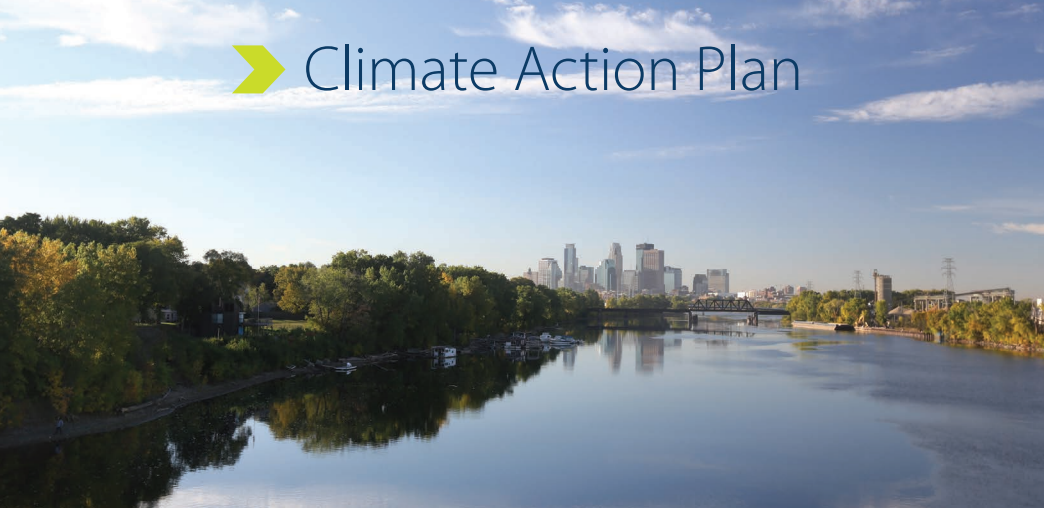
Hennepin County’s response to climate change is critical. The county leads in many areas that offer the most effective ways to cut greenhouse gas emissions, such as investing in transit, conserving energy use in our buildings, protecting natural resources, and preventing waste. The county must also work toward eliminating disparities in our response to climate change and prioritize protecting the health of residents amid increasing threats.
The following are some of the climate solutions the county is currently pursuing.
Learning about and responding to Minnesota’s changing winters
Hennepin County’s Emergency Management and Transportation departments play an essential role in keeping utilities and infrastructure safe and operating in the winter.
Emergency Management collects data on local frost depth and freezing rain to monitor potential hazards such as frozen water mains, spring flooding, and icy roads. Frost depth measurements help monitor potential issues with water main breaks and forecast spring flooding. Freezing rain sensors help local agencies keep transit running, make decisions about de-icing roads, and alert utility companies to potential service disruptions. Read more about how new, local data helps combat winter weather hazards.
Hennepin County road operations staff use sodium chloride, or salt, to effectively remove snow and ice on more than 2,200 lane miles of county roads. Although fast and effective, salt negatively impacts soils and surface waters. Through proactive efforts, Hennepin County has been very successful in significantly reducing the amount of salt applied on county roads over the past 25 years. These efforts align with the Climate Action Plan's goals of enhancing public safety, increasing the resilience of the built environment, and protecting natural resources. Read more about keeping waters clean and healthy while keeping county roads safe and drivable.
Mapping a zero-waste future
About the Zero Waste Plan
Hennepin County is developing an operational plan to map Hennepin County to a zero-waste future that includes a broad community engagement process with a strong focus on equity and disparity reduction.
Hennepin County’s zero-waste vision is a waste management system where all materials are designed to become resources for others to use to systematically avoid and eliminate the volume and toxicity of waste and materials, conserve and recover all resources, and not burn or bury them. The key performance measure is diverting 90% or more of discarded materials from landfills and incinerators.
The Zero Waste Plan will complement the county’s newly adopted Climate Action Plan and provide the foundation for the county’s 2024 Solid Waste Management Master Plan. A draft of the Zero Waste Plan will be presented to the county board in November 2022.
Consultants hired to lead the development of the county’s Zero Waste Plan
Hennepin County recently hired numerous consultants that will work collaboratively with county staff to develop a plan to reach a zero-waste future.
Resource Recycling Systems (RRS) was hired as the solid waste consultant to identify gaps in the county’s existing solid waste system, review the solid waste systems of leading zero-waste communities, conduct stakeholder engagement, and coordinate work groups to develop strategies.
Antonia Apolinário-Wilcoxon, Ed.D. of Equity Strategies, was hired as a facilitator to support the plan’s broad community engagement process with a strong focus on equity and disparity reduction. One key responsibility of the facilitator is to coordinate a cohort of 18 community groups focused on engaging residents who have traditionally been left out of solid waste planning processes and are potentially more burdened by the current solid waste system.
As a skilled local facilitator, Dr. Apolinário-Wilcoxon will provide transparency and neutrality in discussions and analysis of feedback regarding concerns and opportunities related to the county’s solid waste system.
Zero waste plan community engagement partners
Eighteen community groups were selected to receive funding to support community engagement with the Zero Waste Plan. These groups will be responsible for providing input on engagement plans for their communities, hosting engagement sessions, and communicating updates to their members on the process and feedback opportunities. As a cohort, these groups will work together to gain a broader understanding of the solid waste system, develop community-identified solutions, and define themes for use in the subsequent plan development phase.
- Action to Equity
- Audubon Neighborhood Association
- Center for Hmong Arts and Talent
- Climate Generation/Youth Environmental Activists of Minnesota (YEA! MN)
- Community Power
- Congregations Caring for Creation
- Eastside Neighborhood Services
- Ebenezer Oromo Evangelical Church
- Encouraging Leaders
- Lao Assistance Center of Minnesota
- McKinley Community
- MN Renewable Now
- NoMi Roots
- Northside Residents Redevelopment Council
- Off The Blue Couch
- Somali American Women Action Center
- Resilient Cities and Communities with Inquilinxs Unidxs por Justicia
- Thai Cultural Council of Minnesota
Subscribe to the Zero Waste Plan Updates newsletter to receive updates as the plan moves forward. Public engagement will begin in March.
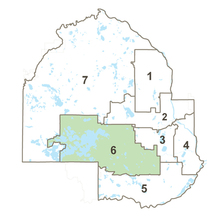
The Hennepin County Board of Commissioners consists of one commissioner from each of seven districts. I am proud to represent Deephaven, north Eden Prairie, Edina, Excelsior, Greenwood, Hopkins, Long Lake, Minnetonka, Minnetonka Beach, northern Mound, Orono, Shorewood, Spring Park, Tonka Bay, Wayzata and Woodland.
|
Chris LaTondresse
Commissioner
6th District
612-348-7886
Jessica Oaxaca
District Director
612-348-6885
Kyle Olson
Policy Director
612-348-3168
|