 New website and educational resources available
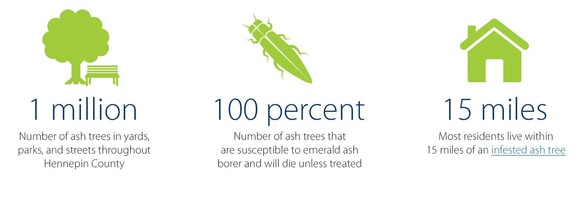
Emerald ash borer, an invasive tree pest that attacks and kills ash trees, is the biggest current threat to our tree canopy.
Hennepin County has created a new website, www.hennepin.us/ashtrees, to help residents learn about emerald ash borer and their options for managing ash trees. The website includes information on identifying ash trees, working with an arborist to preserve or remove trees, and suggested replacement tree species for ash trees that will be removed.
Communication and education materials are available on our environmental education web page, under current campaigns.
Updated recycling progress report available
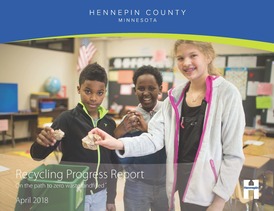 An updated recycling progress report that summarizes the county’s progress toward meeting its recycling goals in 2017 is now available. This edition of the report wraps up the waste management strategies developed in the 2012 Solid Waste Management Master Plan and outlines a vision to move forward to reach the goal of recycling and composting 75 percent of waste by 2030.
The recycling and composting rate in the county has hovered around 50 percent for the past three years. The 2018 Master Plan strategies going forward will continue programs that have proven results, such as school and multifamily recycling, as well as further developing new, creative programs like the zero waste challenge and food waste prevention efforts.
However, to reach our goals, the plan includes an increased focus on organics recycling. New strategies include considering organics requirements for cities and some businesses as well as supporting the development of infrastructure to manage more organic waste.
|
Progress on revising the county’s recycling ordinance to require organics recycling
Hennepin County is in the process of revising its recycling ordinance (ordinance #13 solid waste source separation) to require cities and some businesses to participate in organics recycling and make updates to the requirements for multifamily recycling.
From December 2017 through April 2018, county staff engaged city representatives, trade associations, waste haulers, property managers, businesses and the broader community to seek input on the ordinance language. A report that summarizes the public engagement activities and key findings is now available.
The feedback summarized in the report is being used to draft the ordinance language. The public will be able to review and comment on the draft ordinance language later this summer. The board will consider the action and hold a public hearing prior to adoption of the ordinance revisions in the fall.
Updates on the ordinance revision process will be posted at www.hennepin.us/solidwasteplanning, or you can sign up to receive email updates.
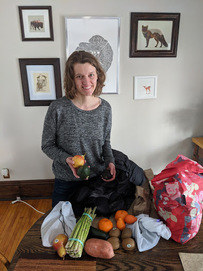 Recently 39 households – a total of 129 adults and children – completed the second round of the Zero Waste Challenge and reported successes in reducing waste and improving recycling.
Participating households cut the amount of waste they generated per person per day by one third. On average, participating households recycled 66 percent of waste generated in their households, which is significantly higher than the countywide diversion rate of 45 percent.
Most of the participating households use some form of composting – curbside collection, drop-off, backyard, or a combination of methods – to achieve those high recycling rates.
This year’s challenge families took a wide variety of actions on their journeys toward zero waste, including some of the following:
|
 Improving recycling: Taking organics to a drop-off site, adding backyard composting, and learning about wish-cycling (and stopping!).
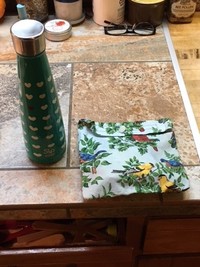
Eliminating disposables: Using steel straws instead of disposable ones, switching to reusable feminine products, sewing reusable sandwich bags, and using handkerchiefs, coffee mugs, cloth napkins and reusable produce bags.
Preventing waste in the first place: Making beeswax wrap, learning to cook more from scratch, getting chickens, organizing the fridge, shopping in bulk, and cutting back on online shopping.
Getting everyone involved: Many households commented about how involved children were, such as one family’s two-year-old who already knows how to say when something is “compostable.”
|
Registration for the next round of the challenge, which will run September 2018 through April 2019, will open at the end of July. For more information, contact Carolyn Collopy at carolyn.collopy@hennepin.us or 612-596-0993.
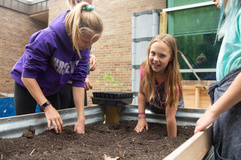 This spring, the county partnered with the Mulch Store, a compost site in Rosemount, to help schools close the loop on organics recycling by providing free compost created in part by organic materials collected in their cafeterias. Compost was delivered to 40 schools who used it in a variety of ways, including in vegetable gardens, a greenhouse, a rain garden, potted plants, and a tree planting.
The county provides free resources, staff assistance, and grants to help schools start or improve recycling and organics recycling programs. Learn more.
|
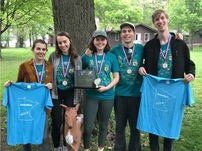 On April 30, about 100 students from around the metro area took part in the metro area Envirothon at the Minnesota Landscape Arboretum. Eighteen teams representing eight high schools and middle schools competed to prove their environmental knowledge in the topics of aquatics, forestry, soils, wildlife and current events.
Teams from Hopkins took first and second, advancing to the state competition, while Minnetonka High School, Hopkins Middle School and Rockford Middle School all brought a strong contingent of engaged and enthusiastic teams.
A team from Hopkins High School won the state Envirothon in May, advancing to nationals in Idaho in July where they'll compete for scholarships.
|
Wayzata Sailing Center receives grant to engage youth in investigating aquatic invasive species
The Wayzata Sailing Center recently received an $11,000 grant from Hennepin County to engage youth in discovery, monitoring, and exploring aquatic invasive species in Lake Minnetonka. This summer, about 200 youth will participate in the sailing center’s Loony Lake Lab where they will use equipment like microscopes and swim masks to conduct hands-on investigations of aquatic invasive species and the overall health of the lake. The center previously used funding from a Hennepin County Green Partners environmental education grant to offer STEM classes at the center. Read more in the Sun Sailor.
Interest in zero waste lifestyle grows in Minnesota
In a recent Star Tribune article, Erika Larson, a recent graduate of the Hennepin County Master Recycler/Composter class, shared her efforts to eliminate waste. She shops from the bulk bins at the grocery store with reusable bags and containers; carries reusable bottles, straws, napkins and silverware with her; and tries to choose packaging that is recyclable. She’s part of a growing zero-waste community in Minnesota, which has gained traction and interest in the past few years. Programs like the county’s Zero Waste Challenge, classes and workshops at grocery stores and wellness centers, and online platforms like blogs and social media sites are helping to support the movement.
Natural resources grant helps fund unique permeable paver alley project
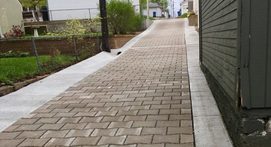 A group of neighbors in the Standish-Ericsson neighborhood of south Minneapolis recently replaced the degraded pavement in their alley with permeable pavers, which will allow rain water and melting snow to soak into the ground instead of running off into the storm drain. Installing the permeable alley met four goals: reducing flooding issues, improving the look of the alley, helping water quality, and producing data on water flow before and after installation. The neighbors partnered with Metro Blooms to plan the project, and secured part of the funding for the project through a Hennepin County Natural Resources Opportunity Grant. This project is one of the first of its kind in the Twin Cities. A grand opening and celebration is planned for Tuesday, June 19 from 5 to 7:30 p.m. Read more in the Star Tribune.
|
Southwest High School green team members advocate for climate action and work to make their lunchroom zero waste
Members of the Southwest High School green team recently participated in the Youth Climate Justice Summit organized by Climate Generation at the state capitol. In addition to advocating for broader political action, the team has been working to educate their peers and make their school more sustainable. They received a Hennepin County school recycling grant to add bins and reusable plates and silverware and learned about recycling from the county’s school recycling coordinator before educating other students. Read more in the Southwest Journal.
Emerald ash borer infestations have been found in 12 cities in Hennepin County, which means most residents live close enough to an infested ash tree that they should start making plans now for how they're going to manage ash trees on their property.
Identify ash trees
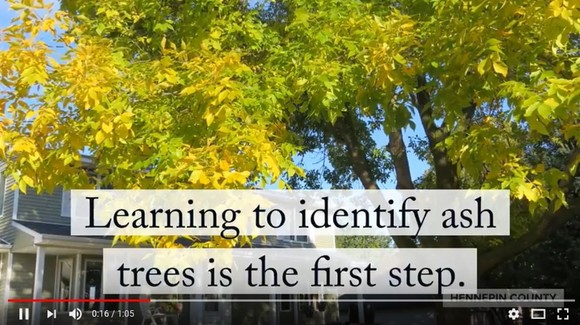
Look for the following characteristics to determine if your tree is an ash tree:
- Branches that grow directly opposite from one another
- Compound leaves, or multiple leave on one stalk joined to a branch
- Bark with a diamond-shaped pattern
- Seeds that are oar-shaped samaras that typically hang in clusters
Watch our learning to identify ash trees video for photos and more information.
Learn your options
-
Preserving: You can work with an arborist to save ash trees that are of high value
-
Removing: Any ash tree not being treated will eventually need to be removed and disposed.
-
Replanting: Trees provide numerous benefits, so planting new trees in place of any you remove is a great idea.
Learn more at www.hennepin.us/ashtrees.
|