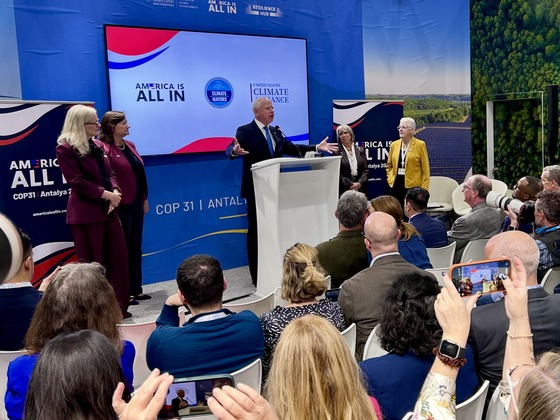
 Governor Walz brought Minnesota’s record of climate action to the global stage at the 2026 United Nations Climate Change Conference (COP31) in Turkey, highlighting how state leadership can cut emissions, protect natural resources, strengthen communities and create economic opportunity. At COP31, Governor Walz joins governors, mayors, and international leaders to discuss how states and cities are advancing climate solutions, building partnerships and delivering tangible benefits for residents.
“Climate action is about protecting the things Minnesotans cherish: clean air and water, healthy communities, and the farms, forests and outdoor spaces that sustain us,” said Governor Walz. “Minnesota has paired ambitious goals with real investments and strong environmental protections. We’re showing that climate leadership at the state level creates good jobs, strengthens our economy and makes life better for people across the state.”
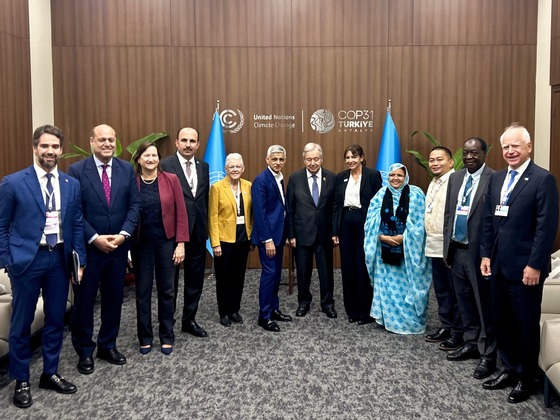
During the conference, Governor Walz spoke on behalf of the U.S. Climate Alliance regarding the role of governors in advancing climate action and joined discussions with international leaders on scaling practical solutions. He also met with the United Nations leadership and climate representatives from France, the Netherlands, and Wales to discuss collaboration and Minnesota’s clean energy work.
Since taking office, Governor Walz has signed more than 40 climate laws and directed more than $1 billion in state funding toward climate change mitigation and adaptation. His administration established a Climate Change Subcabinet, released Minnesota’s first Climate Action Framework in 2022, and updated it in 2026 to guide the state’s work to reduce climate pollution and prepare communities for climate impacts.
A cornerstone of that work is Minnesota’s 100% carbon-free electricity law, which requires utilities to provide carbon-free power by 2040, with a 55% renewable electricity benchmark by 2035. In 2024, more than half of the state’s electricity came from carbon-free sources. The administration also streamlined clean-energy permitting and invested more than $100 million in local climate resilience and water infrastructure, established a $105 million climate innovation finance authority, and updated building codes to reduce energy use in new buildings.
Minnesota is pairing clean energy growth with environmental safeguards. The state’s sustainable aviation fuel (SAF) tax credit supports lower-carbon fuel while ensuring domestic feedstocks and protecting natural lands from conversion. Since July 2026, the state’s first SAF blending facility is delivering fuel to Minneapolis–Saint Paul International Airport, with capacity to blend up to 30 million gallons annually.
Governor Walz authorized state disaster assistance for four southern Minnesota counties affected by severe flooding and two northern Minnesota counties affected by wildfires. The assistance will help Fillmore, Houston, Steele, and Waseca counties recover from flooding that began September 19, and Cook and Lake counties recover from wildfires that began July 7.
“We are grateful to the emergency responders, local officials, volunteers, and community members who have worked together to support their neighbors through these disasters,” said Governor Walz. “Minnesota has been engaged from the start—supporting emergency response, coordinating with local partners, and helping communities recover. This assistance builds on that work and will help repair critical public infrastructure.”
Intense rainfall in southern Minnesota began September 19, causing widespread flooding, mudslides, road closures, and damage to homes and other properties. The Department of Public Safety’s Homeland Security and Emergency Management division coordinated with local partners on damage assessments and recovery efforts.
The northern Minnesota wildfires began July 7 and caused damage to public infrastructure in portions of Cook and Lake counties. Earlier in the response, Governor Walz declared and extended a peacetime emergency, mobilized the Minnesota National Guard, and directed state agencies to coordinate with local, federal, and Canadian partners on fire suppression, evacuations, and emergency operations. Minnesota has also worked with affected communities and business partners to support recovery.
The state will provide recovery support through the Disaster Assistance Contingency Account (DACA), which provides assistance to eligible local governments when disaster costs exceed local resources. The total amount of assistance will be determined after all required documentation has been submitted and recovery work is complete.
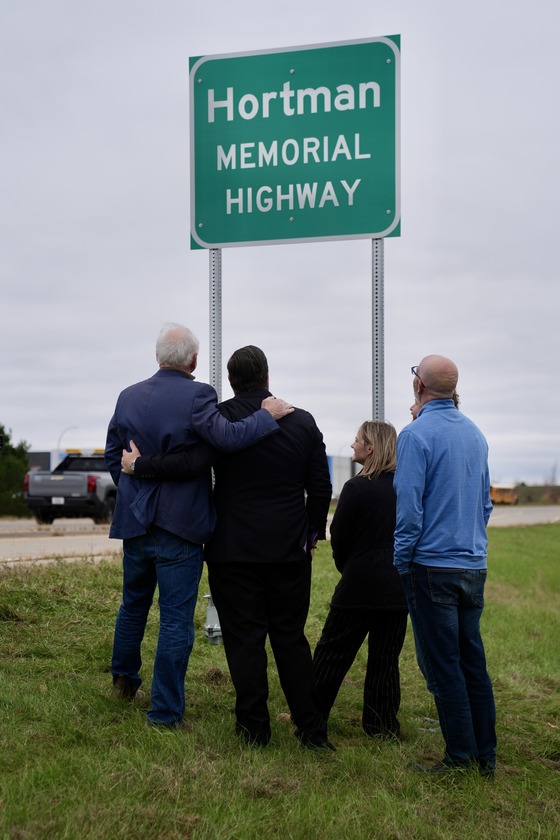 Last week, Governor Walz joined Minnesota legislative leaders and members of the Hortman family to unveil signs designating Trunk Highway 610 as the Hortman Memorial Highway. The designation honors the lives and legacy of Melissa Hortman, former House Speaker Emerita, and Mark Hortman.
“Melissa was a remarkable leader, but more than that, she was a person who showed up for her neighbors, her community, and the people she loved,” said Governor Walz. “She helped build this highway because she believed in the north metro and the people who call it home. I hope that every time someone drives down Highway 610 and sees Melissa and Mark’s names, they’ll remember the lives they lived, the people they loved, and all they gave to Minnesota.”
The memorial highway recognizes the Hortmans’ enduring connection to the north metro, where they lived and served. As a legislator, Melissa Hortman played a pivotal role in securing funding for Highway 610, helping create a vital transportation connection for the region. The designation also honors the extraordinary public service of Speaker Emerita Hortman, who served as the longest-serving speaker of the Minnesota House of Representatives. Throughout her career, she worked across the aisle to advance policies including paid family and medical leave, reproductive protections, and clean energy initiatives that improved the lives of Minnesotans and helped shape the future of the state.
The Hortman Memorial Highway designation was established through legislation sponsored by Representative Erin Koegel and Senator John Hoffman and championed through the legislative process by Transportation Co-Chair Representative Brad Tabke. The Minnesota Department of Transportation is responsible for installing and maintaining the memorial signs along the highway.
|