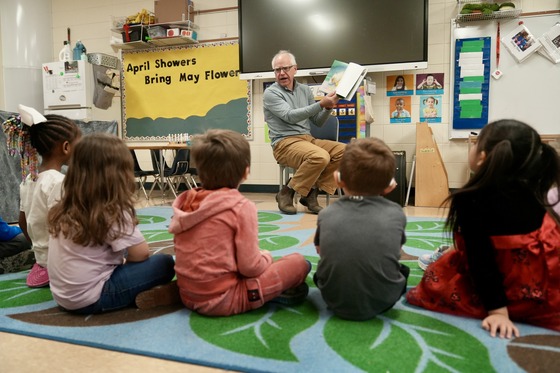
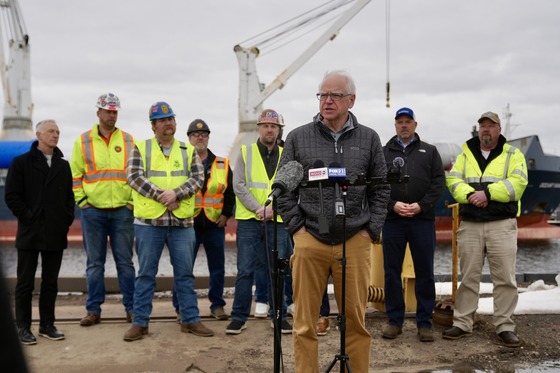
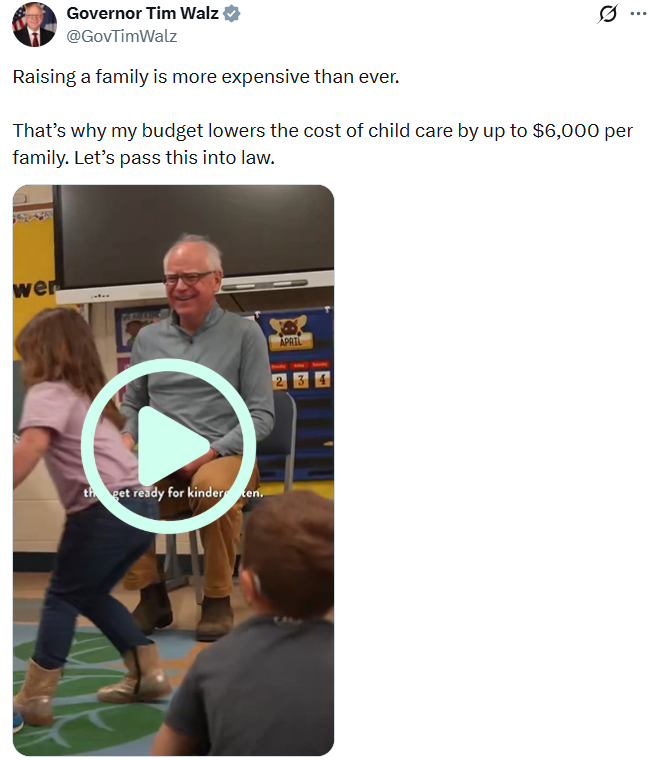
 On Thursday, Governor Walz visited Duluth, where he met with students, education leaders, and families at a local school to discuss child care affordability. The Governor also visited the Port of Duluth-Superior as the second stop on his statewide infrastructure tour, highlighting the importance of continued investments and his proposed $907 million infrastructure plan.
“Child care and infrastructure might seem like two different issues, but they’re both about whether Minnesota families can succeed,” said Governor Walz. “When parents can afford child care, and workers have access to good-paying jobs, our communities grow stronger, and our economy works for everyone. As we head into the final stretch of session, we have an opportunity, and a responsibility, to make life more affordable and create success across Minnesota.”
At Piedmont Elementary School, the Governor read with preschool students and kicked off a roundtable discussion with the Department of Revenue Commissioner Paul Marquart, child care providers, school leaders, and families. The discussion focused on rising child care costs and solutions proposed in the Governor’s budget. The Governor’s proposal would help lower costs by expanding the Dependent Care Tax Credit, benefiting more than 104,800 families and increasing the amount of the refund to families by an average of about $2,100 for families with young children in child care.
Following the school visit, the Governor toured the Port of Duluth-Superior to highlight the impact of infrastructure investments on regional and statewide economic growth, including support for union jobs and global trade. The Port of Duluth-Superior transports approximately 20 million tons of iron ore and one million tons of grain annually, making it the Great Lakes’ top tonnage port and supporting more than 7,000 jobs. As part of his proposed $907 million infrastructure plan, Governor Walz recommends $4 million for the Port Development Assistance Program, which helps ports like Duluth fund critical infrastructure upgrades and remain competitive in global markets.
Governor Walz issued an executive order providing emergency assistance to Winona County following a cyberattack on Monday, April 6, 2026, that disrupted critical systems and digital services. The attack continued into Tuesday, April 7, significantly impairing the county’s ability to deliver vital emergency and municipal services.
“Cyberattacks are an evolving threat that can strike anywhere, at any time,” said Governor Walz. “Swift coordination between state and local experts matters in these moments. That's why I am authorizing the National Guard to support Winona County as they work to protect critical systems and maintain essential services.”
Winona County officials have been working around the clock in coordination with Minnesota Information Technology Services, the Minnesota Bureau of Criminal Apprehension, the League of Minnesota Cities, the Federal Bureau of Investigation, and external cybersecurity experts. Due to the scale and complexity of the incident, Winona County requested cyber protection support from the Minnesota National Guard to ensure continuity of municipal operations.
Last week, Governor Walz celebrated new data from the Minnesota Department of Education showing Minnesota’s Class of 2025 achieved the highest four-year graduation rate in state history at 84.9%, marking the second consecutive year of record-breaking progress.
“This is a moment worth celebrating,” said Governor Walz. “Decades in the classroom have helped inform many of the goals I’ve set and the policies we’ve passed over the last seven years to support our students, teachers, and parents. Every student who receives that diploma is better equipped to navigate the challenges of landing a job, pursuing higher education, and building a future they feel excited about. Congratulations to an incredible class of students.”
Graduation rates increased across nearly every student group, with notable gains among American Indian, Black, Asian, and Hispanic or Latino students, as well as students receiving special education services and those from lower-income families. The graduation rate for American Indian students increased by nearly 5 percentage points from last year and has risen 9 percentage points since 2021, one of the largest gains of any student group. Achievement gaps also continued to narrow in many areas.
“The progress we’re seeing among Native students is meaningful and long overdue,” said Lieutenant Governor Flanagan. “This represents real momentum and reflects intentional investments in education. While we celebrate this progress, we remain committed to continuing this work until every student has the support and opportunity to graduate and thrive.”
|