 Redford Center | September 10, 2018
This first of its kind sequel to Happening: A Clean Energy Revolution is an example of what can happen when a state fully commits itself to a clean energy future, sets aggressive targets, and then shatters them. Minnesota’s not just home to 10,000 lakes—it’s home to a bright renewable energy future as well!
[Watch This]
Star Tribune | September 7, 2018
Minnesota's Medicaid program will make it easier for doctors to prescribe treatment medications for opioid addiction, removing one of the biggest obstacles that has faced people seeking drug therapy.
Physicians will no longer need to obtain prior approval from the state agency that runs the health insurance program for the poor — a process that often caused dangerous delays in treatment and sent some patients back to using heroin or prescription painkillers as a way to cope with intense withdrawal symptoms.
[Read More]
Energy News Network | September 13, 2018
The state of Minnesota and nearly a dozen other government entities will use a collaborative buying approach to build 4 megawatts of on-site solar.
Called “Solar Possible,” the initiative used a master contract and a joint request for proposals to select vendors and gather pricing data. The Minnesota Department of Administration’s Office of Enterprise Sustainability and two partner organizations developed the program.
Participating school districts, government agencies and city governments are getting better prices than they would have on their own, said Office of Enterprise Sustainability director Larry Herke.
[Read More]
MPR | September 13, 2018
Household income increased and unemployment fell last year across Minnesota as the economy continued to improve, according to U.S. Census figures released Thursday. Black and Latino Minnesotans, whose household incomes had stagnated or even fallen during and after the Great Recession, shared a significant portion of the income gains.
The overall median household income of the state rose to $68,400. Black households experienced a bump in income for the third year in a row to $38,100. Black and Latino households each gained about $4,000 in 2017.
[Read More] |
 FOX 9 | September 7, 2018
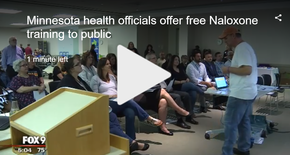
State health officials are attempting to tackle the growing opioid epidemic head-on by offering free training to the public on how to safely use Naxolone, also known as Narcan, to reverse an overdose in case of an emergency.
The training was held Friday at 8:30 a.m. in the Human Services building in St. Paul and was offered as part of National Recovery Month in Minnesota. National Recovering Month is intended to help “increase awareness and understanding of mental health and substance use disorders and celebrate the people who recover,” according to the Department of Human Services.
[Read More]
Red Lake Nation News | September 14, 2018
The Minnesota Public Facilities Authority approved $28.45 million in grants and loans for water and sanitary sewer projects in four cities in Greater Minnesota. Funding was approved for Canby, Cloquet, Waseca and Waubun.
“Communities across Minnesota face serious water-quality challenges,” said Governor Mark Dayton. “This funding supports improvements that will give residents of Canby, Cloquet, Waseca, Waubun and neighboring Greater Minnesota communities access to the safe drinking water they deserve.”
“Upgrading water and sewer systems in Greater Minnesota is a sound practice that provides long-term benefits," said Shawntera Hardy, who chairs the PFA board and is commissioner of DEED. “PFA funding is an investment in public health, the economy and community livability."
[Read More]
The Phoenix Spirit | September 2018
Minnesota Department of Human Services Commissioner Emily Piper: To mark Recovery Month in Minnesota, I want to tell you about substance use disorder treatment reform, a website, and a mother from southern Minnesota.
Let’s start with a hypothetical mother from southern Minnesota. Two years ago after much discussion, she finally gets her son, a heroin user, to agree to treatment. The mother, who knows the system, called the county for an assessment — which is exactly what she is supposed to do, and her son made an appointment. Only problem: the appointment is 20 days away. While this is hypothetical, it is also common. It can take up to 20 days to get an assessment.
Substance use disorder is an illness. We need to get people into treatment as soon as possible; people who need treatment cannot wait. Telling someone to wait 20 days for treatment is like telling someone with a broken leg to wait 20 days to get it set.
[Read More] |