|
Pioneer Press | April 26, 2018
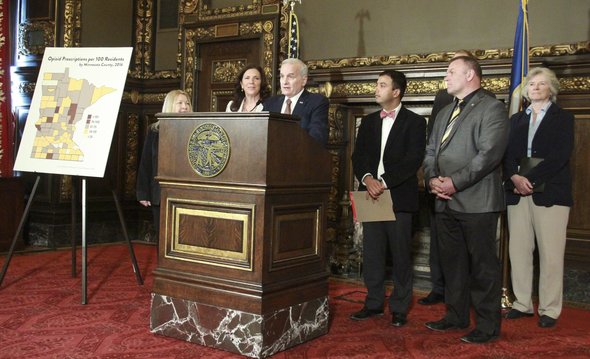
Opioids will be harder to get, addiction treatment should be easier to access and pharmaceutical companies might have to pay more to sell opioids in Minnesota.
Gov. Mark Dayton and a bipartisan group of lawmakers announced these and other efforts Thursday in Minnesota’s ongoing fight against the opioid epidemic. In 2016, 395 people died from opioid overdoses and those numbers are expected to grow.
“The proliferation of these narcotics is really frightening,” Dayton said at a news conference Thursday highlighting new strategies for reducing opioid addiction. “This has to start with the medical community and how they handle these prescriptions.”
[Read More]
St. Cloud Times | April 25, 2018
About 450 children are enrolled in 4-year-old preschool classes in the St. Cloud school district.
Nearly one-fifth of those students could lose their place if the Minnesota Legislature doesn't do something to extend the funding it passed last year.
"We all know what early childhood is (and) where it starts," said Julie Midas, director of early childhood education for St. Cloud schools. "The key to helping children be successful is giving them a great initial experience in early childhood where we focus on their social (and) emotional well-being, as well as preparing them academically for success as they enter kindergarten."
[Read More]
Tower Timberjay News | April 27, 2018
Millions of average Minnesotans are facing a tax increase this year as a result of federal tax changes approved in December and the Legislature seems unwilling to heed Gov. Mark Dayton’s proposal to fix the problem.
Here’s the problem: Federal tax changes approved by Congress and President Trump doled out huge tax cuts for corporations and the wealthy. Indeed, the tax cut for corporations alone comprised 92 percent of the total tax savings in the plan. The Congress and the President paid for it, in part, by exploding the federal deficit, but also by reducing or eliminating a long list of tax deductions that typically benefit the middle class.
[Read More]
|
Duluth News Tribune | April 22, 2018
Esko native Micaila Hey, known for her warmth and eagerness to help others, took her own life in January by overdosing on pure fentanyl, a powerful and often deadly opioid.
Days later, Hey's funeral was the scene of another overdose, when a friend nearly died while sitting among others during the service. Quick action by an attending emergency responder resulted in her being revived in a back room by the overdose antidote Narcan.
"Instead of being angry," said Hey's mother, Rachel Colombe, "I channeled Micaila and urged her to get back into treatment."
[Read More]
Inforum | April 25, 2018
Buying a house is one of the most significant financial and personal decisions that people and families make. Your home is the place where you make memories and where you expect and strive to be safe. In some cases, however, Minnesotans who rely on private wells find out belatedly that their family's safety has been compromised by something they never expected ‑ the well water coming out of their faucets.
We can be thankful that across Minnesota most well water is safe. However, in some cases the groundwater from which private wells draw their water can become contaminated with pollutants such as coliform bacteria from human and animal wastes, naturally occurring or man-made arsenic, or nitrates from leaching of nitrogen fertilizer.
[Read More]
Pioneer Press | April 26, 2018
Improving early education in Minnesota means doing what works for all children. This is why the state set the goal that by 2020 all children are ready for school at kindergarten entry. As has been frequently documented over the past decade, however, Minnesota is far short of where it needs to be to achieve this goal.
The best available evidence from the Minnesota Department of Education is that only half of children enter kindergarten fully ready. Since most young learners are from middle-income families, large increases are needed across the income spectrum to meet the state goal. Schools also have a central role in creating and sustaining early learning gains.
[Read More]
|