|
The second quarter has brought continued momentum for Minnesota’s Traffic Incident Management efforts, and this edition highlights the progress being made across training, coordination and responder safety. From expanding MnTIM training opportunities to strengthening local partnerships, our shared work continues to support the core goals of MnTIM: reducing responder exposure, preventing secondary crashes, improving clearance times, and keeping traffic moving safely.
This issue also includes important reminders of why this work matters. Every traffic incident scene brings risk, and every responder plays a role in building safer, more coordinated responses. As we move through the busy summer travel and construction season, now is a good time to refocus on safe vehicle positioning, high-visibility practices, clear communication and quick clearance strategies.
Thank you for your continued commitment to protecting Minnesota’s responders and roadway users. Your work, training and collaboration are what keep MnTIM moving forward. Stay safe out there, and thank you for all you do.
George Burger, Office of Traffic Safety
Tony Kasella, Department of Transportation
Lt. Brian Schwartz, Minnesota State Patrol
In this issue:
- Work Zone Crashes
- After-Action Reviews
- Training
- Responder Resources: Webinars & Podcasts
- Crash Data
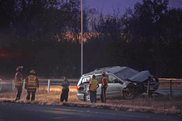
Traffic incidents in work zones can be especially challenging. Lanes and shoulders may be narrow, traffic patterns may shift, visibility may be reduced, and congestion can build quickly. These conditions can increase risk for responders, roadway workers, and the traveling public.
In 2026, Minnesota has already seen 262 crashes occur in work zones. That number is an important reminder that work zones are active, changing environments where a routine response can quickly become more complex. Because crash reports are continually submitted and updated, this total may change as more information becomes available.
When responding to a crash or stalled vehicle in a work zone, keep these strategies in mind:
Slow down and stay alert.
Work zones can change from day to day, or even hour to hour. Watch for lane shifts, cones, barriers, workers, equipment, and stopped traffic as you approach the scene.
Know how you will access the scene.
In some work zones, especially areas with narrow lanes or no shoulders, normal access may not be possible. If the road is confirmed closed and it is safe to do so, responders may need to consider approaching the scene from the opposite direction or using another access point.
Move minor crashes out of travel lanes when possible.
If vehicles can be moved and there are no serious injuries, work with drivers to relocate them to a safer area outside the active travel lanes. This helps protect everyone on scene and reduces backups in areas where traffic is already restricted.
Request towing early.
Contact towing as soon as possible when a vehicle may need to be removed. Placing tow operators on standby can help speed up clearance and reduce the time responders spend exposed to traffic.
Notify the roadway owner or contractor.
Let the appropriate roadway agency or contractor know about the incident as soon as possible. They may need to check for damage, adjust traffic control, assist with access, or address impacts to the work zone.
Work zones require extra coordination and awareness. A safe response starts with slowing down, communicating early, and working together to clear the scene as quickly and safely as possible.
|
 Every traffic incident gives responders an opportunity to learn. Some scenes go exactly as planned. Others reveal gaps in communication, access, traffic control, resource needs, or scene safety. An after-action review, often called an AAR, gives responders a structured way to talk through what happened, what worked well, and what could be improved before the next incident.
AARs do not need to be complicated. They can be short, practical conversations after a significant crash, a long-duration closure, a responder safety concern, a work zone incident, or any event where agencies had to coordinate on scene. The goal is not to assign blame. The goal is to strengthen future response.
Minnesota’s Traffic Incident Management Program Plan identifies enhanced after-action reviews and improved TIM collaboration as key strategies for advancing responder safety, reducing secondary crashes, reducing clearance time and reducing travel delay. That makes AARs an important part of building a stronger statewide TIM program.
A good AAR should bring the right partners to the table, including law enforcement, fire, EMS, towing and recovery, transportation, public works, dispatch, and the roadway owner when appropriate. Each discipline sees the incident from a different perspective. When those perspectives are shared, agencies can better understand what happened from the first call through final clearance.
Common AAR questions include:
- What happened?
- What went well?
- What challenges did responders face?
- Were roles and responsibilities clear?
- Was communication timely and effective?
- Were vehicles positioned safely?
- Were lanes cleared as quickly and safely as possible?
- What should we do differently next time?
The most valuable AARs lead to action. That may mean updating a local contact list, clarifying who requests towing, identifying better access points, adjusting work zone response plans, reviewing emergency traffic control practices, or scheduling additional TIM training.
AARs also help build relationships before the next incident. When responders regularly meet to review real events, they develop trust, improve coordination, and gain a better understanding of each partner’s role.
Not every incident requires a formal meeting or lengthy report. Even a brief review can make a difference when it captures lessons learned and turns them into practical improvements. The important part is creating a habit of learning from the scene.
Traffic incidents are unpredictable, but our preparation does not have to be. After-action reviews help responders identify what is working, fix what is not, and continue improving safety for everyone on the roadway.
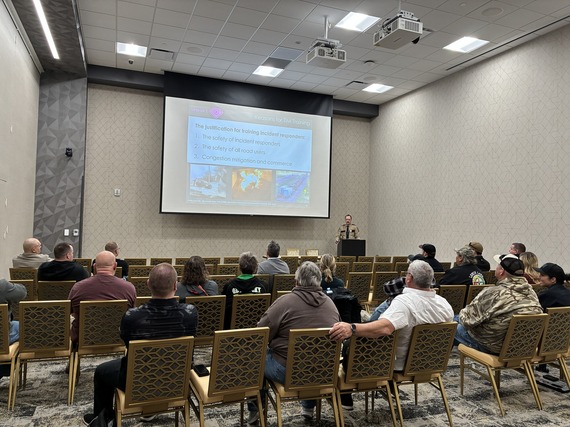 TIM training session at the Minnesota Tribal Traffic Safety Summit.
MnTIM training continues to build momentum across the state. So far in 2026, we have held 13 MnTIM classes and trained a total of 562 responders and partners.
This includes:
-
131 law enforcement responders
-
98 fire/rescue responders
-
29 towing and recovery professionals
-
17 EMS responders
-
73 transportation professionals
-
14 participants from other disciplines
These numbers reflect strong participation from the many disciplines that respond to traffic incidents in Minnesota.
Thank you to everyone who has attended a MnTIM class, helped host a training, or encouraged others in your agency to participate. Every trained responder strengthens Minnesota’s traffic incident response system and helps make our roadways safer for responders and the traveling public.
Wednesday, May 27, 2026
1:00–5:00 p.m.
MnDOT, 3920 US-2, Bemidji, MN
Register
Wednesday, June 3, 2026
1:00–5:00 p.m.
Pine County Boardroom, 635 Northridge Drive NW, Pine City, MN
Register
Wednesday, June 17, 2026
1:00–5:00 p.m.
Mankato MnDOT, 2151 Bassett Dr., Mankato, MN
Register
Wednesday, June 24, 2026
1:00–5:00 p.m.
Joint Operations Facility, 248 125th Ave. NE, Thief River Falls, MN
Register
Wednesday, June 24, 2026
5:30–9:30 p.m.
Albert Lea Fire Training Room, 417 S. Newton Ave., Albert Lea, MN
Register
Wednesday, July 15, 2026
5:30–9:30 p.m.
Owatonna Public Schools, 333 E. School St., Owatonna, MN
Register
Wednesday, August 5, 2026
1:00–5:00 p.m.
Windom MnDOT, 180 County Road 26, Windom, MN
Register
Wednesday, August 19, 2026
5:30–9:30 p.m.
Dodge County Fairgrounds–Midway Building, 62922 Hwy. 57, Kasson, MN
Register
If you are interested in hosting a TIM training class click here.
MNCrash Data: January 1 - May 11, 2026
*Please note: Crash reports are continually being submitted to the database from which these results were calculated. Therefore, these results may continue to change depending on the search criteria used.
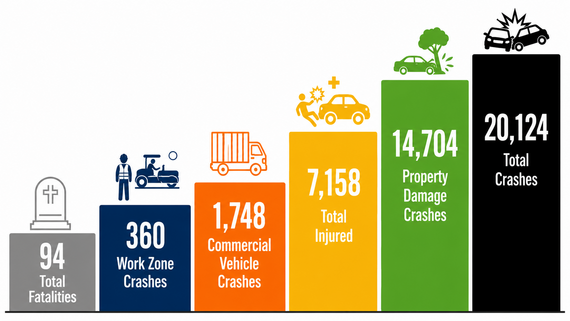 Source: https://mncrash.state.mn.us/
|