D1 - I-535 Blatnik Bridge in Duluth: 2027 construction
 
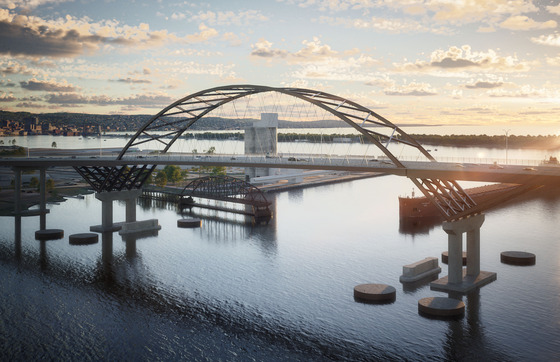 A rendering of the new Blatnik Bridge design.
The new bridge that will replace the Blatnik Bridge will resemble the existing structure that has carried traffic between Duluth and Superior across the St. Louis Bay since Dec. 2, 1961.
The design-build team awarded the project, Ames-Kraemer Joint Venture, chose the tied-arch – a curved arch with cables tied between its ends to carry the deck’s load over the main shipping channel.
Ames-Kraemer picked the tied arch for its building flexibility, affordability, safety and minimal impact on surrounding properties and environmental resources. The tied arch will be supported by delta frames – V-shaped supports rising from the piers below the deck.
Delta frames in bridge construction are a type of steel superstructure that uses a triangular arrangement of members to provide high lateral and torsional stiffness, improved load distribution and greater structural stability. Using the delta frames eliminated four in-water piers and five in-water pier-protection devices known as dolphins.
Officials from the Minnesota and Wisconsin departments of transportation gave the two teams bidding on the project (AKJV and Lunda Construction Co.) two options – a cable-stay or a tied-arch.
The departments also set goals for the bidders – design and construct a durable bridge and roadway that minimize future maintenance activities and cost; minimize impacts to marine traffic, businesses, residents, railroads and Port Terminal Drive access to the port; and have the new structure open no later than Oct. 31, 2031.
Designed to stand for 100 years, key features of the new bridge include:
- Four 12-foot traffic lanes and full shoulders
- A 12-foot shared-use path for pedestrians and cyclists on one side of the bridge
- The current bridge doesn’t have a sidewalk or path for pedestrians and cyclists
- The new path will be able to accommodate bridge inspection equipment and emergency vehicles
- Modern pier protection using large round “dolphins” built to handle the larger ships now on the Great Lakes
- Steel designed to resist atmospheric corrosion and a redundant structural system designed so that no single failure would likely bring down the bridge
The new main span will stretch 720 feet – 120 feet more than the existing bridge. The new structure will extend the Howard’s Pocket span to 485 feet and provide modern pier protection devices.
Construction on the overall project begins this month, with full bridge closure and demolition of the existing bridge tentatively scheduled in March 2027. Demolition of the old bridge is tentatively scheduled to begin in March 2027. The main span will be removed in fall 2027 or winter 2027-28, and its replacement will be floated in during fall 2030 or winter 2030-31.
Landscaping, cleanup and other finishing work is expected to continue until June 2032.
During construction, traffic will be detoured via the Bong Bridge, which crosses the St. Louis River about five miles southwest of the Blatnik Bridge.
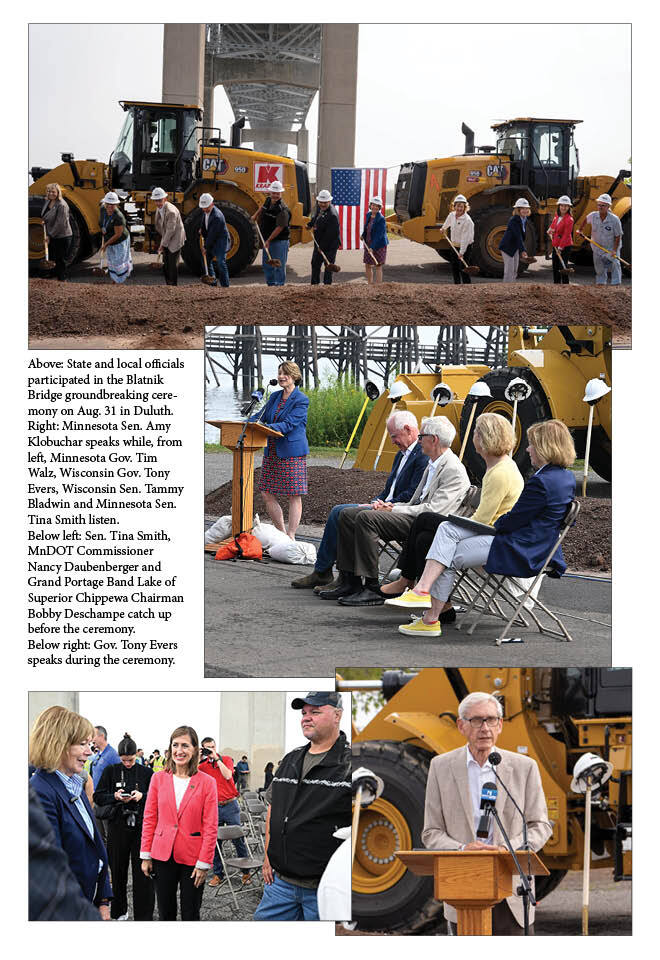
Minnesota and Wisconsin elected officials broke ground on the Blatnik Bridge project in Duluth on Monday, Aug. 31. The $1.8 billion replacement project, which connects Duluth and Superior, is one of the largest projects in both states’ history.
"The Blatnik Bridge project has taken a lot of coordination with state, local, federal and tribal governments, as well as collaboration with our business, labor and industry partners, to get us to this project milestone,” said MnDOT Commissioner Nancy Daubenberger. “We look forward to building a new bridge that is safer and better serves our state and region. We thank all our partners for their help in getting us to this milestone, with a special thanks to our tribal partners who remind us of a deeper meaning of place unique to this project and lasting long after project completion.”
More than 200 project team members, public officials, labor representatives and others from Wisconsin and Minnesota gathered below the bridge on Aug. 31 to recognize the partnerships and historic collaboration necessary to fund and construct a new bridge that will serve the region and economy for decades to come.
Opened to traffic in 1961, the Blatnik Bridge is jointly owned and operated by MnDOT and WisDOT. It is an important freight and commercial connector and is reaching the end of its service life. More than 33,000 vehicles cross the bridge each day, including commuters and visitors. Each year, more than $4 billion in goods pass over the St. Louis River. Many businesses across the upper Midwest rely on the bridge to reach the Port of Duluth-Superior, the largest U.S. port on the Great Lakes.
Minnesota and Wisconsin each committed $400 million for the replacement project. In addition, a $1 billion federal grant was awarded for the project in January 2024.
“White Pine Narrows has always been part of our homelands, and the Blatnik Bridge stands within our shared 1854 Ceded Territory. As MnDOT and WisDOT begin phased construction from 2026 through 2032, with more than a million labor hours anticipated, our Tribal Employment Rights Office looks forward to working with MnDOT and its project partners to ensure Tribal members can access training, trades, and employment opportunities connected to this historic investment,” said Chairman Bruce M. Savage, Fond du Lac Band of Lake Superior Chippewa. “These opportunities will help our people pivot into new careers, strengthen existing skills and build long term stability. It is meaningful to see MnDOT recognize the history of this place and work with Tribal Nations as partners. Building a new Blatnik Bridge is not only an investment in infrastructure, but also an investment in our shared future, our regional economy and the story of this land and the people who continue to care for it.”
Ames-Kraemer Joint Venture II (AKJV) was awarded the contract in June. The design-build process will be used for the project, allowing for efficient coordination between the design team and the construction team, lower costs and a more innovative design and construction.
“This iconic Blatnik Bridge project will be one of the largest in our region’s history. This isn’t a temporary construction job. This is a long-term project that will provide long-term careers for many folks in the Northland, providing for their families for years to come,” said Jack Carlson, Duluth Building Trades president. “An apprentice can start working on the project, and by the time the bridge is built, it could be a quarter of their career. That is what Northlanders need the most - steady, strong, great-paying careers without having to travel to find work. That’s time at home with their families; that’s why it is important that we have these work opportunities.”
“Today’s groundbreaking marks the beginning of that work and an important investment in the future of our region. The Blatnik Bridge is a vital connection between two communities, two states, and the people, businesses, and families who depend on it every day. Replacing this bridge is a generational investment in the future of the Twin Ports. It will strengthen our economy and make this vital transportation connection safer and more reliable for decades to come,” Duluth Mayor Roger Reinert said. “The construction and closure will require patience and cooperation on both sides of the bridge. (Superior) Mayor (Jim) Paine and I are confident that Duluth and Superior will continue to work together throughout the project to minimize, as best we can, the necessary impact and disruption to both our communities resulting from a project of this size and scale."
“The Blatnik Bridge construction project is integral to the continued vitality and success of Superior and our Twin Ports community,” said Kelly Peterson, executive director of the Superior Business Improvement District and president of the Twin Ports Business Alliance. “We appreciate the DOTs’ partnership throughout the planning process and their understanding that our local businesses are at the heart of this significant investment in our future. Those businesses will absorb the disruptions today and through the length of the project, so our entire region will benefit tomorrow. We are committed to continue working closely with the DOTs to minimize the impact and ensure our local businesses in Superior and the Twin Ports emerge stronger, more connected and ready for our next 100 years.”
“The Blatnik Bridge is far more than a connection between Duluth and Superior; it is a critical link in our regional economy and the national supply chain,” said Kevin Beardsley, Duluth Seaway Port Authority executive director. “This historic investment will strengthen the Port of Duluth-Superior, improve the safe and reliable movement of people and freight, and position our region for continued economic growth for generations to come. This is truly a once-in-a-generation project, and we are incredibly grateful to the state and federal partners who made it possible.”
Construction on the project begins this month, and complete bridge closure is planned for up to 56 months beginning in early 2027. The project is scheduled for completion in 2032.
Construction begins this week on resurfacing Winter Street from US 53 to Susquehanna Avenue and Susquehanna from Winter to Belknap Street in the city of Superior. This work is being done to help facilitate the extra traffic in Superior once I-535 is closed and detoured. During construction on the bridge replacement project, Winter Street and Susquehanna Avenue will be signed as an alternate detour during the Blatnik Bridge closure.
To prepare for that, the resurfacing project is:
- Removing a portion of existing pavement on Winter Street and Susquehanna Avenue and placing a new layer of asphalt over the roadways
- Adding a left-turn lane for northbound traffic on Susquehanna Avenue at the on-ramp to westbound US 2
- Adding pavement markings to delineate additional turn lanes, as room allows, on the corridor
- Adding temporary traffic signals on Winter Street at Grand Avenue
- These signals will be removed after construction and restored to the pre-construction condition when the new Blatnik Bridge reopens.
- Adding stop signs on Winter Street at Catlin Avenue and adjusting other stop signs at intersections along Winter Street
The project also will include making pavement marking modifications along Belknap Street and removing left-turn lanes along Belknap at Banks and Ogden avenues. There will also be pavement marking modifications in Minnesota on the entrance to eastbound Hwy 2 from I-35 and the I-35 northbound entrance from Hwy 2.
During construction, Winter Street and Susquehanna Avenue will remain open to traffic, but motorists will encounter lane closures controlled by flagging.
This construction is scheduled for completion in late October.
What to expect over the next few months
What the public will see around the site
-
Geotechnical borings both on land and in the water. These borings will determine the composition and parameter of the soils. The work will require some temporary lane closures near the bridge along US 53 and North 3rd Street in Superior. A barge will be in the waterway under the existing structure.
- Regulated materials test pits to determine if there is asbestos in the soils, which would require specific environmental handling requirements. No impact to traffic is anticipated.
- Pile load tests to determine the strength of the soils for the depth of the bridge pilings. This will potentially cause temporary lane closures near the bridge.
- On-going contaminated soil and sediment testing to determine the levels of contamination for proper environmental disposal. No impact to traffic is anticipated.
Beginning in September
- Winter Street detour corridor construction and pavement marking changes in Minnesota and Wisconsin (see information above).
- Temporary signals on 46th Avenue West in Duluth: Construction will be completed by St. Louis County and its contractors. Two temporary signal systems on 46th Avenue West will be used for the county's 40th Avenue West reconstruction project. Once the project on 40th Avenue West is complete in 2027, the Blatnik Bridge contractor will assume operation of the signals from St. Louis County for use by the Blatnik Bridge project to facilitate traffic on 46th Avenue West while the Blatnik is under construction. This is being done through an agreement between MnDOT and St. Louis County to share the costs on these temporary signals as they will benefit both projects.
- AKJV beginning preparation of the bridge area for the main span over St. Louis River. This includes better project access in and around the site, equipment staging area preparation and material laydown areas for the main span.
Behind the scenes (what the public won’t see):
- Final design of the bridge and roadway approaches.
- All project disciplines holding weekly meetings to ensure design is completed within specifications and to address questions.
- MnDOT, WisDOT and the DOTs' Design Oversight Team working in collaboration on the design to address various disciplines including bridge, roadway, drainage, utilities and maintenance of traffic.
- Regulatory agency permitting meetings to address environmental permits with Army Corps of Engineers, US Coast Guard, Wisconsin and Minnesota DNRs, Minnesota Pollution Control Agency.
- Refinement of the contractor schedule, including bridge closure expected March 1, 2027.
- Contractor and engineering team preparing and submitting multiple documents including Temporary Traffic Management Plan (TMP), Incident Management Plan (IMP), Health and Safety Plan, Quality Manual, Environmental Protection Training Program and Training Schedule, Environmental Compliance Quality Plan and Design and Survey packages
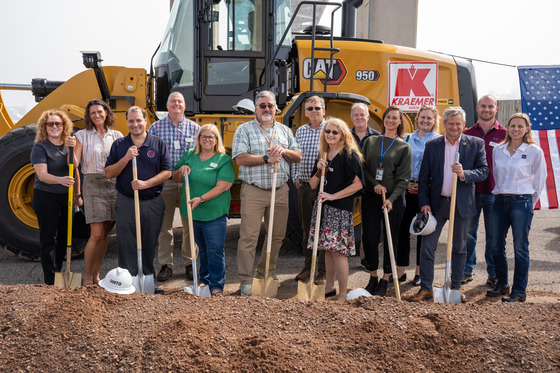 WisDOT staff involved in the Blatnik Bridge project gather for a photo during the groundbreaking ceremony on Aug. 31.
The Blatnik Bridge replacement project reflects three priorities for me: Strengthening the regional economy, protecting our natural environment and honoring the deep history of this corridor. The bridge is a critical connector for the Twin Ports and the largest port on the Great Lakes, and replacing aging infrastructure is essential to supporting the region’s long‑term vitality.
Environmental stewardship is equally important. The Twin Ports’ natural setting is unique, and the project team is committed to minimizing impacts on the sensitive ecosystems and wildlife that share this area with us. This work requires care, precision and respect at every step.
This corridor also carries generations of cultural significance. Recognizing the stories and heritage embedded in this place reminds us that we’re contributing to something much larger than the structure itself.
Collaboration across borders
Border bridge projects are complex, but that complexity brings people together. Working side‑by‑side with MnDOT and WisDOT partners has been one of the most rewarding experiences of my career. Blatnik’s unified team—supported by a bi‑state leadership structure—is built on trust, communication and shared purpose.
Looking toward a new landmark
Most infrastructure quietly serves communities without drawing attention. A major bridge, however, becomes part of a community’s identity. I’m grateful to help deliver a structure that improves safety, supports all modes of travel, protects the environment, and stands as a new visual landmark for the Twin Ports. When it opens, I hope people see a bridge shaped by public input, built for the future, and reflective of the pride of these communities.
A model for future projects
Blatnik showcases what’s possible through early regulatory collaboration, innovative design‑build contracting, and strong interstate partnership. If the lessons learned here help future projects across Minnesota and Wisconsin become more collaborative, more efficient, and more environmentally conscious, that legacy will extend far beyond this bridge.
~ Paul Conlin, WisDOT project director
Did you know? Ames-Kraemer Joint Venture has partnered with HNTB on the bridge replacement project. Once known as Howard, Needles, Tammen & Bergendoff, the architectural and infrastructure design firm served as consulting engineers on the original Blatnik Bridge construction project as well.
More information
For more project information, please visit the project website.
Have a story idea or a question you'd like more information about? Email us.
Sign up for project email updates.
|