D1 - I-535 Blatnik Bridge in Duluth: 2027 construction
 
What will the new Blatnik Bridge look like? Come find out Wednesday, Aug. 12, at the Superior High School Performing Arts Center, 2600 Catlin Ave.
MnDOT and WisDOT are hosting an open house and inviting contractor Ames-Kraemer Joint Venture II to share information on the new bridge design, traffic impacts expected this fall and project timeline. The open house is from 5-7 p.m. in the Performing Arts Center, 2600 Catlin Ave., Superior, with a presentation at 5:15.
For those unable to attend in person, open house materials will be posted to the Blatnik Bridge website following the meeting.

The Twin Ports Business Alliance (TPBA) began when Kelly Peterson, executive director of the Superior Business Improvement District (SBID), and Jen Rossmann, formerly of the Canal Park Business Association and currently the general manager of Barker’s Island Inn, met at a DOT meeting about the Blatnik Bridge.
They recognized the need for a cross-state partnership to navigate the reconstruction. They quickly included Cam Kruger of the Lincoln Park Business Group, Kate Ferguson of the Duluth Seaway Port Authority, Amy Ugstad of One Up Creative and Jim Caesar with the Development Association, who provided organizational guidance. What started as a small planning effort grew into a unified group focused on keeping business districts strong throughout construction and beyond, helping them not only survive the project but thrive.
TPBA meets monthly and provides consistent project updates, connects businesses with MnDOT and WisDOT, and encourages collaborative marketing across the Twin Ports. Additionally, Peterson (pictured above) is working with the SURF program at UW–Superior and is mentoring a research fellow, Sharan Kanugovi, on a traffic study using real data from local businesses to understand how traffic patterns may shift.
"The research aims to identify whether increases or decreases in customer base are tied to construction activities or other factors," Peterson said. "Custom reporting and predictive models will help businesses develop strategies to mitigate any negative effects of the project."
To keep residents and visitors exploring the area, TPBA is creating a Twin Ports Passport that highlights places to eat, shop and enjoy. Events include Hard Hat Happy Hours at The Cedar Lounge/Earth Rider from 4-6 p.m. on the first Monday of every month, beginning Oct. 5, a second Marketing Resources Fair hosted with the SBID, and other creative promotions that will help businesses remain visible during construction.
"You will see the group in the Twin Ports walking and talking their motto, #BigBridgeEnergy," Peterson said.
By strengthening relationships between Duluth and Superior, TPBA is turning a major infrastructure project into an opportunity for connection, growth and long-term community success.
|
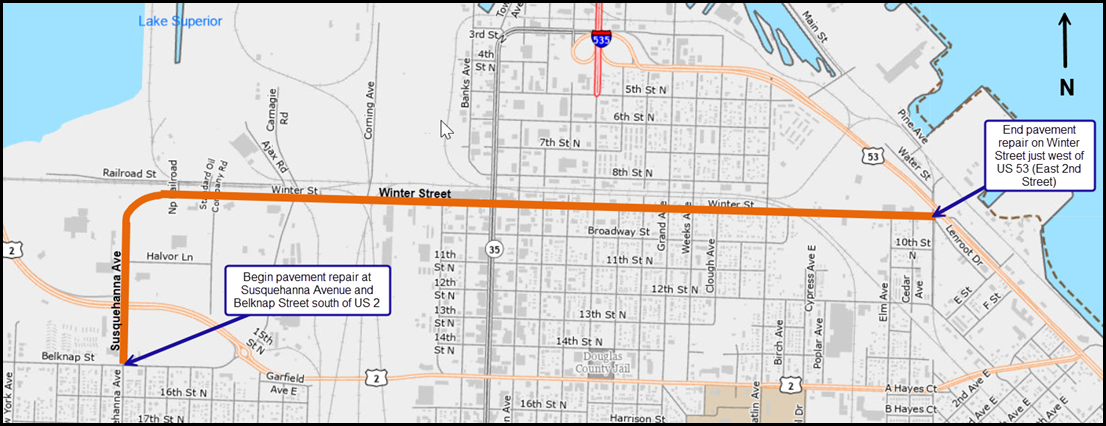
Construction is expected to start in mid- to late September on a resurfacing project on Winter Street and a segment of Susquehanna Avenue as part of the Blatnik Bridge replacement project.
The bridge is anticipated to close to traffic in early 2027. Once that happens, traffic will be detoured via US 2 (Belknap Street) and the Bong Bridge.
To minimize traffic impacts during the bridge closure, Winter Street, along with Susquehanna Avenue from Winter to Belknap Street, are being improved and signed in 2026 as an alternate route to Belknap Street to minimize traffic impacts during bridge closure. This stretch currently functions as a US 2 truck route through the city of Superior.
Construction will include:
-
Removing a portion of the existing pavement on Winter Street and Susquehanna Avenue and placing a new layer of asphalt over the roadways.
-
Adding a left-turn lane for northbound traffic at Susquehanna Avenue at the on-ramp to westbound US 2.
-
Adding pavement markings to delineate additional turn lanes, as room allows, along the corridor.
In addition, a temporary traffic signal will be added at the Winter Street and Grand Avenue intersection. The signal will be removed when the new Blatnik Bridge reopens.
As part of the traffic signal installation at Winter and Grand, a railroad pre-emptive interconnect system will be installed, working in tandem with the traffic signals to ensure that the traffic signals at Winter do not inadvertently cause cars to be backed up on the railroad tracks.
This interconnect will be installed by the contractor in coordination with the railroad companies. Coordination of this effort is still ongoing, and the exact timing of turning on these signals is still unknown. The intent is to turn on these signals as soon as the bridge closes, but there may be delays pending final coordination.
WisDOT considered installing traffic signals along Winter Street at the Catlin Avenue intersection; however, after further discussions with the railroad and evaluation of the traffic system interacting with the railroad crossings, it was determined the travel-time delay due to the signals would be greater than a two-way stop along Winter Street. Stop signs will be reconfigured at the intersection to stop traffic on Catlin.
The other traffic signal systems along Winter Street at Hammond and Tower avenues will remain as is, but there will be some minor signal modifications to increase visibility of those signal systems to drivers along Winter Street.
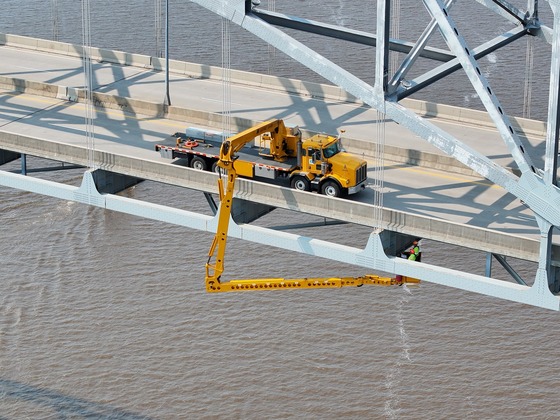
The Blatnik Bridge got a thumbs up at its last scheduled inspection before being demolished next year. MnDOT and WisDOT are replacing the aging structure with a new bridge over the next several years.
Most state-maintained bridges are inspected every two years, but since Blatnik has been load restricted and deteriorating, it is inspected each year. MnDOT crews worked for two weeks on approach spans and the main span, comparing infrastructure to how it looked last year. Routine inspections help ensure safety and monitor the effects of traffic, weather and other elements on bridge structures.
“We didn’t find anything concerning,” District 1 Bridge Supervisor Rob Ronning said. “There were no changes from our last inspection.”
Each year, crews reference documentation of what was found during the previous year’s inspection and compare it during the current inspection. Crews use drones for inspections on pre-cast bridges, but steel bridges are more hands-on, including the Blatnik Bridge. The use of drones improves safety since one lane of traffic does not need to be closed on bridges. They also save time because fewer people are needed, and therefore maintenance staff can do other work instead of protecting closed traffic lanes.
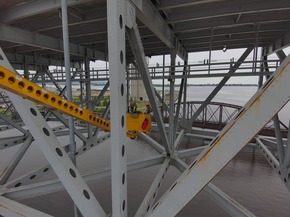
MnDOT inspectors used a snooper truck on the Blatnik Bridge inspection. It allows inspectors to reach high or difficult areas to access underneath the bridge, using a multi-jointed arm with a basket attached to hold the bridge inspectors. The equipment allows the inspection team to maneuver under the bridge while the truck is parked on the bridge deck.
MnDOT maintains about 20,000 bridges statewide.
|
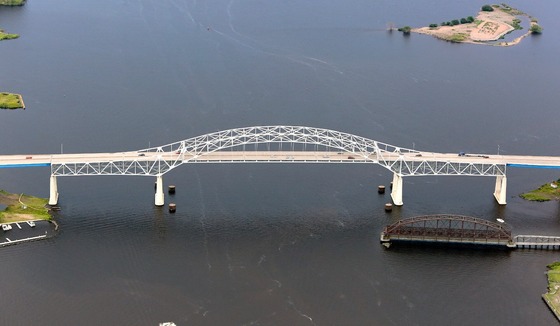
The first car crossed the new High Bridge connecting Duluth and Superior before noon Saturday, Dec. 2, 1961, immediately after a ribbon-cutting ceremony on the high center span.
Between then and noon on Monday, Dec. 4, 1961, traffic counts were up to 51,000 vehicles after a peak of 29,778 between 3 p.m. Saturday, Dec. 2 and 3 p.m. Sunday, Dec. 3, according to Eugene Riser, the district traffic engineer of the Minnesota Highway Department, in a Dec. 5, 1962, article in The Evening Telegram.
One month after the structure’s opening, 9,000 to 10,000 vehicles per day were using the new river crossing, according to Riser in a Jan. 2, 1962, article in The Evening Telegram.
In comparison, Riser said:
-
The Interstate Bridge - the structure replaced by the High Bridge - was used by 6,000 to 7,000 vehicles per day before it was barricaded to traffic, and the new bridge opened.
-
Traffic on the Arrowhead Bridge, the only remaining toll bridge in the area at that time, was down about 40 percent, or 1,000 vehicles per day.
-
Traffic on the Oliver Bridge remained the same.
Renamed the Blatnik Bridge in 1971, the bridge carries about 33,000 vehicles per day today.
Once the Blatnik Bridges closes in 2027, traffic will be detoured via the Bong Bridge, and the Oliver Bridge, which carries train and motor vehicle traffic, will remain another option for motorists wanting to cross the St. Louis River between Minnesota and Wisconsin.
More information
For more project information, please visit the project website.
Have a story idea or a question you'd like more information about? Email us.
Sign up for project email updates.
|