D1 - I-535 Blatnik Bridge in Duluth: 2027 construction
 
The ups and downs of funding for the Blatnik Bridge project have been in the news over the last month. The grant amendment has been signed, and Minnesota and Wisconsin have received the needed funding for the project.
Minnesota and Wisconsin have each earmarked $400 million for the project. The two states also received a $1.058 billion bipartisan-supported federal grant in January 2024, but as of early March this year, the U.S. Department of Transportation had not acted on executing the amendment that would release the grant funding. Construction could not begin without the execution of the amended grant agreement from the Secretary of Transportation.
Several elected officials released comments in early March, trying to pressure the USDOT to sign off on the amendment so construction of the new bridge would not be delayed and so there would not be a large increase in cost or disruption to the project schedule.
On March 18, the amendment was signed, and funds were released to the Blatnik Bridge project. This did not cause any delay in the project, and the timeline has stayed the same.
Bids will be received and opened this June, and the successful contractor will begin work this fall. The bridge is still planned for closure in early 2027. Once a contractor is on board this summer, MnDOT and WisDOT will be able to provide more detailed information on schedule and design.
Editor’s note: This is the final story in a series of three, sharing the process of how we got to where we are today on the Blatnik Bridge project. In February, we talked about determining the purpose and need statement for the project, and March included information on the NEPA process and narrowing down the alternatives.
After completing the NEPA process, the Blatnik Bridge project moved into preliminary engineering phase. In 2024, the team focused on field investigations and planning for construction. Here’s what was done and what’s coming next.
Field investigations
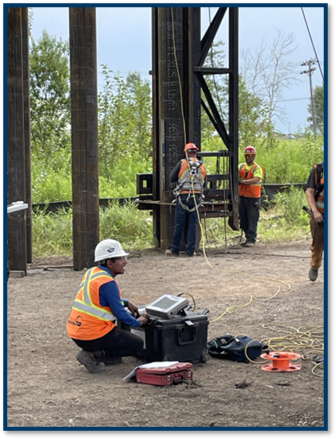
From June to December 2024, crews worked on several important tasks:
- Pile load testing at six locations to understand soil strength and support needs
- Excavating select future pier locations for the new bridge
- Building an access road on Connors Point to support future construction
- Geotechnical borings to study soil conditions
- Testing for contaminated material to plan safe construction methods
Foundations
Crews investigated 22 locations for bridge foundations. The goal is to design footings that are perched — sitting higher rather than fully buried — to reduce contact with contaminated soil and water.
Structures
Work on the bridge design included:
- Creating a preliminary bridge plan
- Studying pile corrosion to ensure long-term durability
- Coordinating permits with agencies
- Conducting a peer review comparing two main span concepts: a tied-arch vs. a cable-stay design
- Developing a visual quality manual to guide the look of the bridge
- Preparing cost estimates for multiple design options
Traffic management
Planning for traffic during construction is a science but also some guesswork. While the two states can plan ahead for traffic impacts, this will be an ongoing analysis as the project progresses. The process has included:
- Identifying congestion hot spots expected when I-535 closes
- Modeling traffic patterns to predict delays
- Beginning corridor planning to keep traffic moving through the Belknap corridor
- Planning upgrades to Winter Street in Superior including resurfacing and temporary signals
- Planning two temporary traffic signals on 46th Avenue West in Duluth
These investigations and studies will help finalize the bridge design and construction plan. The team is working to minimize environmental impacts, keep traffic flowing and deliver a safe, 100-year bridge for the future.
 Construction season is underway.
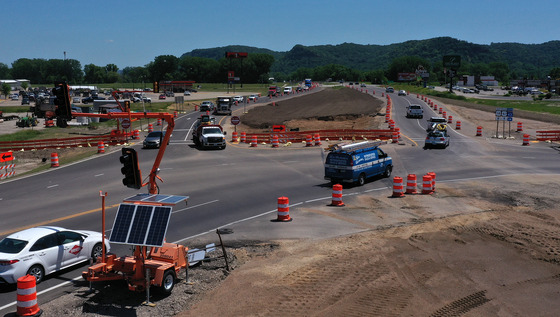
The 2026 construction season includes more than 600 road and bridge improvement projects between the Minnesota and Wisconsin Departments of Transportation to modernize the states’ transportation systems, enhance safety and mobility for all road users, continue to spur economic growth across both states and support jobs.
To help make sure those are completed without a hitch, travelers across both states need to do their part as Minnesota and Wisconsin each reported more than 2,000 work zone crashes in 2025.
Motorists should always be prepared to encounter traffic changes when approaching work zones including lane closures, lane shifts, uneven road surfaces, slow-moving heavy equipment and slow or stopped traffic. To keep everyone safe, drivers must:
- Obey posted speed limits, which are often reduced in work zones.
- Drive undistracted. Avoid using cell phones or other mobile devices, adjusting the radio and even eating while in work zones.
- Move over. Give workers room to safely complete their work.
-
Be patient and expect delays, especially during peak travel times.
-
Use the zipper merge.
-
Avoid making unnecessary lane changes.
-
Never enter a road blocked with barriers or cones.
-
Know before you go. Get real-time information about traffic and road conditions at www.511mn.org or https://511wi.gov/ or get the free 511mn or 511 WI smartphone app.
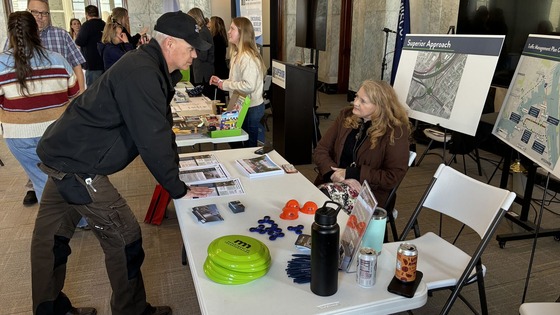 Christena O'Brien, WisDOT, speaks with a member of the public about the Blatnik Bridge project. Below: Business owners participate in a Marketing Resource Fair on March 23.
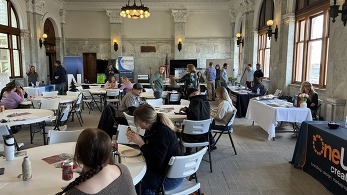
Members of the Blatnik Bridge team participated in the Superior Business Improvement District and Twin Ports Business Alliance's Marketing Resource Fair on March 23. The event was held to help businesses ensure they have the tools to remain visible and competitive during bridge construction.
The Blatnik team provided handouts, postcards and magnets with project information. They also answered questions and stayed connected with Twin Ports businesses.
Let us know if you have an event you'd like the Blatnik team to attend and provide information on the project.
|
 Stock photo
As work on the Blatnik Bridge replacement moves forward, the Minnesota and Wisconsin Departments of Transportation are also focusing on the well-being of the people who make infrastructure projects possible.
Construction workers across the country face some of the highest mental health risks of any profession, with suicide rates four times higher than the national average. Minnesota and Wisconsin see similar trends, where about 1 in 5 adults experiences a mental health challenge each year. Strengthening support for workers is an important step toward addressing these needs.
The Associated General Contractors of Minnesota Foundation has received a $450,000 grant from the Minnesota Department of Labor & Industry to expand statewide efforts that address mental health and suicide prevention in the construction industry. The funding supports the Minnesota Construction Mental Health Alliance, a coalition working to make mental wellbeing a routine part of jobsite safety.
The initiative will advance three focus areas:
• Expanded suicide prevention training through VitalCog in construction
• A new multilingual mental health curriculum for apprenticeship programs
• Leadership development and systems‑wide change through the Alliance
As the Blatnik Bridge project continues, these efforts reflect a shared commitment to safe and healthy worksites. Supporting worker wellbeing helps build successful projects and stronger communities.
To learn more visit: constructionmentalhealthmn.org.
Where will traffic be rerouted if a crash or weather close the Bong Bridge?
The Blatnik project team is coordinating with emergency responders in Minnesota and Wisconsin to minimize such impacts and to develop a plan in advance of the Blatnik closure.
In the unlikely event a closure of the Bong Bridge would be necessary, the closest two alternative crossings are southwest of the Bong Bridge – the Oliver Bridge, which carries Minnesota Hwy 39 and Wisconsin Hwy 105 over the St. Louis River, and an unnamed bridge that carries Minnesota Hwy 48 and Wisconsin Hwy 77 over the St. Croix River between Hinckley, Minn., and Danbury, Wis.
What are/were public input opportunities?
MnDOT and WisDOT have hosted multiple public meetings since project planning began in 2020. The public was also invited to contribute feedback throughout the Environmental Assessment (NEPA) process, which included studying bridge alignment alternatives.
Every in-person public meeting included a recording posted online for those who were unable to attend in person.
The team is out and about in the Twin Ports communities, sharing information on the project and answering questions. Reach out to request a presentation or with any questions you have on the project.
There will be many more opportunities to attend public meetings in the future.
For more FAQs, visit the project website.
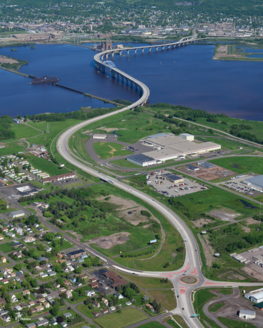
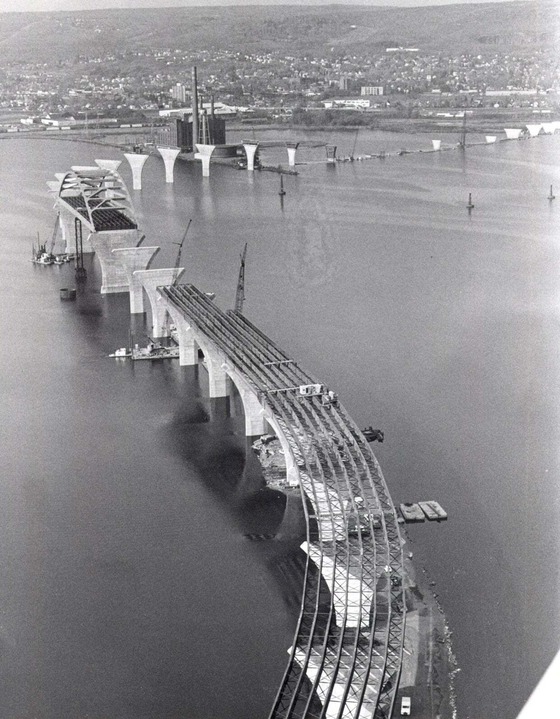 The Richard I. Bong Bridge was built to replace the Arrowhead Bridge. Below, the completed bridge and Wisconsin approach.
Ground was broken on what would become the Richard I. Bong Memorial Bridge in September 1979 to replace the aging Arrowhead Bridge and relieve increases on traffic on the Blatnik Bridge, which had opened to traffic 18 years earlier.
The Wisconsin Department of Transportation designed the steel tied-arch span of the structure, and Ayres Associates was selected in 1976 to design the rest of the bridge and provide oversight for the four-year construction of the nearly $70 million project. At the same time, the bridge had to be designed to accommodate the large shipping vessels using the harbor to access Lake Superior.
The 1.5-mile bridge rises some 120 feet over the water’s surface. More than 80 percent of the structure is on a horizontal curve, so it is designed to allow ships to approach the bridge straight on instead of at an angle to the river’s flow. Guides embedded into the river bottom prevent ships from colliding with the structure.
The bridge rests on 43 champagne-glass-shaped piers to help stabilize the structure during high winds. Piers are supported by steel pilings under the riverbed, some of them 280 to 290 feet below the surface. In addition to the two lanes of traffic in each direction, the bridge features an 8-foot emergency lane, providing motorists room to pull out of traffic in case of mechanical failure or accident.
The 2014-2015 rehabilitation was the first major project to be completed on the Richard I. Bong Memorial Bridge since its construction.
|
More information
For more project information, please visit the project website.
Have a story idea or a question you'd like more information about? Email us.
Sign up for project email updates.
|