D1 - I-535 Blatnik Bridge in Duluth: 2027 construction
 
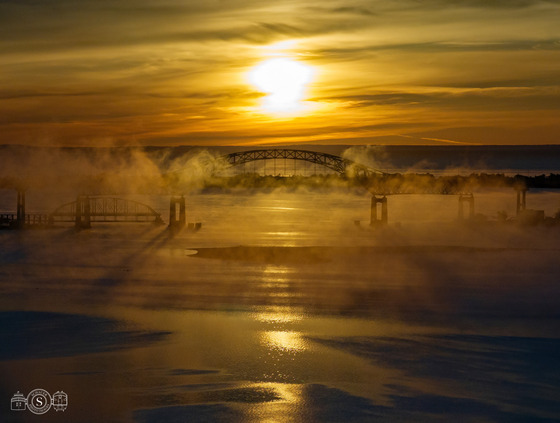 Photo by Schauer Photo Images
Editor’s note: This is the first story in a series of three, sharing the process of how we got to where we are today on the Blatnik Bridge project.
When the Blatnik Bridge opened to traffic in 1961 – then known as the High Bridge – four lanes of traffic stretched across the bay. Today that same bridge carries about 33,000 vehicles every day. Like any structure – especially one in Minnesota weather – time, weather, and wear have taken their toll over the past 65 years. It is currently rated “poor” and nearing the end of its service life. It could close as early as 2030 if it isn’t replaced.
That doesn’t mean we’ve ignored it over the years. MnDOT has worked hard to keep the bridge safe:
- 1994: Widened to add shoulders
- 2008: Made emergency gusset repair and lowered weight limit to 80,000 pounds (It was originally built for 154,000 pounds.)
- 2012–2013: Completed more maintenance; removed weight limit
- 2016: Made emergency repairs; lowered weight limit to 104,000 pounds
- 2019: Lowered weight limit to 80,000 pounds again, where it remains today
The bridge is inspected every year (most bridges are checked every two years) and remains safe for travel.
So why not replace it sooner?
The Blatnik Bridge and the Twin Ports Interchange in Duluth were built around the same time, so both needed major work. Replacing them together would have caused major traffic headaches and huge funding challenges. MnDOT prioritized the interchange first and is now focused on the Blatnik.
Where did we start?
Planning for the future of the Blatnik Bridge has been a big job. In 2020, Minnesota and Wisconsin DOTs started looking at everything—repairing the bridge, replacing it, building a tunnel under the bay, even considering different routes. The states follow the National Environmental Policy Act (NEPA) process, which requires studying how projects affect people, health, and natural resources. It also includes public input every step of the way.
Part of the NEPA process includes defining a purpose and need statement to use as a guideline for the future of the project. The project purpose and need statement explains why a project is being proposed and what problem it aims to solve. The purpose and need statement also went through the public participation process.
Purpose statement: “Provide an interstate highway connection across the St. Louis Bay that does not restrict the movement of freight and provides local, regional, and international movement in a reliable and efficient manner.”
The deficiencies of the existing bridge, listed below, were the primary focus for both states in addressing the needs of the new bridge.
- Poor condition of the bridge
- Bridge conditions hinder vehicle and freight mobility
- Design deficiencies impair traffic operations
- High crash rates on the bridge, approaches and access interchanges
- No bicycle or pedestrian facilities on the existing bridge
Next month’s Part 2 of the series will cover the alignment options and more on the NEPA process.
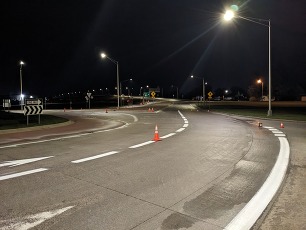
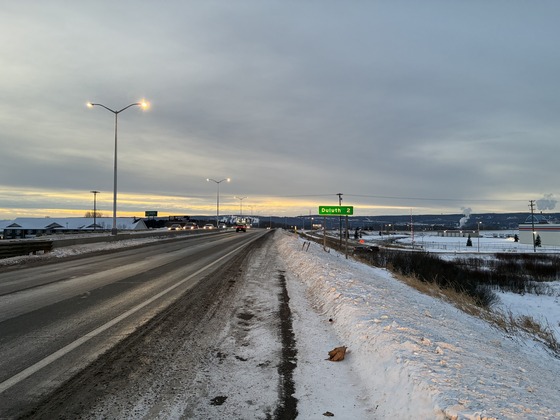 New streetlights were installed on the Wisconsin side of the Bong Bridge Dec. 10-11. Below: The roundabout on Hwy 2 in Superior got new pavement markings as part of the Bong Bridge rehabilitation project.
Construction on a project rehabilitating the Bong Bridge, which carries Hwy 2 over the St. Louis River between Superior and Duluth, was completed last month.
The Bong Bridge, which opened to traffic in 1984, will serve as the detour route during the closure of the Blatnik Bridge. To make sure the bridge is ready for additional traffic, the Wisconsin Department of Transportation-led project included the following work:
- Painting spot locations of the existing steel arch structure of the center span
-
Making concrete surface repairs at spot locations of the two piers that support the center steel arch structure
-
Removing and replacing the rubber strip seals of the center tied arch
-
Applying a concrete sealer to the entire deck, including the Minnesota ramps
-
Placing new pavement markings on the entire bridge, Minnesota ramps and Wisconsin approach
-
Replacing street lighting on the Wisconsin approach
-
Replacing street lighting on the Minnesota half of the structure, including on the Minnesota ramps
-
Installing lighting on the ramps was completed in late December. Installing lights on the Minnesota side was completed in January
|
 A snapping turtle swims around under the ice of a wetland in Minnesota.
Minnesota and Wisconsin are home to an incredible variety of wetlands—from marshes and swamps to bogs and wet meadows. These natural areas quietly perform some of the region’s most important work. They filter and clean our water, reduce the impacts of storms and flooding, support fishing and outdoor recreation, and provide habitat for countless species of birds, fish, and wildlife.
As planning continues for the Blatnik Bridge replacement, protecting these sensitive environments remains a top priority. MnDOT and WisDOT are carefully identifying and mapping wetlands near the project area to ensure construction activities avoid or minimize impacts. This early work helps both states make informed decisions and preserve the ecological health of the St. Louis River estuary.
The project team will follow all federal and state wetland regulations and obtain necessary permits for the project. In addition, the agencies are coordinating closely with the Minnesota and Wisconsin Departments of Natural Resources, the Minnesota Pollution Control Agency, and the U.S. Army Corps of Engineers. This collaborative approach ensures that the bridge replacement moves forward responsibly while preserving wetlands that make our region resilient, vibrant, and unique
Learn more about MnDOT’s work with wetlands: Wetlands - Environmental Stewardship Learn more about WisDOT’s environmental efforts: Wisconsin Department of Transportation Wetland and Waters
Wetlands play a vital role in keeping our communities safe and our ecosystems thriving. Feb. 2—World Wetlands Day—offers a reminder of why these landscapes deserve attention and care all year long.
How are MnDOT and WisDOT paying for the project?
The total project cost estimate for replacing the Blatnik Bridge is $1.8 billion. In early 2024, MnDOT and WisDOT received $1.058 billion in federal funding in bipartisan IIJA funds from the Multimodal Project Discretionary Grant under the MEGA and INFRA program categories. The two agencies will split the remaining costs and have earmarked $400 million each for the project.
What is the timeline for new construction?
Preliminary design continues from now until mid-2026, final design is 2026-27 and phased construction is fall of 2026-32. There will be a complete bridge closure for approximately 4-5 years beginning in early 2027. This timeline could change once a contractor is hired this summer.
For more FAQs, visit the project website.
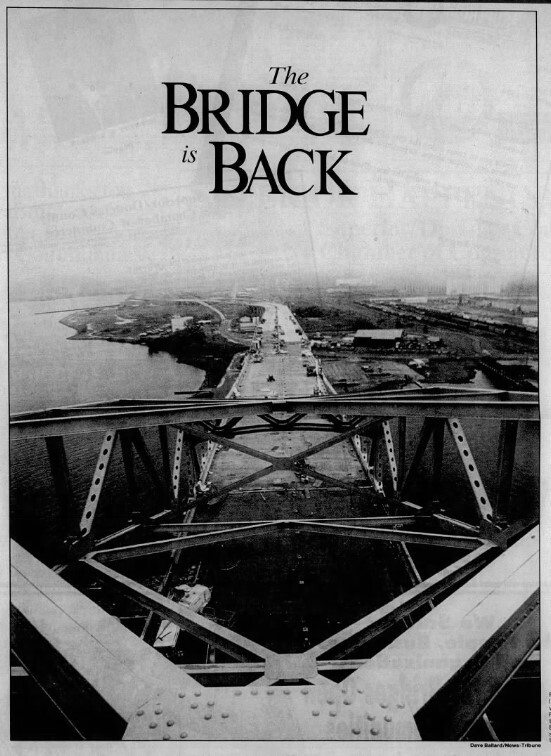 On June 26, 1994, the Duluth News Tribune included special coverage of the Blatnik Bridge improvement project as construction on phase 2 was coming to a close.
Replacing the Blatnik Bridge will result in full closure of the close to 8,000-foot structure. It won’t be the first time the bridge has been closed for an extended period.
Construction on the bridge began in November 1958, and the new St. Louis River crossing opened to traffic on Dec. 2, 1961.
Thirty-one years later, work began on a three-phase multi-year improvement project:
-
Phase 1: Work included making substructure repairs and widening pier caps.
-
Phase 2: Work included removing and replacing the entire bridge deck and widening the structure. During this phase, each side of the Blatnik Bridge was widened from 27 feet 9 inches to 35 feet. This provided for two 12-foot driving lanes with 8-foot shoulders on the outside of the structure and 3-foot shoulders on the inside. The project also featured median-mounted lighting.
-
Phase 3: Work included painting the massive structure.
Construction on the entire project began in 1992 and was completed in the late 1990s. The first and last phase had no significant traffic impacts. However, phase 2 required closing the bridge for nine months. It reopened to traffic the week of June 26, 1994.
More information
For more project information, please visit the project website.
Have a story idea or a question you'd like more information about? Email us.
Sign up for project email updates.
|