|
Transportation Research Update

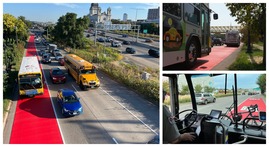
MnDOT research has developed a modeling tool that identifies the bus route segments that would benefit most from the installation of a dedicated right of way (ROW) for buses. Transit service reliability is one of the most requested service improvements. By implementing a transit ROW where needed most, MnDOT can improve transit reliability and better serve riders who use transit to commute to work, complete errands and engage with the community.
This project analyzed bus route reliability and contributing factors, such as traffic lights and traffic volume, to better understand where low reliability service occurs and if an ROW would be beneficial. Test results indicated that an increased ratio of bus lanes and busways led to more reliability, but only when the ratio exceeds 20%. Other factors associated with more reliable transit service are higher free-flow speeds, fewer traffic signals and longer route segments. Additional analyses identified specific route segments along several service corridors that would benefit most from an ROW.
For the interactive experience, including maps, go to Value of Dedicated Right of Way
|
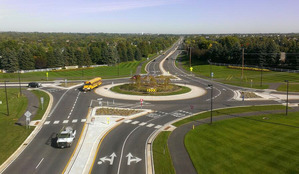
Compared to other types of intersections, roundabouts have been shown to significantly decrease severe crashes, including those involving pedestrians and bicyclists. But some pedestrians still have safety concerns. MnDOT and local transportation agencies sought to better understand driver behavior toward pedestrians and bicyclists to enhance safety for all road users at roundabouts.
Researchers analyzed driver yielding behavior in nearly 3,000 interactions with pedestrians or bicyclists at 16 roundabouts in Minnesota. In both urban and suburban settings, the roundabouts varied in number of lanes, speed limits and traffic volumes. Researchers identified the factors corresponding to higher yielding rates, such as roundabout size, number of lanes and location of crosswalks. The project’s insights will guide local agency and MnDOT efforts to optimize pedestrian and bicyclist safety in designing and managing roundabouts.
|
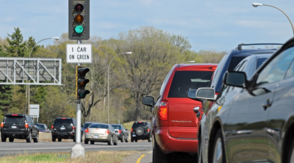
While automated vehicles (AVs) have the potential for improving safety and mobility, their transition into widespread use may be accompanied by inefficiencies throughout the transportation landscape. This project examined the effects of AV features such as adaptive cruise control on traffic flow and ramp meter operations. Results of simulations showed that traffic flow performance decreased with vehicles operating adaptive cruise control. But MnDOT could counter some of the negative impacts of AV features by adjusting the ramp metering algorithms.
|
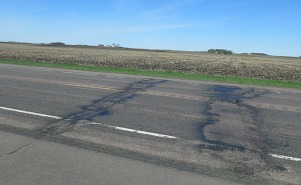
Study results confirm that MnDOT’s actions to repair deteriorating concrete roads have a measurable positive effect on road surface conditions. Using metrics for road smoothness and rider perception, researchers compared these ratings to the timing of repair efforts by the agency, noting an uptick after work was completed.
The cause of the pavement deterioration, found in roads built in the 1980s and 1990s, is a chemical interaction between alkali and silica, two components in concrete mixtures. The alkali-silica reaction occurs when moisture is present, causing stress within the concrete that leads to cracking and progressive, irreversible damage.
|
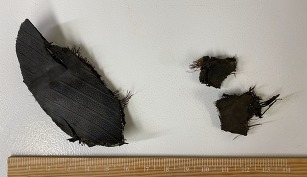
Repurposing old tires as tire-derived aggregate (TDA) is a cost-effective stormwater management practice. TDA adsorbs phosphate, preventing it from reaching soil and water sources. This project analyzed the environmental and fiscal impacts of deploying TDA as a stormwater management strategy. Results of laboratory tests showed effective adsorption of phosphate and growth of biofilm on TDA, which can retain much of the zinc, copper and iron released from TDA. Fiscally, installing TDA for stormwater management rather than disposing tires in landfills can reduce the lifetime costs of the material and add value by $273 per ton.
|
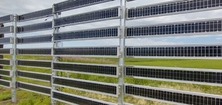
A recently installed solar snow fence demonstrated its functionality in winter weather conditions and generated enough power over 18 months to serve an average-sized family. A 100-foot snow fence fitted with solar panels was monitored for temperature, moisture, solar intensity, wind speed, and electrical voltage and current. Economic viability scenarios focusing on construction costs, and generated energy analyzed the financial feasibility of future installations.
Implementation results showed the fence generated 10 to 30 kWh per day with a payback period of approximately 11 years. The solar snow fence outperformed a traditional snow fence at managing drifting snow due to its lower porosity and higher stiffness. The length of the fence is a critical factor for economic viability, as those measuring at least one mile will benefit from economies of scale. Design improvements such as longer solar panels, fewer posts, and a better connection between the solar panel and the steel post will lower costs and potentially reduce the payback period to five years.
|
Research Radar: Traffic & Safety
Virtual webinar: August 21, 10-11 AM
Join MnDOT's Office of Research & Innovation and the Minnesota Local Road Research Board for this month's Research Radar: Traffic & Safety. In this webinar, we'll feature the following projects:
|
|
If you need an ASL, a foreign language interpreter, or documents in an alternative format please contact Janet Miller at 651-366-4720 (711 or 1-800-627-3529 for MN Relay). If you need any other reasonable accommodation to participate, please email your request to ADArequest.dot@state.mn.us. |
|
|
|