|
Transportation Research Update

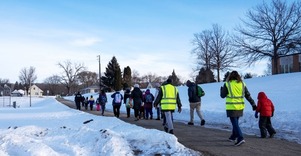
Recent research has determined that early school start times do not discourage students from walking or biking to school. A stated preference survey distributed to parents and caregivers of elementary school-age children in the Minneapolis/St. Paul area asked parents and caregivers how their children commuted to school and to rank factors (including start time) that impacted if their children walked or biked to school. Mobile-sourced data based on smartphone tracking also indicated if a student walked or biked to school.
Study results showed that students actually walked or biked more in February, when the sun rose later, than in September. Parents and caregivers also indicated that distance was the top factor for whether a student walked or biked to school followed by the student’s age, presence of comfortable commuting options such as sidewalks and bike trails, and difficult or high-traffic road crossings. Traveling to school before sunrise or after sunset ranked sixth out of 11 choices.
|
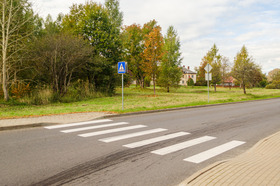
With increasing trends and public requests for crosswalks, agencies are seeking resources on best practices for pedestrian crossings to improve safety, comfort, and consistency of the transportation network. This guidebook provides a comprehensive overview of rural pedestrian crossings for both pedestrians and drivers by examining Minnesota statutes, summarizing key features of pedestrian crossings, synthesizing findings from existing research reports and studies, and integrating other relevant resources.
|
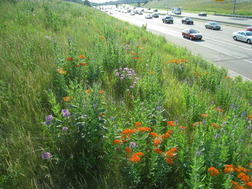
New research has developed guidance for MnDOT and local transportation agencies to establish roadside vegetation growth after road construction projects. These projects often damage roadside vegetation, which is important for managing stormwater, limiting erosion and improving soil stability. This project analyzed the effectiveness of adding organic and proprietary amendments to roadside topsoil to rapidly reestablish vegetation.
Researchers measured the impact of these amendments on the physical, chemical and biological properties of roadside soils, along with plant biomass and coverage, to determine combinations and blends that provide the nutrients needed for rapid vegetation establishment. The project involved extensive soil and amendment analyses; greenhouse experiments, including a study that simulated the effects of rainfall; and field studies on nine experimental plots. Results provided recommended amendment application rates to balance vegetation growth with water quality considerations. The recommendations will be incorporated into guidelines to promote cost-effective implementation.
|
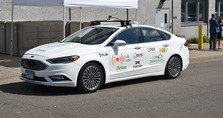
Our colleagues at Destination CAV recently published project summaries of their research into connected and automated vehicles in the MnDOT Digital Library. Please take some time to browse through them and see what they have been doing. |
|
 |
Project Summaries
-
May 2, 2025, NBER Spring 20205 Conference, Economics of Transportation in the 21st Century (livestreamed on YouTube)
-
May 6, 2025, 9:15–11:30 a.m., CTS Seminar: Unpacking Freight: Routing, VMT Reduction, and Curb Management (in person at McNamara Alumni Center, UMN)
-
May 23, 2025, 1:00–2:30 p.m., CTS Webinar: Freight and Commercial Vehicle Safety in Roundabouts
-
August 5th, 2025, Bolton & Menk: 2025 Salt Symposium (livestream only)
-
Aug. 25 to 27, 2025, 2025 MAASTO Annual Conference
|
|
If you need an ASL, a foreign language interpreter, or documents in an alternative format please contact Janet Miller at 651-366-4720 (711 or 1-800-627-3529 for MN Relay). If you need any other reasonable accommodation to participate, please email your request to ADArequest.dot@state.mn.us. |
|
|
|