|
State and local governing boards selected 26 new university research proposals for funding next fiscal year in response to needs identified by transportation practitioners. See project awards.
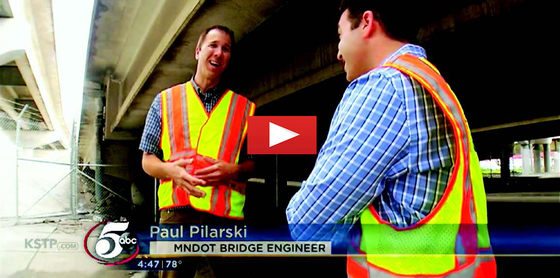 Salting roadways during Minnesota winters can cause significant corrosion to bridges. In 2013, crews encountered two severely deteriorated concrete beams on the Highway 169 Nine Mile Creek Bridge. To repair the girders, MnDOT tried a novel method developed in Michigan: placing steel reinforcement cages around the damaged beam ends and encasing the ends in concrete through a process called "shotcrete." Researchers found the strength of the repaired beams not only met but exceeded the strength of undamaged beams. Learn more at “Affordable Bridge Girder End Repair Method Restores Concrete Beams.”
|
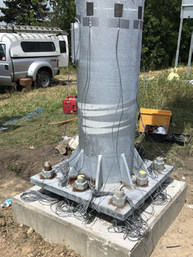
BRIDGES & STRUCTURES — Installers and inspectors in Minnesota follow national guidelines for tightening anchor bolts on signs, lightpoles and traffic signals. Still, field crews find loose nuts on roughly 20 percent of these bolts at any given time. At this rate of loosening, crews would have to inspect the entire system annually. To determine why these bolts were loosening on MnDOT structures, researchers surveyed maintenance staff and observed installation and retightening practices in Iowa and Minnesota.
Learn more at "Answers To National Problem of Loose Anchor Bolts on Overhead Signs and Light Poles.”
|
|
 |
 BRIDGES & STRUCTURES – Since 2015, MnDOT has used unmanned aircraft systems (UAS) to inspect more than 60 Minnesota bridges, developing procedures and perfecting techniques for inspecting structures in award-winning research projects. Phase III of an ongoing research effort evaluated a drone that flies within a protective rolling cage to take readings and videos in confined spaces.
TECHNICAL SUMMARY 2018-26
|
|
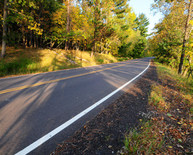
MAINTENANCE – Maintaining the yellow centerlines and white edge lines on Minnesota's roads can strain the limited budgets of local agencies. A new decision-making tool can help decide which pavement markings are worth installing and maintaining. The spreadsheet tool and related materials are available at lrrb.org.
Learn more at "Prioritizing Pavement Markings on Low-Volume Roads."
|
|
 |
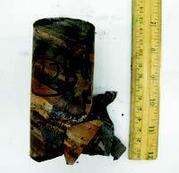 MATERIALS & CONSTRUCTION — Bridge designers needed data on hard rock that was too strong for MnDOT’s standard testing approach. Researchers used a high-capacity load frame to test rock samples from a site in northern Minnesota and to examine the stiffness characteristics of concrete-filled steel piles used throughout the state. The stiffness and strength information improves MnDOT’s rock database and was used in building a 204-foot-tall bridge—Minnesota’s highest—on U.S. Highway 53 between Virginia and Eveleth.
TECHNICAL SUMMARY 2018-19/20
|
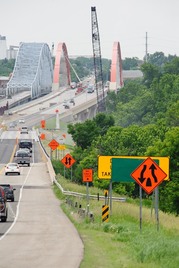 MATERIALS & CONSTRUCTION – Pavement engineers often explain the maintenance and construction needs of Minnesota’s highway system in terms of remaining service life (RSL), an estimate of years of service after which a road will require replacement or rehabilitation. MnDOT’s Bridge Office uses different ways to describe the needs of its 20,000 bridges. After studying national management approaches, researchers developed a revised version of RSL that fits pavements and bridges. Learn more at "New Measure Allows Comparison Between Bridge and Pavement Conditions."
|
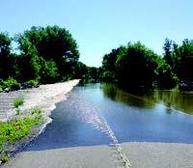
When road crews respond to natural emergencies, they require nimble fleets and thorough preparation. A recent report on resiliency and redundancy in transportation systems funded by a group of transportation agencies from Puerto Rico and 14 states, including Minnesota, emphasizes short-term event preparation and long-term climate change planning. Read more about the flash flood project and other programs on MnDOT’s climate change website, mndot.gov/climate. |
|
 |
 |
|
MnDOT Research Services recently completed a visioning session with agency stakeholders as the first step in implementing the recommendations of a recently completed research strategic plan. Research Services is developing a system that can track all the research conducted by MnDOT, as well as the outcomes of all the research. This information will aim to answer MnDOT senior leadership’s questions about the level and value of research investments and help guide future decisions. Learn more at "Implementation of Research Strategic Plan Underway." |
1/13-17
TRB Annual Meeting, Washington, D.C.
3/13-14
Minnesota Transportation Conference, St. Paul, MN
|