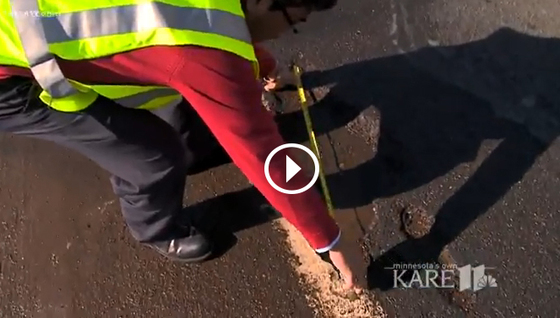
MATERIALS AND CONSTRUCTION — MnDOT research has produced a new flashcard-style guide that
includes a simple decision tree for evaluating potholes and selecting the
best repair method.
This guidance was informed by a two-year study of 20 pothole
repairs at five sites in northern Minnesota and a comprehensive literature
review that identified four repair methods best suited for Minnesota. The
research study aimed to identify the effectiveness of various methods in terms
of durability, road safety, ride quality, driver satisfaction and other
factors. Learn more in Technical Summary 2017-25.
Of course, the best way to fight potholes is to
keep them from forming. A newly-released MnDOT research report identifies critical
factors in pothole formation to identify solutions for both delaying their
formation and increasing the durability of repairs. One key recommendation:
Repair cracks early, before they become potholes! Technical Summary 2018-14
The
Transportation Research and Innovation Group (TRIG), the governing board for
MnDOT’s program, has selected eight new research implementation projects for
funding in fiscal year 2019. Among the requests was funding to develop a
user/policy manual and an inspection plan for bridges best suited for drone
use. See other approved projects.
 MATERIALS
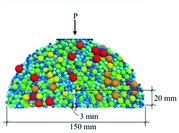
& CONSTRUCTION — To
improve pavement performance, engineers use additives to modify the asphalt
that binds the aggregate. Recent research shows that adding very small
particles (with a dimension of less than 100 nanometers) to asphalt mixtures
can improve performance. Using the results of laboratory tests and computer
modeling, researchers have developed a cost-effective method to determine the
optimum design of asphalt mixtures that are reinforced by graphite
nanoplatelets, which consist of graphite layers less than 10 nanometers thick.
Compared to mixtures with unmodified asphalt binders, mixtures with the right
amount of graphite nanoplatelets demonstrate significantly improved pavement
strength and fracture resistance.
Technical Summary 2018-02
|
 ENVIRONMENTAL – Environmental regulations require
culverts that allow fish to pass freely through them. Small migratory species
may have difficulty moving through culverts that are steep or have high-velocity
currents. MnDOT followed up on recent research from New Zealand to evaluate
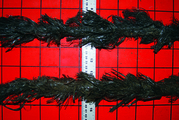
whether placing mussel spat rope in culverts would improve passage. Long, dense
fibers along the length of the rope reduce the current’s velocity and
turbulence, providing refuge for small fish as they pass through. This
low-cost, low-maintenance technique proved highly effective and will be
included in an upcoming guide for designing culverts in Minnesota that allow
aquatic organism passage. This project is only one of several recent MnDOT
studies into fish-friendly culverts. Read about the others in Technical Summaries
2017-44 and 2015-08.
Technical Summary 2018-13
|
 BRIDGES
& STRUCTURES –
Damage in reinforced concrete bridges often appears first at bridge joints, where
water can corrode reinforcing steel, cause concrete to flake or crumble, or
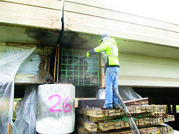
even lead to joint failure. Researchers used a bridge in Hopkins built in 1975
as a test case for an innovative technique to repair the damaged ends of these
girders. The method uses a reinforcement cage (pictured) and “shotcrete”
cement, which is sprayed from a hose. Testing repaired and unrepaired girders
from the bridge showed that this technique successfully repaired severely
deteriorated beam ends for a $5,000 to $10,000 investment. MnDOT is continuing
to refine this method and will continue to use the beam end repair method if
similar conditions are encountered in the state.
Technical Summary 2018-07
|
MATERIALS & CONSTRUCTION – MnDOT uses global navigation satellite system (GNSS) receivers to keep track of assets, take care of the environment and survey land before construction. Data from these receivers must be very accurate, and because of the high demands put on these devices, MnDOT must use models that often cost more than $10,000 each. However, new, compact receivers cost less than $1,000, so researchers tested these for accuracy while stationary or moving. They found that the lower-cost GNSS receivers performed well in certain applications, but the technology is not quite ready for use in safety-of-life applications that require centimeter-level accuracy.
Technical Summary 2018-10
 TRAFFIC
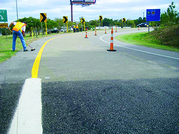
& SAFETY — The
Federal Highway Administration has recommended applying a polish-resistant
aggregate to pavement in areas with high friction demand such as curves and
other crash-prone areas. High friction surface treatments enhance skid
resistance, and MnDOT is exploring the best way to implement this technology on
state roads. In a recent survey of state departments of transportation known to
use these treatments, 15 respondents provided detailed information about their
state’s practices. Four states surveyed have installed high friction surface
treatments at 100 or more locations.
TRS 1802
|
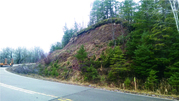 ENVIRONMENTAL – Roadside slopes susceptible to
failure have been mapped in Carlton and Sibley counties so that county highway
departments can develop preventive strategies for protecting roadways during
floods. After studying known slope failures to identify risk factors,
researchers used geographic information system technology and available data on
soils and hydrology to create the maps. Beyond providing a decision-making tool
for these two Minnesota counties, this project served as a proof of concept for
other counties.
MnDOT is building on these efforts with a
research project to identify, map and rank vulnerable slides that could impact
the trunk highway network. More at mndot.gov/research/ projects/slopes.html.
Technical Summary 2018-05
|
4/30
Abstracts due, CTS Research Conference
5/11
MnDOT and LRRB research ideas due for RFP
5/30
MnDOT research program governing board (TRIG) summer meeting, Arden Hills
6/20-21
LRRB and RIC summer meetings, Rochester
|