Lower Shore: Duluth to Two Harbors
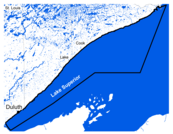
Surface water temps were 55-60 °F at all stations. Construction continues on Highway 61 at the McQuade intersection, and on Lighthouse Point Road in Two Harbors. Anglers reported a steady bite for 18-29 inch Lake Trout from all stations and good numbers of 15-19 inch Walleye near Duluth. There were also a few reports of 20-23 inch Chinook, but they were rare. Anglers near Duluth found success trolling spoons, stick baits, and smelt in 70-160 feet of water with fish favoring the lower part of the water column. Further north, anglers found success jigging on structure in 80-150 feet of water and trolling bright spoons, stick baits, and smelt in 100-250 feet of water with fish also favoring the lower part of the water column. On the St. Louis River Estuary anglers reported catching 15-19 inch Walleye and a few decent Muskies. Trolling stick baits and worm harnesses on the flats and jigging live bait on deeper structure was the most productive.
Upper Shore: Twin Points to Hovland
Surface water temps were 52-54 °F at all stations. Anglers reported improved fishing for Lake Trout, especially from Taconite Harbor and Grand Marais. Lake Trout were closer to shore this week, but still deep in the water column. Successful anglers presented green and chartreuse spoons on downriggers and lead core lines in 75-150 feet of water. Lake trout were typically 23-30 inches long. Only a few 20-22 inch Coho and Chinook Salmon were reported as well as some very small 8-12 inch fish Salmon. Most North Shore rivers were low and clear and only a few Pink Salmon were observed in the Brule, Cascade and Temperance Rivers.
Management Updates: Pink Salmon in Lake Superior
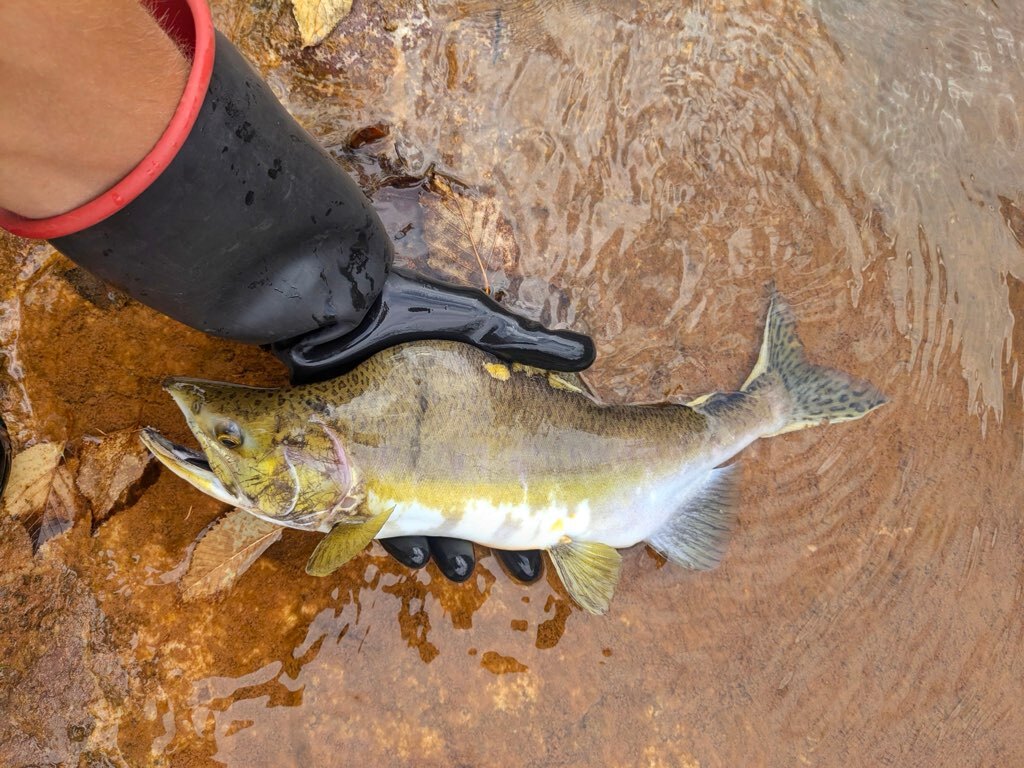
Pink Salmon first appeared in Lake Superior by accident in 1956, but they have proven far more adaptable than originally expected. After decades of low or fluctuating numbers, recent reports across the Great Lakes — including Lake Superior — indicate notable increases in Pink Salmon abundance, with strong year classes showing up in creel surveys and river traps. These regional trends mirror what is happening globally: in the Pacific Ocean, Pink Salmon are reaching record‑high abundance, especially during warm periods, and similar warming conditions in the Great Lakes may be supporting renewed growth in local populations.
One reason Pink Salmon can rebound quickly is their remarkable life‑history flexibility. Unlike Pacific populations that strictly mature at two years, Great Lakes Pink Salmon have adapted to mature at ages 1 through 4, allowing them to take advantage of favorable conditions. They also require very little spawning habitat compared to other salmonids. Pink Salmon can successfully spawn in short tributaries, small streams, and occasionally even along exposed lake shorelines. This ability to use minimal habitat — combined with their willingness to stray into new tributaries — makes them capable of expanding or re‑establishing runs across many Lake Superior streams.
Pink Salmon are also generalist feeders, consuming whatever forage is available. In Lake Superior, they feed on smelt, insects, zooplankton, and native amphipods such as Diporeia. Their flexible diet helps them persist through changing food‑web conditions and gives them an advantage during years when prey availability is low or shifting — conditions that are increasingly common with ongoing ecological change in the lake. This adaptability has helped support rebound years, even during periods when other salmonid species struggle for consistent growth.
Given warming lake temperatures, increasing observations across multiple tributaries, and the species’ proven adaptability, anglers should expect to continue seeing Pink Salmon during fall runs, primarily from September through mid‑October. While still a relatively minor component of the Lake Superior fishery, Pink Salmon represent an expanding and highly resilient species that may become more common during warm years and favorable environmental periods. Fisheries managers will continue tracking abundance trends and assessing interactions with other salmonids as climate‑related changes influence Lake Superior’s ecosystem.
See the recent news release highlighting Dr. Joe Langan’s work with the National Oceanic and Atmospheric Administration that looks at trends in the oceans and the Great Lakes https://www.noaa.gov/stories/pink-salmon-invasion-in-great-lakes-has-lessons-for-north-atlantic-arctic-communities or read the full publication https://onlinelibrary.wiley.com/doi/10.1111/faf.70084.
Helpful Links
 Questions?
Email us at Lake Superior fishing report
Give us a call at 218-302-3277
Report suspicious activity at 800-652-9093
Visit us online at mndnr.gov
If this message was shared with you, sign up to receive it at the link above or text MNDNR SUPERIORFISHING to 66468 to subscribe for text updates.
Message and data rates may apply. Message frequency varies. Reply HELP for help or contact support@Granicus.com. Reply STOP to cancel. To view terms and conditions and privacy policy visit: https://public.govdelivery.com/accounts/MNDNR/text-message
|