Lower Shore: Duluth to Two Harbors
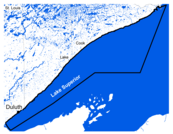
Surface water temps were 35-37 °F along the Lower Shore this week. Lake Trout fishing was fairly slow, but some anglers did well trolling flasher-fly rigs and spoons, 40-80 feet down, in 90-140 feet of water. Most anglers were able to catch a few Coho Salmon, and many were able to catch their limit, trolling stick baits 5-10 feet down in 80-140 feet of water. There were also several reports of anglers getting into decent numbers of nice sized Chinook Salmon, particularly closer to the South Shore and in Wisconsin waters. Most salmon catches were reported closer to the Duluth area, particularly out of McQuade, with additional catches reported near Knife River Marina. Targeting the edges of the stained water coming out of the St. Louis River can be a good place to start if you are not experienced. Fishing in the St. Louis River Estuary has been good for Walleye in the 16–26 inch range. Trolling stick baits and jigging on structure were the most productive this week.
Upper Shore: Twin Points to Hovland
Surface water temps were 33-34 °F along the Upper Shore this week. Despite decent weather conditions, fishing pressure was low this week and fishing was fairly slow. Silver Bay anglers caught fair numbers of Lake Trout jigging in 150-250 feet of water, near bottom structure. Grand Marais anglers reported fair numbers of smaller Lake Trout in the 18-20 inch range with the occasional large fish. Trolling flasher-fly rigs and spoons deep was the most common method with no colors reported as the most productive. No reports of any Salmon have been received yet. Salmon typically are not caught along the Upper Shore until water temperatures increase alter in the summer.
Management Update: Sea Lamprey Control
Fisheries management in the Great Lakes relies heavily on Sea Lamprey control. Without these annual efforts, Lake Superior's sport, commercial, charter, and tribal fishing opportunities would not exist today. While Minnesota’s North Shore streams generally lack ideal habitat for Sea Lamprey production, specific river systems like the Nemadji and tributary areas near the Lake Superior confluence still produce them. Special thanks to the Great Lakes Fishery Commission, US Fish and Wildlife Service, and Fisheries and Oceans Canada for their ongoing dedication to controlling this harmful invasive species.
U.S. Fish and Wildlife Service News Release May 21, 2026
Marquette Biological Station, 1095 Cornerstone Drive, Marquette, Michigan 49855
FOR IMMEDIATE RELEASE
Contact: Shawn Nowicki, shawn_nowicki@fws.gov, 906-226-1216
Sea lamprey control planned for Lake Superior tributary
U.S. Fish and Wildlife Service (Service) personnel will apply lampricides to tributaries of the Nemadji River (South Fork and Net River, Carlton County) to kill invasive sea lamprey larvae burrowed in the stream bottom. Applications will be conducted between June 2 - 11, 2026, in accordance with State of Minnesota permits. Application dates are tentative and may be changed based upon local weather or stream conditions near the time of treatment.
For more information on sea lamprey control in the Great Lakes visit fws.gov/invasive-sea-lamprey.
Sea lampreys are parasitic fish native to the Atlantic Ocean that invaded the Great Lakes via shipping canals in the early 1900s and remain a major threat to the fishery. They attach to fish with a suction-cup mouth lined with sharp teeth, feed on their body fluids and can kill up to 40 pounds of fish during their parasitic phase. Each spawning pair produces up to 100,000 eggs, with larvae living for years in tributaries before transforming into parasites that migrate to the Great Lakes to prey on host fish.
Infested tributaries must be treated on a regular basis with lampricides to control sea lamprey populations. Failure to reduce sea lamprey larvae populations in streams will result in significant damage to the Great Lakes fishery.
Extensive preparations and precautions are required to deliver a safe and effective stream treatment. Prior to treatment, trained personnel collect data on stream water chemistry and discharge. In addition, they may conduct on-site toxicity tests and streamflow studies using non-toxic dyes that make stream water appear red or green.
Lampricides are carefully metered into the stream for approximately 12 hours and continually analyzed at predetermined sites to ensure proper concentrations are maintained as they move downstream. Applicators are trained and certified by regulatory agencies for aquatic pesticide applications.
The U.S. Environmental Protection Agency and Health Canada Pest Management Regulatory Agency have reviewed human health and environmental safety data for lampricides and concluded that the lampricides pose no unreasonable risk to the general population and the environment when applied at concentrations necessary to control larval sea lampreys. However, as with any pesticide, the public is advised to use discretion and minimize unnecessary exposure. Lampricides are selectively toxic to sea lampreys, but some fish, insects, and broadleaf plants are sensitive. Persons confining bait fish or other organisms in stream water are advised to use an alternate water source because lampricides may cause mortality among aquatic organisms stressed by crowding and handling. Agricultural irrigation must be suspended for 24 hours, during and following treatment.
The sea lamprey control program is contracted through the Great Lakes Fishery Commission (Commission) to the Service and Fisheries and Oceans Canada. Established in 1955 by the U.S. and Canadian governments, the Commission began chemical control of sea lampreys in 1958 as a response to the catastrophic damage of their invasion. Since that time the highly successful program has contributed significantly to the maintenance of the $5.1 billion Great Lakes sport and commercial fisheries. For more information on the Commission, visit www.glfc.org.
The Service works closely with the U.S. Geological Survey to support research, such as the development of supplemental control techniques to be used in areas where lampricides are particularly challenging to apply. In addition, the Service maintains a partnership with the U.S. Army Corps of Engineers in developing a comprehensive barrier strategy for sea lamprey-producing streams, and is investigating barrier design, traps, attractants, and biological control as part of a robust research program administered by the Commission.
For additional information in Canada call 1-800-553-9091. To reach the Marquette Biological Station call 1-906-226-6571 or to reach the Ludington Biological Station call 1-231-843-7300.
For more information, questions about fisheries management in Minnesota waters of Lake Superior, or to suggest a topic for a Management Update, please contact Lake Superior Fisheries Supervisor Cory Goldsworthy at cory.goldsworthy@state.mn.us or 218-302-3268.
Helpful Links
 Questions?
Email us at Lake Superior fishing report
Give us a call at 218-302-3277
Report suspicious activity at 800-652-9093
Visit us online at mndnr.gov
If this message was shared with you, sign up to receive it at the link above or text MNDNR SUPERIORFISHING to 66468 to subscribe for text updates.
Message and data rates may apply. Message frequency varies. Reply HELP for help or contact support@Granicus.com. Reply STOP to cancel. To view terms and conditions and privacy policy visit: https://public.govdelivery.com/accounts/MNDNR/text-message
|