|
April 30, 2026
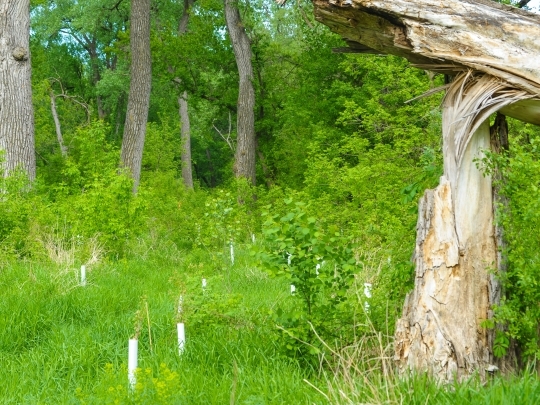 Photo courtesy of Rob Thoresen, Ruffed Grouse Society and American Woodcock Society.
The Minnesota Forest Resources Council passed a "Keeping Forests Forested" resolution at its March meeting. Adopted with unanimous consent, the resolution conveys the Council's support of policies, programs, and funding that provide enduring solutions to retain, restore, and sustainably manage public and privately owned forest lands.
"Among strategies the MFRC resolution broadly supports is voluntary landowner enrollment in property tax incentive programs that support forest management, such as Class 2c, as well as voluntary conservation easement protection programs, such as Forests for the Future," said MFRC Executive Director Eric Schenck. "When annual programs like Class 2c are combined with a conservation easement, enrolled forest lands can be perpetually protected and managed over multiple generations."
Read the MFRC's Keeping Forests Forested Resolution. Stay tuned to this newsletter for more discussion on forest conservation strategies.
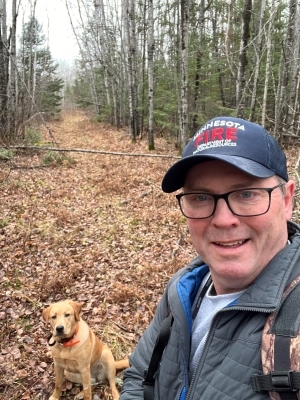
The MFRC welcomes Tom Radovich as its forest products industry representative. The Office of the Governor announced Radovich's appointment effective through Jan. 4, 2027.
"The MFRC has been instrumental in supporting forest policy that maintains a proper balance between all the stakeholders that utilize this wonderful natural resource," Tom said. "Minnesota's forests are a cornerstone of our economy and way of life in the Northland. I look forward to working with fellow MFRC members to advance sustainable forest management policies and showcase how our industry drives a renewable, circular economy that benefits everyone."
Tom is executive vice president of Minnesota Forest Industries and served as president of the MFI Board of Directors in 2023. Previously, he was managing director of Sappi Cloquet Pulp and Paper Mill in Cloquet.
Learn more about Tom and the MFRC’s 17 members who represent Minnesota's multifaceted, diverse forests interests.
|

Join us in welcoming Charlie Davis as our new forest policy administrator, beginning May 11. Charlie draws on more than 15 years of experience in strategic planning, policy development, economic analysis, public-private partnerships, and sustainable rural development to lead coordination of the MFRC's policy analysis and initiatives.
"I've been exploring and benefiting from Minnesota's forests since I was a toddler," Charlie said. "Taking on this new role, I'm eager to support the critical policy related work of the MFRC, helping conserve and manage forests in the state for the benefit of Minnesotans for generations to come."
Learn more about Charlie.
|
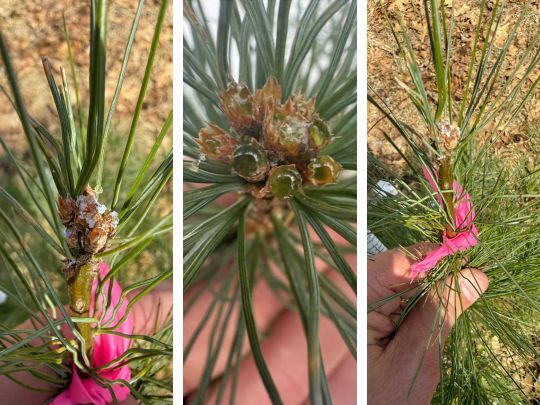 Last newsletter we shared a forest mystery from MFRC Family Forest Landowner Representative John Rajala who continues his investigation into what's been making a meal of his White Pine seedlings.
John offered updated photos of the partially consumed bud sections and the following inquiry:
"Not much has changed on the 'whodunnit' buds because they haven't started growing yet. They may, they may not. This is part one of the mystery: Is this type of "herbivory" fatal to the bud sections? Part two of the mystery: Whodunnit? Not deer. Their teeth are for grabbing and grinding. After observing thousands of instances of this from late fall through winter, I'm convinced deer couldn't precisely nibble in this fashion. I also believe that the weight of a bird would not be supported by the seedling, unless it's a small bird like a birch. I can't think of a small mammal, like a rabbit, that could do this. That leads me to insects and small rodents, and I’ve seen no insects. To conclude, I believe this is rodent herbivory–mice or voles. I've observed literally millions of White Pine seedling buds over the years. This type of herbivory seems to go in cycles that could correspond with rodent population cycles, which in turn correspond with rodent predator cycles."
Now that you have heard more details and a theory from John, we invite you to share your thoughts. Selected ideas may be included in an upcoming newsletter. All observations are welcomed and appreciated!
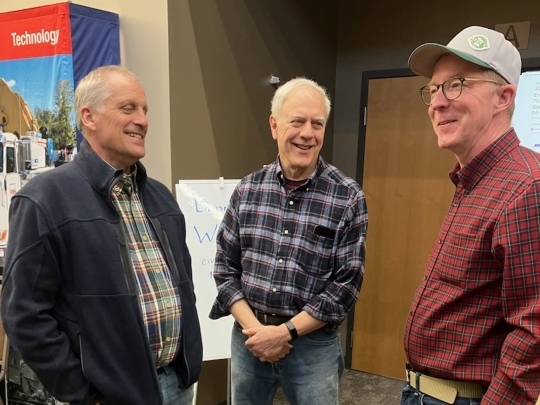 From left, Kory Cease, Cass County land commissioner and MFRC county land representative, visits with Charlie Blinn, University of Minnesota Forest Resources Department professor emeritus, and Dave Nolle, MLEP executive director, at the MLEP conference in Virginia.
MFRC representatives welcomed the opportunity to connect with Minnesota loggers at the Minnesota Logger Education Program (MLEP) conferences in Virginia and Bemidji this month.
Council members discussed the nuts and bolts of the MFRC's updated voluntary Forest Management Guidelines, including tips for getting the most out of the handbook's best practices and harvest guidelines while meeting landowner objectives and operating within a range of site-level conditions. Members also held panel discussions, answering questions and gaining valuable insights on topics ranging from forest policy to communication with non-loggers, workforce recruitment, improving forest bird habitat, and safely loading logging trucks.
Thank you to MLEP for the invitation to participate in this annual gathering. It is an honor to meet with the many skilled professionals who strengthen Minnesota's forest products industry and sustainably manage our forests for future generations.
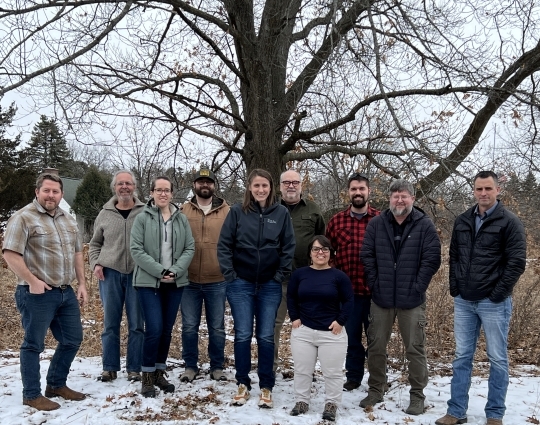 MFRC regional committee leadership from across Minnesota.
MFRC's regional landscape committees, located across the forested areas of Minnesota, are chaired by a dedicated group of forestry leaders committed to providing a forum for coordination and planning on regional forest resources. Regional committee chairs recently gathered to exchange insights with the Council and assess the overall health of the MFRC's Regional Landscape Program.
"The real story here is the continued growth and strengthening of MFRC's grassroots leadership," said Jaime Thibodeaux, MFRC Regional Landscape Program coordinator. "These regional leaders have made significant efforts to build communities and relationships across disciplines, agencies, and landownerships. Those relationships are the foundation of meaningful collaboration."
During the meeting, participants highlighted several milestones from the past two years, made possible by their collective efforts combined with the MFRC’s administrative, financial, and institutional support, including:
- Steady, reliable, and engaging meetings across the state,
- Increased involvement and diversity of participation in regional committees, and
- A new model of shared leadership, which has deepened member engagement.
They also reinforced the critical role regional committees play in bringing local, on-the-ground perspectives to statewide forestry discussions.
Learn more about the MFRC Landscape Program's six regional committees.
Arrowhead Collaborative Shared Stewardship Project Storymap
This storymap illustrates critical forest stewardship being accomplished by the Arrowhead Collaborative, which cooperatively manages about 545,000 acres in St. Louis County, Minn. Explore the site to learn about the collaborative's conservation needs, goals, partners, accomplishments, project updates, and resources for private landowners and natural resource professionals. A project born out of the MFRC's Regional Landscape Program, the Arrowhead Collaborative is a great example of what can be achieved by providing personnel and resources for cross-boundary, multi-stakeholder forest management and collaboration.
Minnesota’s Outdoor Recreation Industry Partnership Website
This website is a wealth of information and resources on growing Minnesota's outdoor recreation industry and economy, of which forests are a vital component. Check out the 2026 Outdoor Economic Impact Report, listen to the Explore Minnesota More podcast, and subscribe to email updates. The Minnesota State Outdoor Business Alliance, launched last year, is also working to uplift the outdoor recreation industry by building community, sharing resources, and advocating on key issues.
 Minnesota Forest Resources Council is seeking a student worker to join our team and assist with policy, program, and administrative projects this summer.
This is an excellent opportunity to gain professional experience while working alongside natural resources and forestry sector leaders in the stewardship of Minnesota's forests. The salary range is $17.84 - $20.89/hour, and applications are accepted through May 7.
If you or someone you know is looking to join a dynamic team, build skills through meaningful projects, and make a positive impact for Minnesota's forests, see details here: https://mn.gov/mmb/careers/search-for-jobs/; search Job ID: 93562.
|