|
December 12, 2025
Making Mussel History
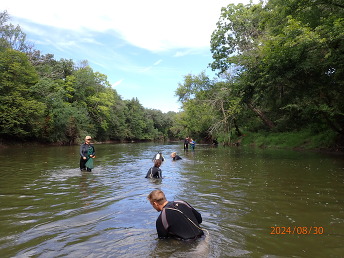
The First Specactlecase Release
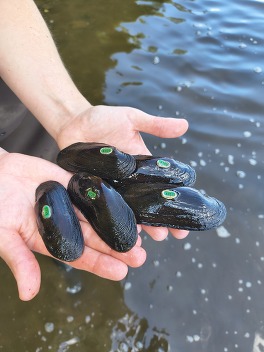
This past summer, biologists from the Center for Aquatic Mollusk Programs (CAMP) worked with U.S. Fish and Wildlife Service and the Wisconsin DNR to release 177 eight-year-old, federally endangered Spectaclecase mussels into the Chippewa River in Wisconsin. These are the first propagated individuals of this species ever released for restoration. To understand the importance of this milestone, it helps to look at how far we’ve come with Spectaclecase conservation.
|
Spectaclecase mussels were once common in parts of the Mississippi and St. Croix Rivers, but like many freshwater mussels they have declined sharply due to pollution, dam construction, and pressure from invasive Zebra Mussels. This species has an unusual lifestyle, living in tight colonies tucked beneath large rocks where they’re sheltered from strong currents, a preference that makes them especially difficult to locate. Because they cluster in dense groups deep within rocky crevices, traditional river surveys often miss them, leaving researchers with limited knowledge of their current distribution. To better understand where Spectaclecase still persist, the U.S. Fish and Wildlife Service, U.S. Army Corps of Engineers (USACOE), CAMP, and the Wisconsin DNR have been working together to locate these elusive mussels and assess their conservation status since 2019.
|
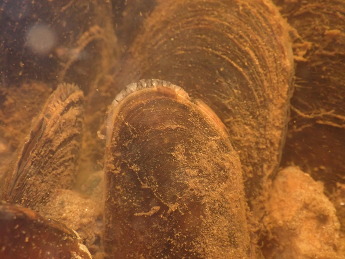
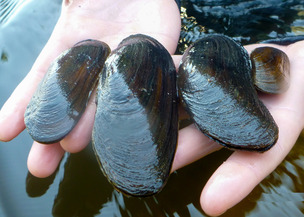
To improve the chances of detecting new Spectaclecase populations, several approaches are being used. CAMP focuses on surveying manmade structures such as wing dams along the Mississippi River that could provide suitable habitat. Historical shell records from museum collections are reviewed to identify areas where the species once thrived. The Wisconsin DNR has mapped the distribution of the mussel’s host fishes, Mooneye and Goldeye, and the U.S. Geological Survey (USGS) has tracked host fish movement, particularly Mooneye, to better understand where mussel populations may be. Building on these efforts, CAMP, the Wisconsin DNR, and the U.S. Army Corps of Engineers partnered with USGS to develop new tools for locating populations, including eDNA protocols and hydroacoustic techniques that use riverbed structure to pinpoint promising habitat. Together, these methods complement traditional SCUBA surveys and greatly improve the efficiency of finding new populations.
|
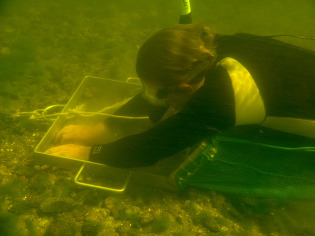
Conducting surveys to understand the status and distribution of Spectaclecase across the Midwest is only part of CAMP’s process for recovering this species. Restoring populations where they have declined is equally as important in order to have self-sustaining populations and restore ecosystem services. Finding the mussels was only half the battle; the other half came from identifying the host fish required for Spectaclecase to reproduce, and facilitating this process in a lab setting.
As a refresher, the process of propagating mussels is very unique in that mussels require a host, most often a fish, to complete transformation. Mussels in their larval stage, also called glochidia, are obligate parasites. They latch onto the gills of a fish and live there for a period of weeks to months while they absorb nutrients and transform into juvenile mussels. In a lab setting, this process is made possible by facilitating the attachment of mussel larvae on fish gills by combining both in a water bath, often called a host-fish inoculation.
|
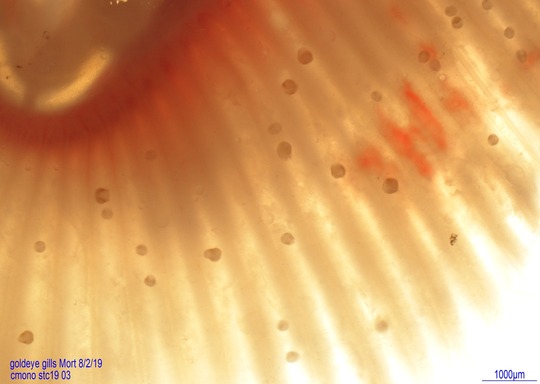 Host fish gills containing Spectaclecase larvae
Finding the fish-host for Spectaclecase was among the largest and most challenging searches for any freshwater mussel species. Over 50 species of fishes and other aquatic animals had been tested for host suitability without success. In 2017, CAMP biologists and collaborators at the University of Minnesota solved the long-standing challenge after extensive laboratory work and field observations confirmed that Mooneye and Goldeye serve as suitable hosts. This finding was later solidified when CAMP recovered wild Spectaclecase glochidia from the gills of Mooneye in the St. Croix River.
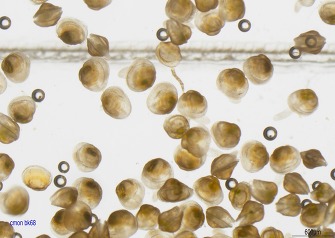
CAMP biologists spent several years refining the growing conditions needed for young Spectaclecase and for their wild-caught host fish, Goldeye, to thrive in the lab. After the juvenile mussels finish transforming and drop off the fish gills, they’re held in CAMP’s custom recirculating aquaculture systems for one or two years and then another six years in the St. Croix River for additional grow-out before their final release into the wild.
|
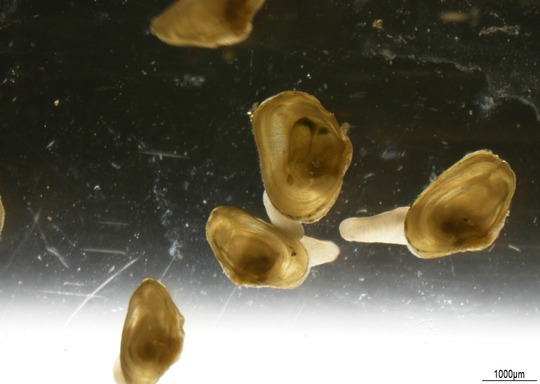 Juvenile Spectaclecase mussels
This work demands daily attention to water quality, food, aeration, and overall aquarium system performance. The team’s consistent, seven-days-a-week dedication has been crucial to the species’ recovery, resulting in the 177 sub-adult Spectaclecase in the Chippewa River that now pave the way for future mussel generations.
With support from @mnenrtf and the Clean Water, Land and Legacy Amendment, CAMP continues to advance Spectaclecase conservation through ongoing surveys, monitoring, and propagation efforts that help secure a future for this remarkable species. While the progress made over the past six years has been significant, the work is far from finished. This federally endangered mussel still faces many challenges, and CAMP is committed to learning more and improving conservation strategies each year.
|