|
Oct. 2025


Halloween is a time of year when we humans indulge in costume and trickery. But for some Minnesota wildlife, putting on a costume isn’t a holiday tradition, but how they survive.
Mimicry is a survival tactic where an animal borrows the behavior traits, calls or appearances of other wildlife species. They do this for a few reasons. Animals mimic to confuse predators, scare off competition and warn their companions of danger.
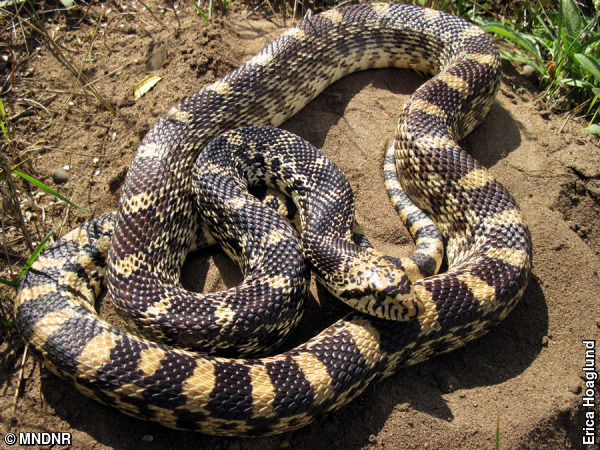 Gophersnake curled on the ground
Snakes are a great example of mimicry. Minnesota is home to 17 snake species and only two are venomous. However, we have many harmless snake species that mimic rattlesnakes. For example, the nonvenomous gophersnake (pictured) will rapidly shake its tail against the ground to mimic a rattlesnake. This behavior is an example of Batesian mimicry, where a harmless species imitates the appearance or threat behavior of other species to avoid predation.
Gophersnakes and other rattlesnake mimics are harmless, but it’s best to let them think they fooled you. If you see a snake in the wild, simply give it space and wish it well. They are a rare sight!
Learn more about Minnesota’s snakes in our “Snakes and Lizards of Minnesota”.
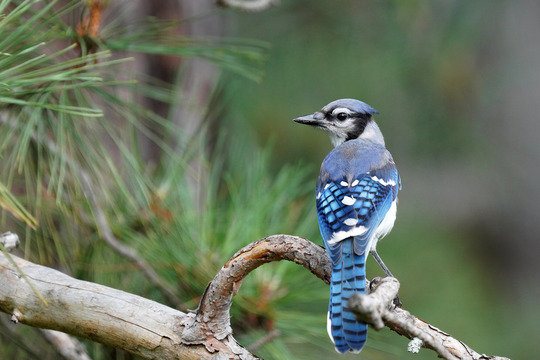 Photo caption: Blue jay, photo taken by U.S.F.W.S (public domain).
Blue jays are another great mimic, with vocals that allow them to imitate many bird species. They usually mimic hawks, using the piercing cry of a red-tailed hawk to scare off other birds so there is no competition for food. Blue jays can also mimic other birds to warn that a threat is nearby.
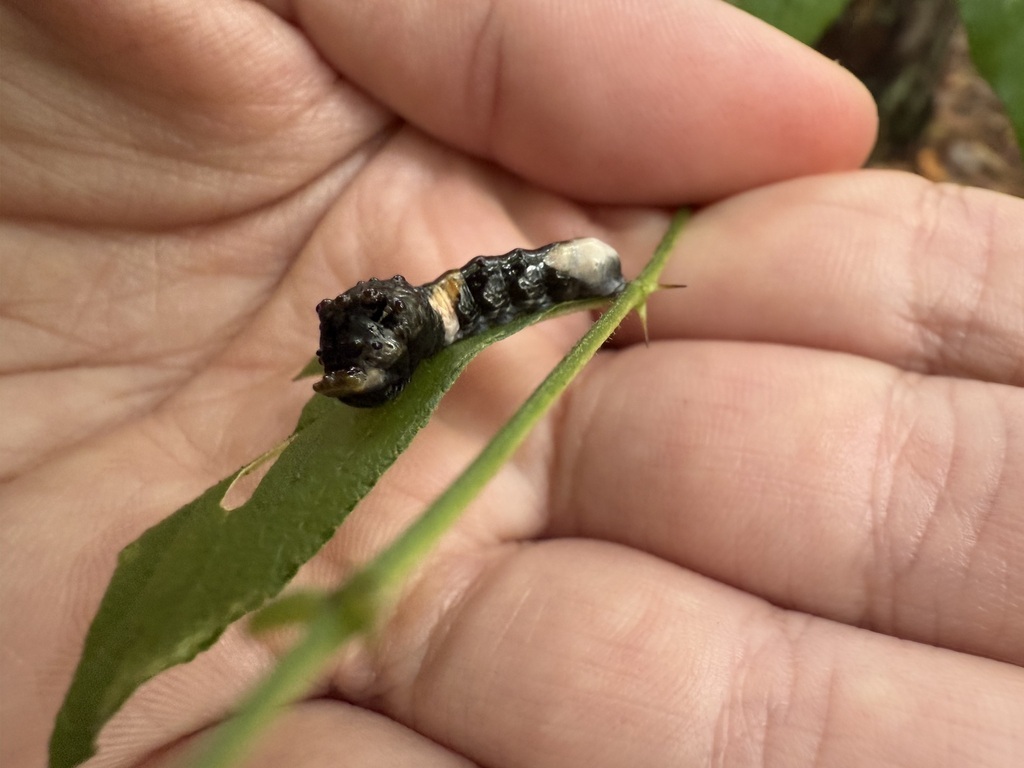 Photo caption: Photo of a giant swallowtail caterpillar, taken by MackCaughtABug, uploaded to iNaturalist. (CC-BY-NC).
In the insect world, swallowtail caterpillars are masters of mimicry. Their brown and white patterning and shiny skin looks a lot like fresh bird droppings, making them unappetizing to their bird predators. Many swallowtail caterpillars use this technique only during early larval stages, but the giant swallowtail caterpillar (pictured) will keep their bird poop disguise until they become a chrysalis.
Whether pretending to be poop or mimicking the call of a fearsome hawk, mimicry is how many animals survive in the wild. We humans can put our costumes away after Halloween, but these critters keep mimicking all year long.
It was a busy field season for the program’s nongame biologists. We asked our staff for stories from this summer, and they have some wonderful tales to share.
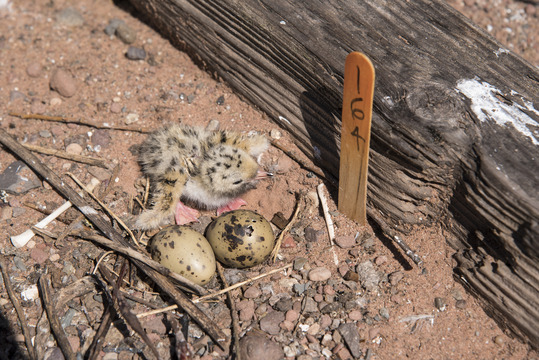 A common tern chick
There’s good news in Duluth’s harbor: “Due to the dedication of Nongame Wildlife Program volunteer Fred Strand, there is good news to report for common tern, a threatened species. In 2025, we had the highest number of chicks fledged per nest in the Duluth estuary since 1989!
“The number of chicks fledged per nest has doubled over the past 5 years compared to the long-term average. There are likely two reasons for this increase:
“A large island restoration project occurred in 2020, which increased the size and elevation of the island, allowing more space for gulls to nest away from the terns. Gulls predate tern eggs and chicks and compete with terns for nesting sites.
“In addition, Fred has increased efforts to deter gulls. He maintains a network of string grids and fencing to deter gulls from getting into the tern colony, and he discourages gulls from nesting near the tern colony. These efforts are paying off!”
We can’t thank Fred enough for his commitment to this important conservation work. Thank you, Fred!
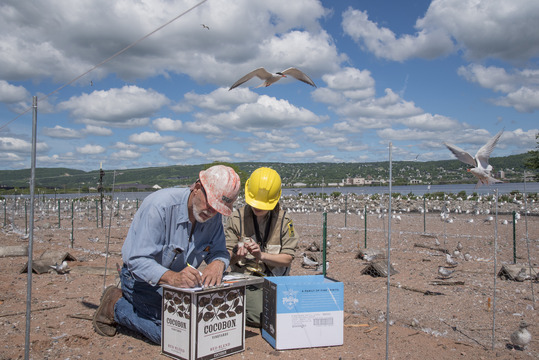 Fred Strand and DNR staff banding common tern chicks.
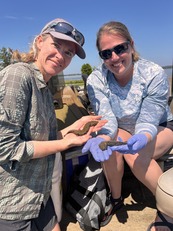
Staff in west-central Minnesota spent some of this summer searching for mudpuppies. “This survey was part of a larger investigation into the causes of mudpuppy die-offs in the lakes of west-central Minnesota. Specimens collected during this work will serve as an important baseline for future mudpuppy mortality investigations.”
Photo caption: Nongame staff holding mudpuppies captured during a snorkeling survey.
|
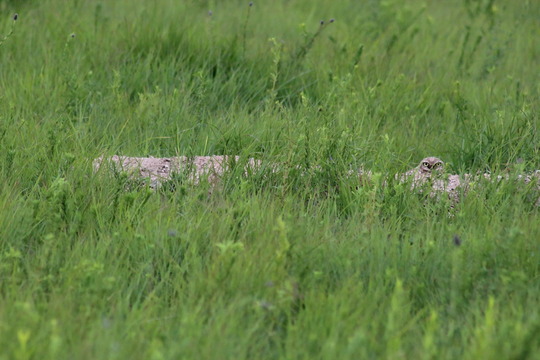 Burrowing owl.
In southern Minnesota, our staff had an exciting find. “The burrowing owl is listed as State Endangered in Minnesota, yet the current status of burrowing owls as a nesting/breeding species in MN had been uncertain. Then in 2025, three pairs were documented! Two pairs in southern Minnesota and one pair in central Minnesota.
“Based upon updates we received from a reliable local contact, we know that one of the pairs fledged young. Monitoring and protection of these owls has required a team effort by the Nongame Wildlife Program, other state agencies and local residents.”
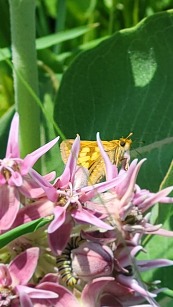
Staff in southern Minnesota also monitored butterflies and bumble bees as part of two ongoing studies to see how pollinators are responding to our prairie reconstruction and management work. They visited many sites, both publicly and privately owned, searching for species such as regal fritillaries, American bumble bees and Peck’s skippers (pictured).
|
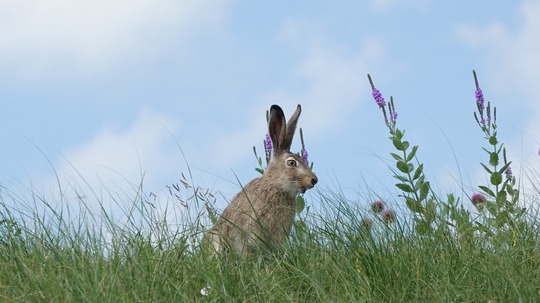 One of the nongame biologists recounted, “a fun encounter I had this summer was a pair of jackrabbits at Hole-In-Mountain WMA. This was in our grazing study where I was surveying for bumble bees and butterflies. They hung out around me and seemed to be trying to lure me away, so I suspect they had young nearby.
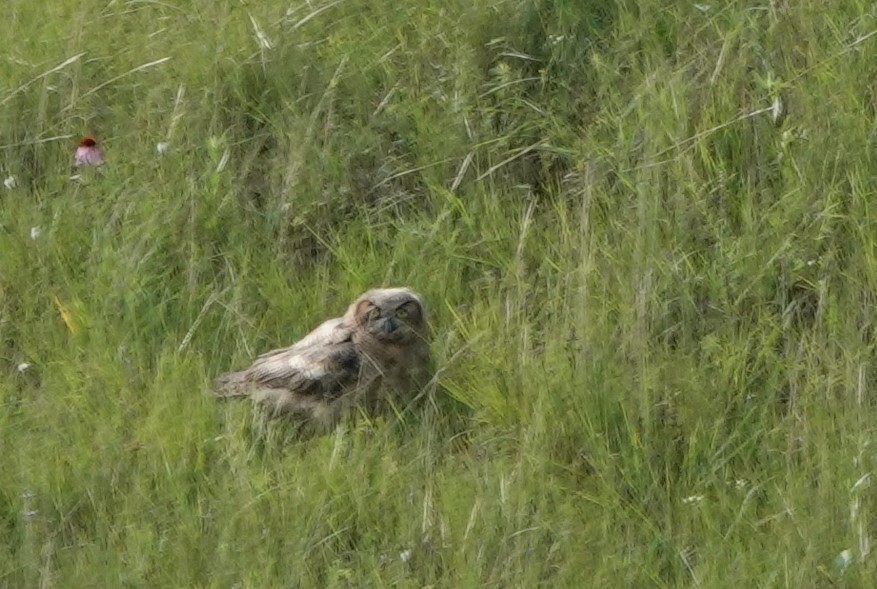 “Then soon after in the same project area I observed a family of short-eared owls. I think only the third time I’ve seen jackrabbits and the very first time I’ve seen short-eared owls in MN prairie.”
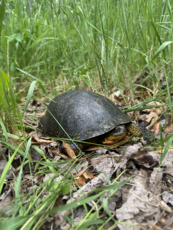
Blanding's turtles, a state threatened species, may move long to lay a clutch of eggs. While out doing surveys, a nongame staff member happened to spot a turtle (pictured) lurking on the side of road.
|

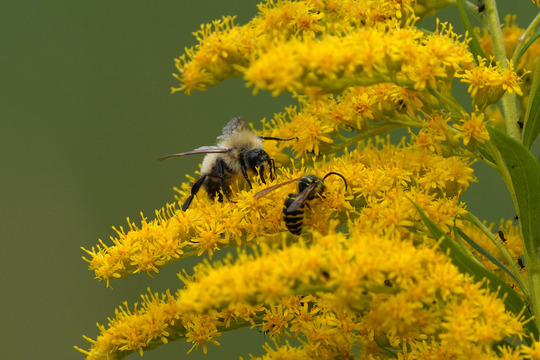 Photo of a bumble bee and yellowjacket on goldenrod. Photo taken by U.S.F.W.S. (public domain).
Fall is an important time to create habitat for bumble bees and other native pollinators. If you have a yard or garden, leave behind freshly fallen leaves, rotting logs, standing dead stalks and loose dirt. This will help pollinators that rely on ground shelter (like fallen leaves) and hollow stems to create a winter home. Leaving seed heads on your flowers will also provide a natural food source for seed-eating birds.
If you have a bird feeder, fall is a great time to give it a refresh to ensure birds stay healthy while eating from it. Discard any wet or moldy feed, disassemble and sanitize your feeder. Wash it out with hot, soapy water or use a 10% bleach solution and let it dry completely before refilling it. Cleaning your bird feeders regularly helps protect birds against disease. Once the weather begins to cool this fall, consider hanging up suet feeders, which are high in fat. This high-energy food will keep our winter birds going and warm. As a tip, use a suet feeder that requires birds to hang upside down–it will dissuade starlings, but will be easily accessed by woodpeckers, chickadees, and nuthatches.

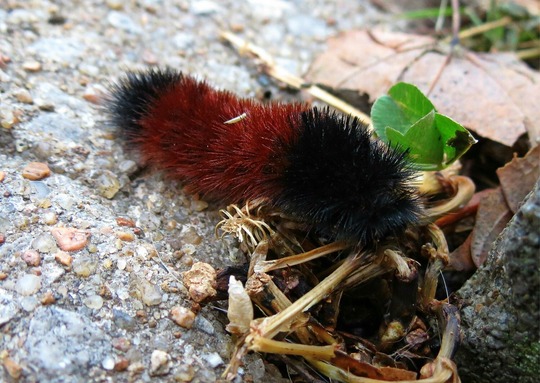 Photo caption: Woolly bear caterpillar. Photo taken by U.S.F.W.S. (public domain).
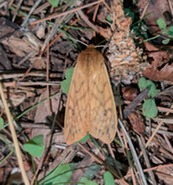
Banded woolly bear caterpillars are fuzzy critters commonly seen in the fall.
These caterpillars are searching for leaves to protect them from Minnesota’s harsh winters. They curl up under the leaf litter and release a chemical called glycerol to act as antifreeze, protecting them from the chilly temperatures.
In the spring, they cocoon and transform into the Isabella tiger moth. They find a mate, lay some eggs and the cycle begins again!
Photo caption: Isabella tiger moth, photo taken by Brandon Caswell. Uploaded to iNaturalist, CC-BY-NC.
|

Frog and Toad Calling Survey
The Nongame Wildlife Program’s Frog and Toad Calling Survey resumed in 2025. We were fortunate to have both existing volunteers return and new volunteers sign up. A huge thank you to everyone who participated.
Over the spring and summer our volunteers covered 55 monitoring routes throughout the state, on repeat visits, resulting in over 1,300 individual survey submissions. Volunteers heard 12 of Minnesota’s 14 species, documented new populations of the State Endangered Blanchard’s cricket frog and submitted some great photos and audio recordings. It was a great season, and we look forward to expanding and welcoming more volunteers in 2026! Photo caption: Northern Leopard Frog. Photo taken by U.S.F.W.S. (public domain).
|
Chimney swifts
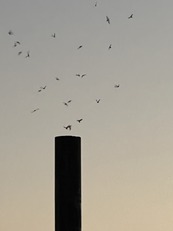
Chimney swifts are a fascinating native bird species. They eat insects in flight, spending most of their time in the air. They nest in vertical structures like hollowed logs and chimneys and roost communally in the spring in fall.
In 2025, we continued the Chimney Swift Roost Detection and Monitoring program in collaboration with Urban Bird Collective, U.S. Fish and Wildlife Service, Saint Paul Parks, American Bird Conservancy, Saint Paul Bird Alliance, and Land of Lakes Bird Alliance. At least four new roosts were detected around the metro (with more still being reported), and we initiated volunteer monitoring of known roosts for the first time. We also hosted three Swift Sit events, so that anyone interested could experience roost monitoring and learn how to get involved. Our biggest Swift Sit night this fall counted over 1,000 swifts entering one large chimney! Another highlight was the spotting of a merlin, which attempted but failed in snagging a swift. Stay tuned to join us in 2026.
Photo caption: Chimney swifts entering a roost. Photo taken by U.S.F.W.S. (public domain).
|

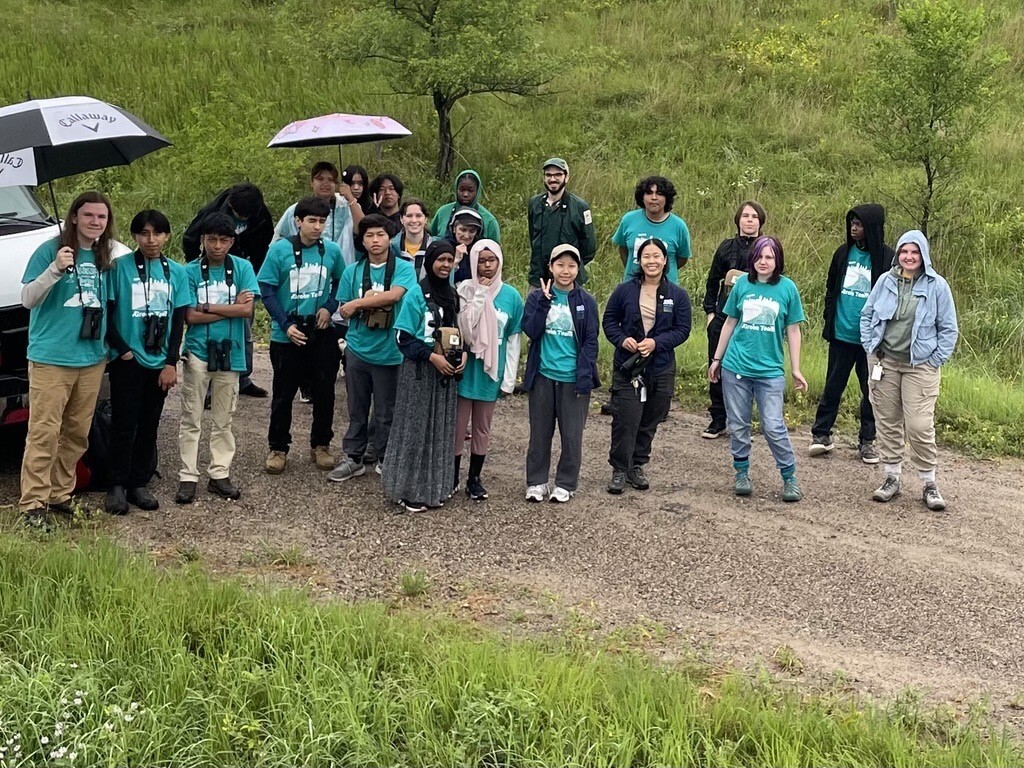 The 2025 EPIC cohort
This summer, 15 young people from the Minneapolis Parks and Rec Board and Mississippi Watershed Management Organization’s Green Team participated in the DNR’s EPIC (Empowering Pathways into Conservation Program). These young people had the chance to connect with DNR and other conservation organization professionals over the summer to learn about the many different career options that exist in the wildlife conservation and natural resources field.
This summer’s experiences included everything from kestrel banding with the Nongame Wildlife Program Supervisor, to macroinvertebrate sampling with park naturalists at William O’Brien State Park, to pollinator surveys in restored prairie with Nongame Wildlife biologists, to animal husbandry and care with Dodge Nature Center.
Here are some of the things students had to say about their summer with EPIC:
“I got the chance to understand and feel wildlife.”
“The macroinvertebrate survey was the best.”
“I wouldn’t change anything because it is perfect the way it is.”
“Thank you so much… now I know what I can do and how to have my dream job. Thanks!”
The summer concluded with a career day event hosted at the Minnesota Valley National Wildlife Refuge and coordinated by Environmental Initiative. Young people from the Green Team and other youth serving conservation organizations spent the day learning from and connecting with conservation professionals from the DNR, U.S. Fish and Wildlife Service, and more.
To learn more about EPIC, visit our website at: https://www.dnr.state.mn.us/eco/nongame/projects/epic.html
Funding for this program was provided by the Minnesota Environment and Natural Resources Trust Fund as recommended by the Legislative-Citizen Commission on Minnesota Resources (LCCMR) and the Nongame Wildlife Program

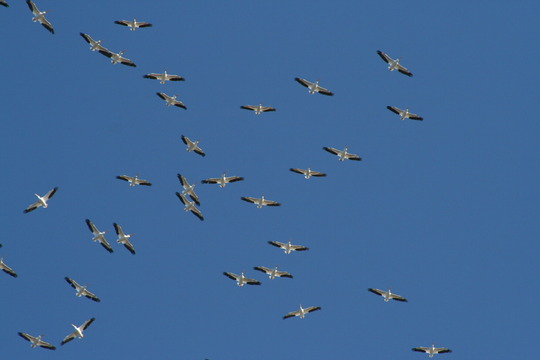 American white pelicans migrating. Photo by U.S. Fish and Wildlife Service. (public domain).
Whether you live in rolling plains of southern Minnesota or the woods of the north, there are thousands of birds flying overhead every night as they make their way south for the winter. Check out eBird’s HotSpots to see what people are noticing near you and visit BirdCast to learn what species are migrating when.
Minnesota Scientific and Natural Areas (SNA) are also great birding spots to visit during fall migration. These beautiful, rustic natural areas can be found all over the state. Many have bird checklists you can download or print off before you visit, and the program has several SNAs they recommend for birding.
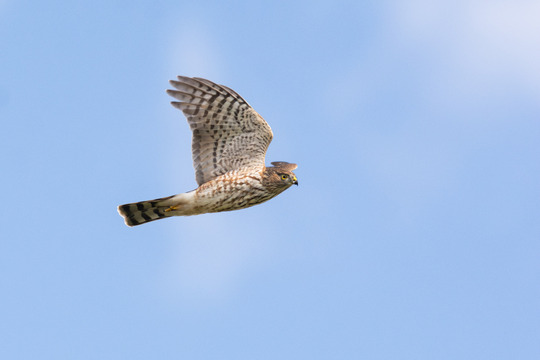 A sharp-shinned hawk in flight over Hawk Ridge Bird Observatory. Photo taken by Peter Mundale. Uploaded to iNaturalist, CC-BY-NC.
Hawk Ridge Bird Observatory in Duluth, Minnesota is one of the best places to visit for fall raptor migration. Nestled along the East Skyline Parkway, Hawk Ridge offers incredible views of Duluth, Lake Superior and the hundreds of raptors migrating along the North Shore.
Visit Agassiz National Wildlife Refuge this fall for some incredible bird migration. The refuge is nestled in northwestern Minnesota. It has 61,500 acres of wetland and upland habitat, making it a stopover site for thousands of ducks, geese and other waterfowl. Red-necked grebes, great blue herons and Franklin’s gulls have also been observed in the refuge during the fall.
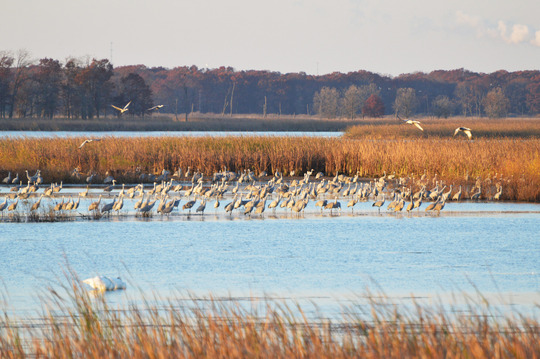 Sherburne National Wildlife Refuge in central Minnesota is a 30,700-acre refuge filled with marshes, oak savanna, forest and wetlands. These abundant wetlands make it a stopover site for many migrating species, especially sandhill cranes.
|