|
Aug. 1, 2025
In this edition, get the details you need for deer hunting and testing for chronic wasting disease this season, share your thoughts with the DNR about use of fees, plus an important reminder about preventing tick-borne disease.
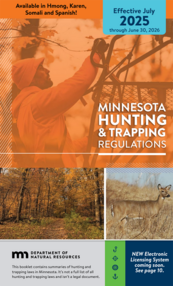
Deer season details available
It’s that time of the year! You can now review the 2025 Minnesota deer hunting regulations, and deer hunting licenses are available to purchase starting today. Check out the DNR deer hunting page for details, and here are some dates to get on the calendars.
- Archery: Saturday, Sept. 13, through Wednesday, Dec. 31
- Youth and early antlerless: Thursday, Oct. 16, through Sunday, Oct. 19
- Firearms: Saturday, Nov. 8, with various closing dates depending on location
- Muzzleloader: Saturday, Nov. 29, through Sunday, Dec. 14
- Late CWD (DPAs 605, 642, 643, 645, 646, 647, 648 and 649): Friday Dec. 19, through Sunday, Dec. 21.
For a guide on finding the most up-to-date information throughout the deer season including details about individual DPAs, preparing for hunting, to find CWD sampling locations or to request a mail-in sampling kit, visit this helpful DNR online planning tool.
|
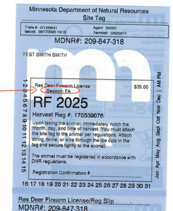
One statewide firearms license
This deer season, the DNR has simplified how to buy a firearms deer license. There is now one statewide firearms deer license. The B season license has been eliminated, and a statewide license is valid during both the statewide firearms A season and the late southeast B season.
Prior to this change, due to the expansion of the CWD management zone in the southeast, only two DPAs (338 and 341) still required a B license to participate in the late southeast B season, while neighboring DPAs allowed hunting during both seasons with either the A or B license. To simplify regulations and reduce confusion, there is now just one license which can be used for both the statewide firearms and the late southeast season.
|
Summary of bag limit changes
For the 2025 deer season, 103 deer permit areas have kept the same designation as the previous season. Two DPAs have lower bag limits to reduce the harvest of antlerless deer, with the intent of increasing deer populations. Twenty-five DPAs have increased bag limits this year.
Winter conditions were favorable to deer populations for the second consecutive winter, contributing to increased harvest opportunity this deer season. Harvest designations remain conservative in northern Minnesota, where deer populations are still in recovery from the severe winters of 2021-2022 and 2022-2023.
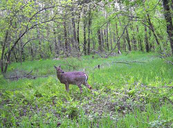
Trail cam photo courtesy of Tom Fritz
|
Antlerless lottery deadline is Sept. 4
Firearm and muzzleloader hunters who want to harvest antlerless deer in a DPA designated as antlerless permit lottery must purchase their license by Thursday, Sept. 4. Hunters who purchase their license by Sept. 4 are automatically entered into the lottery for the DPA or special hunt area they declare.
No application is needed to take antlerless deer in permit areas with either-sex, two-deer limit, three-deer limit, or five-deer limit designations. Hunters should note that DPA 183 has been split into two smaller DPAs (153 and 154), and these DPAs are designated as lottery with different numbers of antlerless permits.
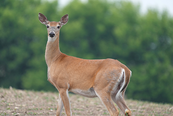
Doe in cropfield photo courtesy of Shayna Vendela
|
CWD self-service station change
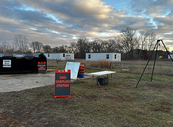
In another important change this season, self-service stations in CWD management and surveillance zones will now only be available during the opening weekend of firearms season and the following Monday (Saturday, Nov. 8, through Monday, Nov. 10), as well as during CWD special hunts. In prior years, these stations remained open throughout the entire firearms season.
Because of the expanding footprint of CWD in Minnesota, the DNR will prioritize collecting baseline surveillance data in three new areas and had to shift staff resources to accommodate this increased workload.
|
CWD testing requirements
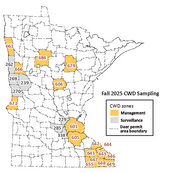
Hunters should check the CWD testing requirements and available sampling options for the DPAs where they hunt. Hunters can find DPA-specific information on the DNR website. Hunters are required to have deer one year or older sampled in all CWD management and surveillance zones if they harvest their deer during the opening weekend of the firearms season (Nov. 8-9).
|
Choosing to test for CWD
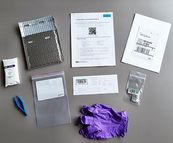
In all areas outside CWD management and surveillance zones — or in these zones outside of opening firearms weekend — hunters can also have their deer sampled for CWD, if they choose.
Multiple CWD sampling options are available, including:
Hunters can request a mail-in kit before hunting or use their unused kits from previous years. However, CWD mail-in kits received prior to Nov. 1, 2024, have shipping labels that are no longer valid. Hunters wishing to use these kits will need to request a new shipping label using a form available on the DNR website.
|
Share about how fees support natural resources and outdoor recreation
The DNR wants to hear your thoughts on the use of fees to support natural resources and outdoor recreation opportunities in Minnesota!
Please take the 4 The Outdoors questionnaire to share your values and preferences. Your input will be used to help select, design and implement improvements to DNR’s fees in the future. Access the questionnaire here.
For more information on the 4 The Outdoors initiative, visit the Engage with DNR webpage.
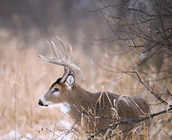
Photo courtesy of Greg Schwieters
|
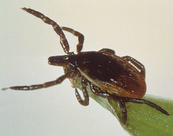
Prevent tick-borne diseases
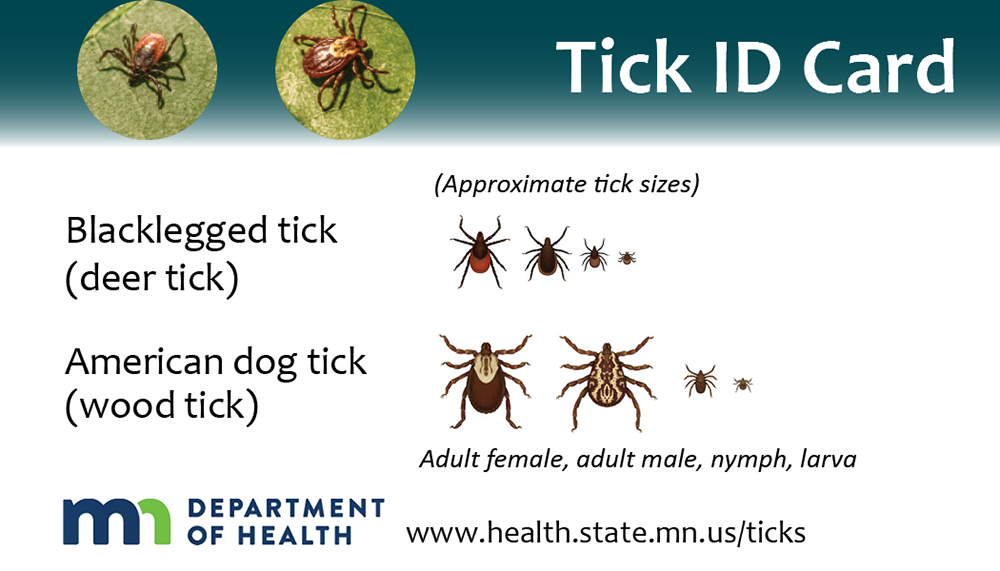
Did you know there are about a dozen different types of ticks found in Minnesota? The most common ticks people encounter are the American dog tick (often called the wood tick) and the blacklegged tick (commonly known as the deer tick).
While several tick-borne diseases are present in Minnesota, Lyme disease, transmitted by the blacklegged tick, is the most commonly reported. However, another concerning illness is alpha-gal syndrome, a red meat allergy linked primarily to bites from the lone star tick. Although the lone star tick does not have an established population in Minnesota, its range appears to be expanding. This condition can be especially troubling for deer hunters, as the allergic reaction to red meat includes venison.
Preventing tick bites starts with knowing where ticks are likely to be. Ticks thrive in wooded, brushy, and grassy areas, especially in the central, north-central, and southeastern parts of the state where tickborne disease rates are highest. Using tick repellent on yourself and your gear is another important preventive measure. Choose an EPA-registered product so you know it is safe and effective against tick bites. Products containing permethrin (used on clothing and gear) or DEET (applied to skin) are highly recommended. Wearing long sleeves and tucking pants into socks can also help reduce the chance of ticks attaching to your skin. It’s a good idea to stick to the center of trails when hiking, and wearing light-colored clothing makes it easier to spot ticks before they latch on.
Always check yourself, your gear and your pets for ticks. If you find a tick on yourself, remove it promptly using fine-tipped tweezers. Grasp the tick as close to the skin as possible and pull upward steadily without twisting. After removal, clean the area with soap and water or rubbing alcohol. Watch for tick-borne disease symptoms (like fever, rash, aches) for about a month following a tick bite and contact your health care provider if symptoms arise.
For more detailed information about tick-borne diseases and prevention tips, visit the Minnesota Department of Health’s comprehensive webpage on ticks in Minnesota.
|
Share your wildlife and hunting photos
Do you have any hunting or wildlife photos you want to share? Consider uploading them using the DNR photo uploader. We use many of these photos in Deer Notes, social media, our webpages and other communications.
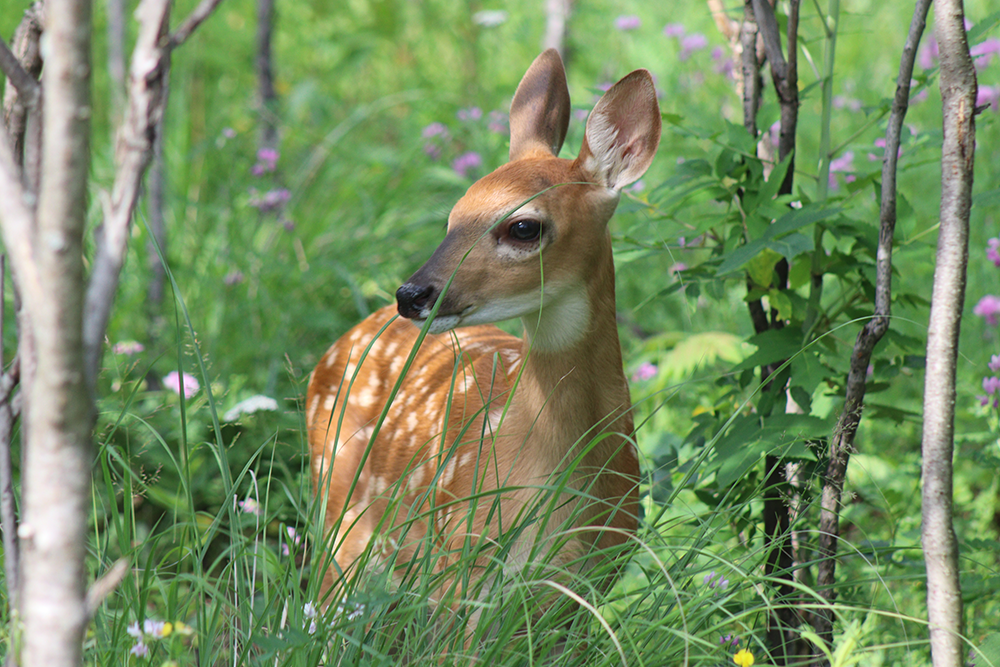 “While walking along Collegeview Road in Bloomington, MN this baby fawn was standing near the sidewalk,” photo courtesy of Meelyn Johnson
|