|
June 24, 2025
In this edition, why we have a shotgun zone, the deer feeding and attractant ban expands, a webinar and webpages on reducing human-wildlife conflict, applications open for the elk lottery, and a study on deer-vehicle collisions.
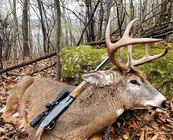
The history of Minnesota’s shotgun zone
When it comes to deer hunting in Minnesota, many assume the state’s shotgun zone was established for safety reasons. After all, it covers the much more open farmland regions of southern and western Minnesota, in contrast to the densely forested northern region where rifles are allowed. However, the real reason behind the shotgun zone’s creation was more about wildlife management than hunter safety.
Established in 1942, the shotgun zone was designed as a tool to manage deer populations in areas where numbers were historically low. In the mid-20th century, parts of southern Minnesota had such sparse deer populations that hunting seasons were occasionally closed altogether. At the time, shotguns were significantly less accurate than rifles, especially at longer distances. Their limited effective range required hunters to get much closer to their targets, which naturally reduced harvest rates. Limiting hunters to shotguns was a deliberate strategy to reduce efficiency and support the recovery of the region’s deer population.
Today, things have changed. Deer populations in many areas of the shotgun zone have rebounded significantly, and at the same time, shotgun technology has advanced dramatically. Modern ammunition, combined with rifled barrels and optics, have made shotguns nearly as accurate as rifles, even at extended ranges. Given these changes in both deer numbers and firearm capabilities, some stakeholders have advocated for removing the shotgun zone entirely, allowing rifles to be used statewide. Others, however, remained concerned. For comparison, Wisconsin eliminated its shotgun zone in 2013 and has not experienced an increase in firearms-related incidents.
For 2026, shotgun zone repealed
The shotgun zone remains in effect for the 2025 deer season.
Looking ahead, the Minnesota Legislature repealed the shotgun zone for the 2026 season. There will be no changes for the fall 2025 season. Legislation also allows counties within the current shotgun zone to restrict firearms use within county boundaries. And the new legislation requires the DNR to, by March 1, 2026, notify county boards and county sheriffs of this option available to counties in the shotgun zone to adopt an ordinance restricting firearms use.
A map of the shotgun-rifle zone boundary is available on the deer permit area map PDF.
Photo courtesy of Andy Stetter
|
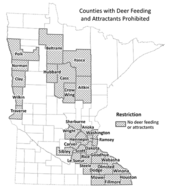
DNR adds eight counties to deer feeding and attractant ban
The Minnesota DNR has added eight counties to a deer feeding and attractant ban to reduce the risk of chronic wasting disease spread, after CWD was detected in wild deer in new areas of the state last year.
Added to the feeding and attractant ban are Anoka, Clay, Ramsey, Sherburne, Steele, Traverse, Wilkin and Wright counties.
The ban now includes 32 Minnesota counties and remains in effect for Aitkin, Beltrami, Carver, Cass, Crow Wing, Dakota, Dodge, Fillmore, Goodhue, Hennepin, Houston, Hubbard, Itasca, Le Sueur, Mower, Norman, Olmsted, Polk, Rice, Scott, Sibley, Wabasha, Washington and Winona counties.
The feeding and attractant ban is one tool to reduce unnatural congregating of deer and lower the risk of CWD spread. It’s a tool used where it provides the greatest benefit to the health of Minnesota’s white-tailed deer.
The wording of the ban was clarified to prevent it from covering natural or manufactured products that do not have attractants added. This change allows hunters to use items such as non-scented ropes, mock scrapes with no scents added, and other items which were never intended to be covered under the deer feeding and attractant ban.
In areas outside the ban, the Minnesota DNR recommends that the public not feed deer. People interested in helping deer should focus efforts on improving habitat to provide long-term food resources and shelter.
|
Join this Wednesday webinar all about living with wildlife
What’s the difference between a trophy white-tailed deer and a garden pest? The answer is all about context! Human-wildlife conflict can exist when wildlife crosses a human social tolerance level. Social tolerance varies for wildlife and by understanding phenology, behavior, and animal sensory systems, we can improve strategies for mitigating human-wildlife conflicts and help keep wildlife wild.
Want to hear more? We have a webinar coming up Wednesday, June 25, all about living with wildlife. Join Brandon Kaiser, wildlife damage specialist, as we learn about ways to reduce human-wildlife conflict and increase social tolerance by understanding the social values we place on wildlife.
Also make sure to catch the webinar on buckthorn management coming up Wednesday, July 23. Sascha Lodge, terrestrial invasive species coordinator, will cover the two buckthorn species found in Minnesota, their impacts on forests, and a variety of methods to manage these invasive plants.
The webinars are part of the Minnesota Outdoor Skills and Stewardship Series and they’re free with registration required. Visit the DNR website for the registration portal, more information about upcoming webinars and recordings of past webinars.
You can also read up on living with wildlife on the DNR website and about how to manage deer damage on trees and other plants from the University of Minnesota Extension program. The Extension information includes topics like deer biology, how to identify what deer damage looks like, and numerous methods on how to mitigate or prevent deer damage in urban areas.
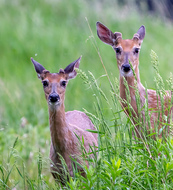
“Young bucks” photo courtesy of Gregory Gerhart
|
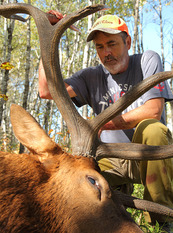
Elk hunt license applications open
Hunters have through Thursday, July 3, to apply for one of four elk licenses offered this year by the Minnesota DNR. This is a once-in-a-lifetime hunt for Minnesota residents.
There are currently three recognized herds in northwest Minnesota: Grygla, Kittson Central and Caribou-Vita. The Grygla area zone remains closed to state-licensed elk hunters, and this year the Kittson Central zone will also be closed to state-licensed hunters.
The Minnesota DNR reduced opportunities for elk harvest this year to make sure Minnesota’s elk populations continue to thrive. The number of permits available is based on the lower-than-expected number of elk counted during the 2025 aerial flights and recent trends in population growth. The DNR will continue to work with Tribal nations, local landowners, agricultural producers, legislators, local government officials and state agencies to sustainably manage Minnesota’s elk.
|
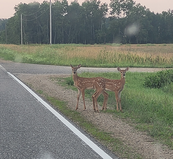
When are you likely to hit a deer?
It’s the time of the year again when summer is here, and people are hitting the road to get away for the weekends. You’re driving and you notice more dead deer on the side of the road than usual. This isn’t just your imagination. Researchers at the University of Minnesota conducted a study examining historic deer and vehicle collision incidents to pinpoint factors that contribute to increased likelihood of a deer-vehicle collision. There are many factors that can contribute to the likelihood that a deer leaps in front of your car in the blink of an eye, including: how busy the road is, installed deer barriers along the road, habitat type and density, and the time of the year.
Many people are aware that during the middle to the end of fall during deer breeding season, deer are moving at all hours, with the highest risk being at sunrise and sunset. But what about summer? Researchers compiled deer-vehicle collision report data and found that from 2005 to 2022, June had the third highest number of collisions at 10.24% behind November (19.88%) and October (14.03%). Roads that had higher traffic and higher average speeds were also more likely to have a vehicle collide with a deer. Next time you’re traveling for the weekend, keep your eyes peeled for those deer!
Photo courtesy of Scott Skov
|
Share your wildlife and hunting photos
Do you have any hunting or wildlife photos you want to share? Consider uploading them using the DNR photo uploader. We use many of these photos in Deer Notes, social media, our webpages and other communications.
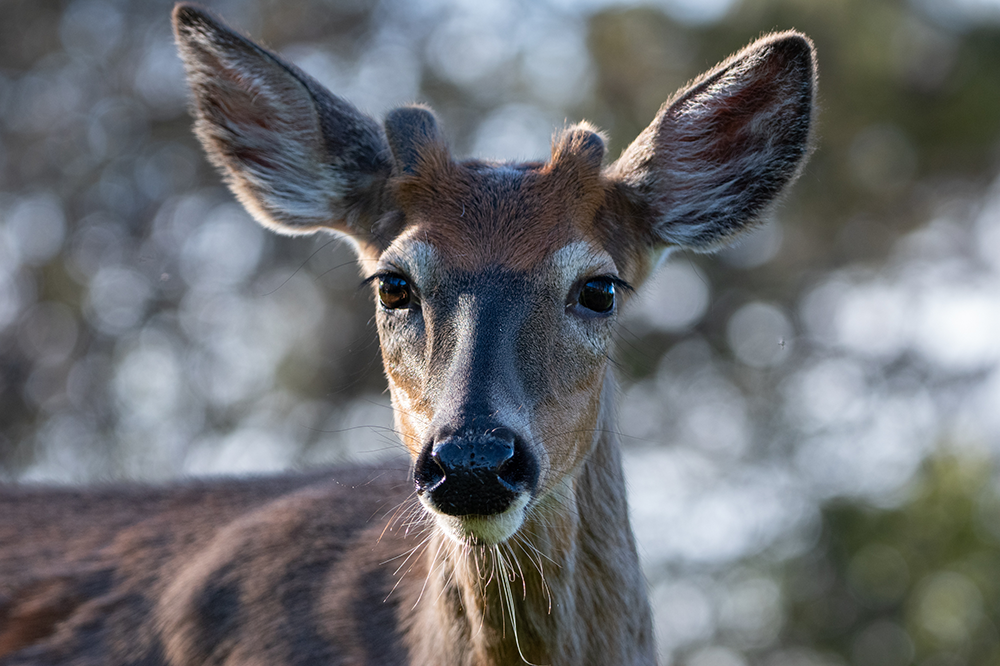 “Young buck In Grand Marais” photo courtesy of Kalli Hawkins
|