|
June 2025


Summertime means water time in Minnesota, with many of us flocking to lakes and rivers. But for some Minnesota animals, spending time in water isn’t just a seasonal activity, it’s their life.
While you are recreating on the water this summer, be sure to Own Your Wake and practice good boating etiquette to help everyone, including our aquatic wildlife, enjoy the lake and river.
Mudpuppy
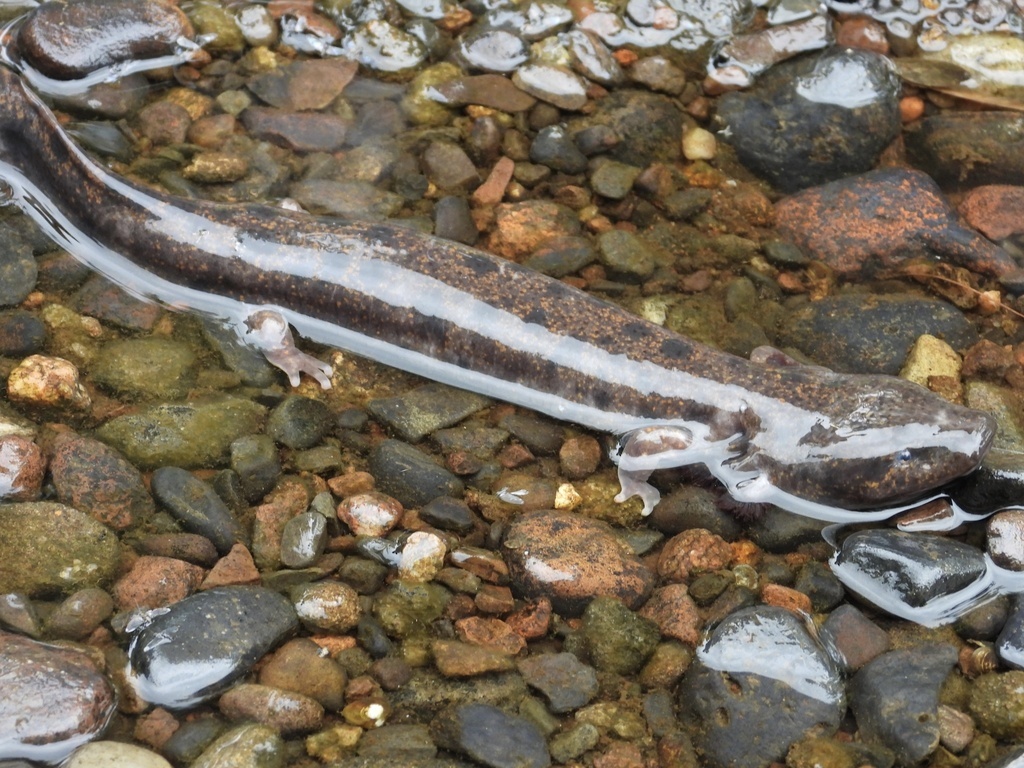 Photo by Matthew Thompson, uploaded to iNaturalist, no changes made.
Salamanders head to water in the spring to lay their eggs, but the mudpuppy dwells in the water year-round. They are Minnesota’s only fully aquatic salamander, spending their entire life underwater in rivers and lakes throughout Minnesota. They use their fluffy red gills to breathe and are most active in the winter, when the water is colder and has more oxygen.
Visit our Rare Species Guide to learn more about these “water dogs.”
Native fish
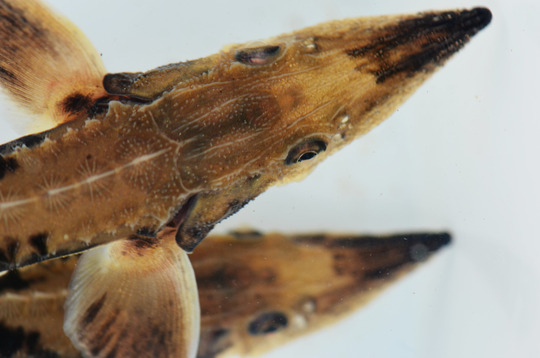
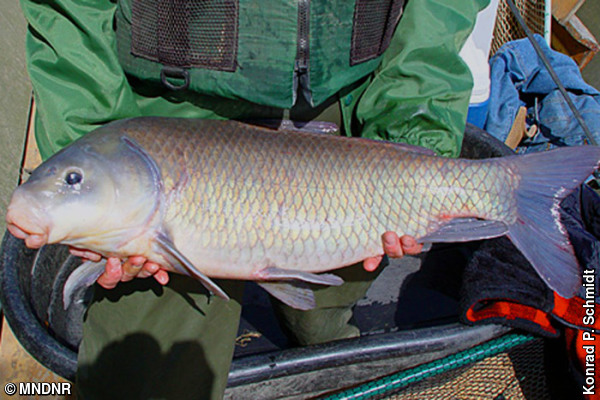 Minnesota is home to 26 species of unique native fish, formally known to some as “rough” fish. 🐟
From the iridescent black buffalo (pictured) to the long longnose gar, these fish capture the fascination of many anglers.
Learn more about them in the Minnesota Conservation Volunteer feature “At the Bend in the River” by Roy Heilman.
Mussels
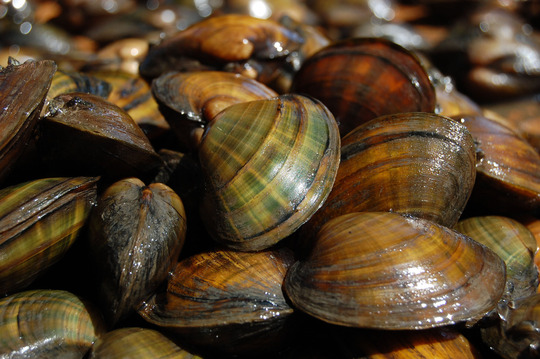 Photo of Higgins’ eye pearly mussels by U.S. Fish and Wildlife Service, public domain
The mighty native mussel is a hero of Minnesota’s waters. Not to be confused with invasive zebra mussels, 51 species of beneficial native mussels can be found in our state.
They live partially buried in river and lake bottoms across Minnesota. Nature’s natural water filter, these invertebrates improve water quality by filtering oxygen and particles from the water, cleansing the water in the process and absorbing what they consume into their bodies and shells.
These native mussels are important to water ecosystems, but 28 of Minnesota’s species are listed as endangered, threatened, or of special concern. Without them, our water quality would suffer.
Learn more about how the DNR is brining native mussels back in “Mussel Building” by Keith Goetzman, also from the Minnesota Conservation Volunteer.
Freshwater mammals
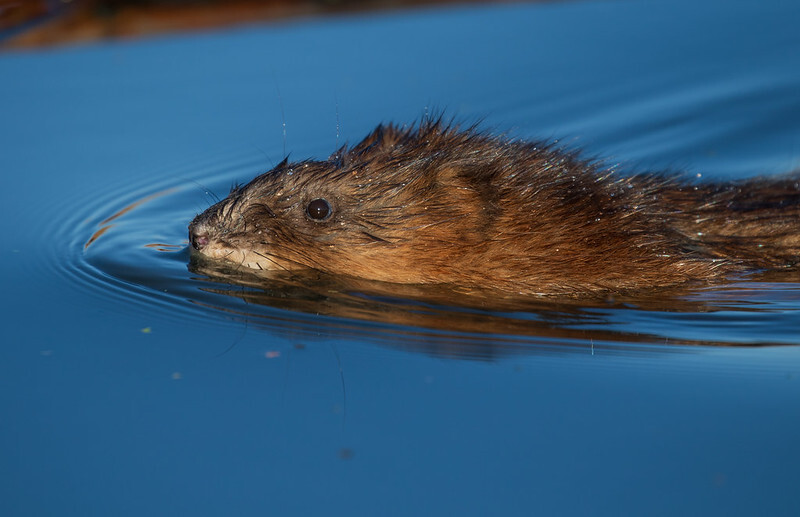 Photo of a muskrat by U.S. Fish and Wildlife Service, public domain
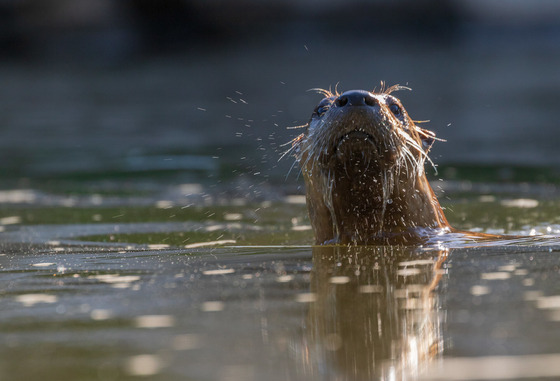
A flash of fur ducks beneath a wave. Was that a beaver? An otter? Maybe a muskrat? 🦦
Minnesota is home to many freshwater mammals that live in our waters. Cool Green Science has a great guide that dives into the freshwater mammals you may notice in Minnesota this summer.
Loons
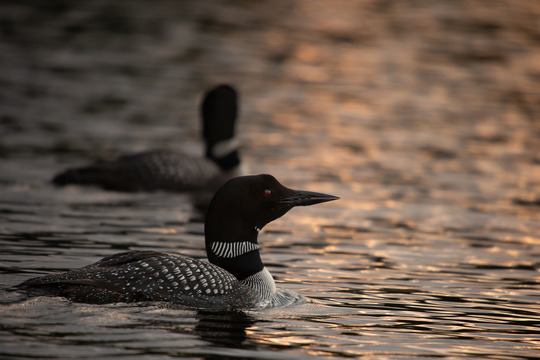 Photo by Jenna Martin
We can’t talk about summer in Minnesota without mentioning loons.
The common loon is a Minnesota icon for a reason. They drift across our lakes and fill our summer evenings with their beautiful calls.
Loons are built for a life on water. Unlike most birds, their bones are solid, allowing them dive as deep as 250 feet in search of food. They can stay underwater for up to five minutes and their special webbed feet make them excellent swimmers.
These same feet keep them close to the water. It’s difficult for them to walk on land and they have to take off in water. They build their nests on or near lakeshores, making shorelines incredibly important habitat for our beloved state bird.
Visit our website for tips on how you can make your lakeshore loon-friendly: mndnr.gov/eco/nongame/loon-habitat.html.
EagleCam chicks receive bands
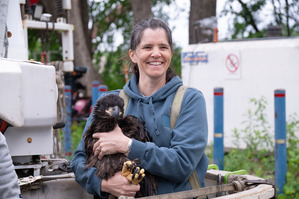
DNR staff visited the EagleCam pair’s alternate nest on Friday, May 16 and banded the two eaglets. Both appeared healthy and we believe both are female. At the time of banding, the chicks were estimated to be about seven weeks old.
In the coming weeks, the eaglets will begin to exercise their wings and venture further from the center of the nest. Before they fledge (leave the nest), they will “branch” out onto the tree, practicing perching on live tree branches. At about ten weeks of age, they will take their first flight.
The alternate nest continues to be out of view of the camera, so we have moved the view toward the river, where the adults can sometimes be seen perching: mndnr.gov/eaglecam.
Photo: Kristin Hall, Nongame Wildlife Program supervisor, holding one of the banded eagle chicks.
|
Three peregrine falcon chicks from the FalconCam received bands and have fledged
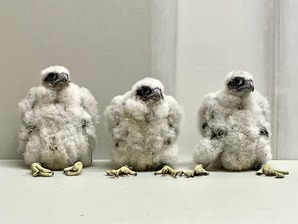
On Monday, June 2, the Midwest Peregrine Society led the banding of the DNR FalconCam chicks. DNR staff were also present, assisting as each peregrine falcon chick received identification bands and a health checkup. All three were deemed to be developing well, seemed healthy and were returned to the nest box. Two of the chicks were identified as male and one as female. All banding, marking and sampling was conducted under a federal authorized Bird Banding Permit issued by the U.S. Geological Survey.
One of the FalconCam chicks fledged at 6:47 a.m. on June 18. The remaining two chicks fledged on June 24; one in the morning and one in the evening.
Over the next few weeks, the parent falcons will continue feeding and watching over their young, protecting them from predators. Eventually, they will show them how to be a peregrine falcon, teaching them how and where to hunt for food. The adult falcons may occasionally visit the nest box and be seen on camera, which will remain on.
Now that the chicks have fledged, they will most likely not return to the nest box and will ultimately find their own territories. Thank you for watching this season with us.
Photo: The three FalconCam chicks with their identification bands.
|

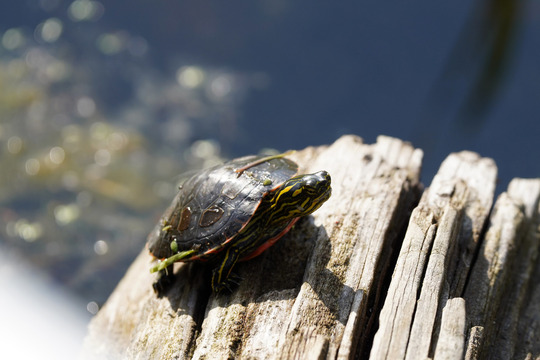 Photo of a western painted turtle basking in the sun by U.S. Fish and Wildlife Service, public domain
“I’m gonna soak up the sun.” 🎶☀️🎶
If you’re near water this summer, chances are good that you will spot a turtle sitting on a log sunbathing. This is called “basking” and helps turtles regulate their body temperature.
Turtles are reptiles and cannot internally regulate their body temperature, so they need to bask in the sun to warm up. Basking also helps turtles kill any latched leeches, if they stay in the sun long enough. 💀
Click the link to learn more about basking: https://www.orilliamatters.com/outdoors/for-turtles-basking-in-the-sun-can-be-a-matter-of-life-or-death-2636895

Our participatory science program continues to expand.
The Frog and Toad Calling Survey season is in full swing, and we’ve been fortunate to welcome new and returning volunteers this year. The early spring survey period is over for southern and central Minnesota and well underway for routes in northern Minnesota. Volunteers have mainly heard wood frogs, spring peepers, boreal chorus frogs, leopard frogs, American toads and gray tree frogs. Volunteers also heard the state endangered Blanchard’s cricket frog (pictured) at a couple of stops, and one lucky volunteer found an active fox den with pups. The survey continues through the summer.
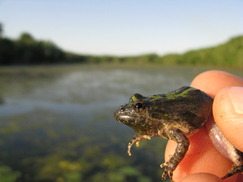
Our Blanchard’s Cricket Frog Survey is also welcoming new volunteers this year. The Blanchard’s cricket frog is our only state endangered frog, and we need help locating new populations. This project is a collaboration among the DNR Nongame Wildlife Program, the Minnesota Amphibian and Reptile survey and Herp Mapper. Visit the survey’s webpage for more information.
|
We are expanding our chimney swift program this season, in collaboration with multiple local conservation groups. Chimney swifts nest and roost in chimneys and other vertical structures. Swifts are good neighbors and provide a valuable service by eating lots of insects. Visit our website to learn how you can help conserve and support chimney swifts.
Stay up to date with our participatory science program events by following us on Facebook.
Photo: Blanchard’s cricket frog, held by a DNR nongame wildlife specialist.

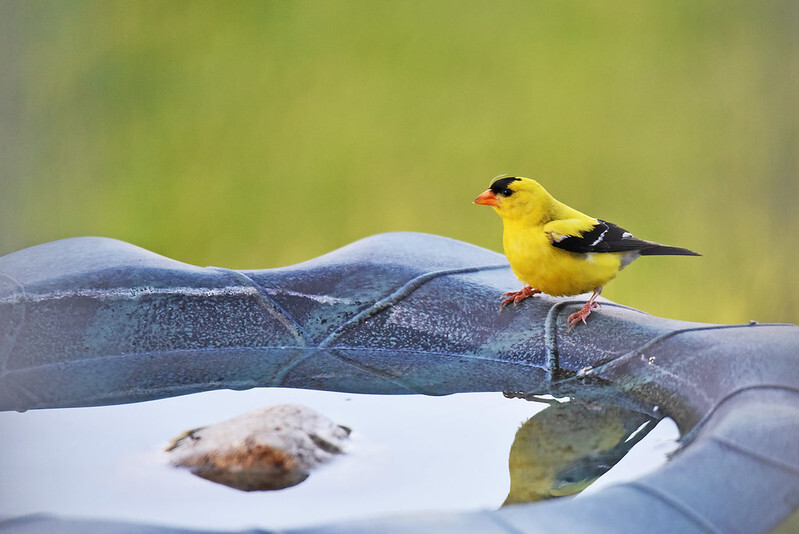 An American goldfinch at a bird bath by U.S. Fish and Wildlife Service, public domain
Attract birds to your backyard with a bird bath. 🛁 🐤
Bird baths are an excellent way to provide clean drinking and bathing water for birds. Place them near shrubs and bird feeders to maximize their habitat value by providing food and protective cover along with the water source. Add a few pebbles or stones to your bath to give the birds extra places to perch.
Keep your visitors safe and healthy, and avoid creating a breeding place for mosquitos, by regularly emptying and cleaning your bird bath. Mold and bacteria can grow quickly, harming the birds you’re trying to help. Bird baths should be emptied and rinsed every other day, so any potential mosquito larvae don’t have time to mature. Deep clean every few weeks, but avoid using detergents or chemicals. Simply scrub it down with nine parts water, one part vinegar and rise well before refilling.
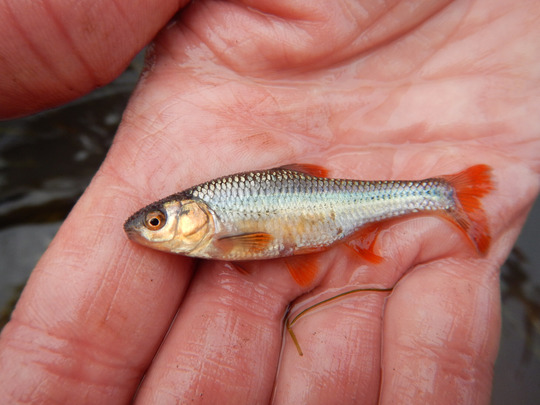 A Topeka shiner by U.S. Fish and Wildlife Service, public domain
The Topeka shiner is a small minnow that lives in prairie streams in southwestern Minnesota. They only grow to 3 inches in length, with silvery scales and orange-red fins.
Topeka shiners are federally endangered and a special concern species in Minnesota. Habitat loss has greatly reduced their numbers, and they now occupy less than 10% of their original geographic range.
The DNR and our partners have been researching this endangered fish and restoring prairie streams, resulting in a hopeful comeback for this humble minnow.
Learn more about Topeka shiners, and how the Nongame Wildlife Program is supporting their conservation, in “Prairie Lights” by Laurie Allmann.

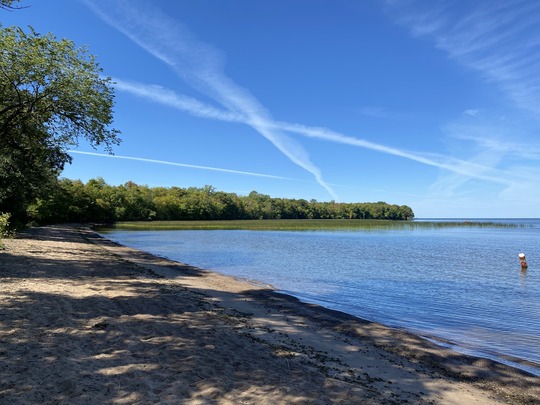 The beach at Father Hennepin State Park
No cabin? No problem! There are many free or low-cost watery places you can visit this summer to spot aquatic wildlife. Be like a loon and go for a swim or tap into your inner turtle and soak up the sun. ☀️
Sit by the shore at a state park beach 🏖️
There are 10 state parks across the state that have swimming beaches you can enjoy. Day passes are $7 and an annual pass is $35.
Go for a dip in a Scientific and Natural Area 🏊
There are many Scientific and Natural Areas with rivers, lakes and streams. Some, like Watrous Island SNA in Koochiching County, Iona’s Beach SNA in Lake County and Mississippi Oxbow SNA in Itasca County have swimming areas you can enjoy. And many allow fishing. Check their rules page for more information. SNAs are free to visit, but more rustic than state parks, so prepare before you go.
Enjoy a paddle down a state water trail 🛶
Minnesota’s incredible state trail system also includes 35 state water trails. That’s over 4,500 miles of paddling you can enjoy, giving you ample opportunity to see our water-loving wildlife.
Slip into the water at a state forest 🌲
There are 15 state forests with beaches, all free to visit. Make a trip of it by camping for only $17 a night. Find one near you at mndnr.gov/state_forests/list.html.
Take advantage of the metro’s extensive park system 🌊
Minnesota is the land of 10,000 lakes, and hundreds of them are in the Twin Cities and surrounding suburbs. Three Rivers Park District has 18 sites that you can paddle in and all are free to visit. Bring your own canoe or rent one of theirs.
|