|
The Pearl Button Industry
|
|
|
May 22, 2024
Ecosystem Engineers
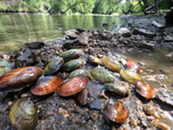
Freshwater mussels are one of the most imperiled groups of animals in the world, and there are many facilities in the United States that are working to restore declining mussel populations. Dams, pollution and sedimentation play a huge part in mussel decline. To fully understand this decline in populations, we need to go back to a time where mussels were plentiful- during the button industry boom.
|
|
|
Mississippi Buttons
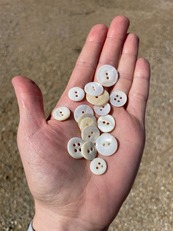
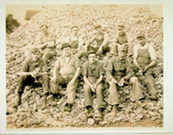
In the 1800s, a German man named J.F. Beopple is said to have traveled to the US and stumbled upon freshwater mussel shells on the shore of the Mississippi River. As legend goes, he realized the shell was similar to those in Germany he had used to make buttons with. Ten years after Beopple found his first shell, a multimillion-dollar industry was established to harvest mussels to make buttons from their shells. By 1899, there was more than 50 button factories lining the banks of the Mississippi River near Muscatine, Iowa. Production grew from 11.4 million buttons being produced annually by 1904 to 40 million by 1916. This operation was able to create thousands of jobs in small river towns along the Mississippi River. Some folks would bring home $10 per day if they hit a good mussel bed. Within just a couple years, the growing demand for buttons started to take a serious toll on freshwater mussel populations. The obvious solution at the time was to attempt freshwater mussel propagation solely for button production.
History of Mussel Harvest on the River
|
A Failed Propagation Attempt
By 1912, the button industry hit a barrier when they realized they had overharvested the native mussels. This took a major toll on the mussel populations in the Mississippi River. The next logical step at the time was to start propagating these animals for their shells. The Fairport Biological Station opened for mussel propagation shortly after. Unfortunately for them, the operation had to stop in 1930. The biologists realized that their juvenile mussels were not surviving in the local rivers that had been polluted with sewage from new cities and silt from new ag practices nearby.
|
Propagation for Restoration
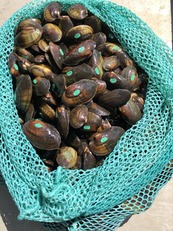
Around the same time in the 1930s, plastic buttons came on scene, and they were cheaper and easier to make. Harvesting mussel shells for buttons would continue around the country until the late 70s and 80s. By the late 90s into the early 2000s, the decline of freshwater mussels started to gain serious recognition as surveys were being conducted all over the country. Now in 2024, there are over 30 mussel hatcheries in the United States that are working tirelessly to restore historic populations.
|
 |
|
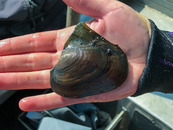
Ironically enough, J.F. Beopple is said to have died by cutting his foot on a pink heelsplitter mussel and developing a blood infection. |
 |
|
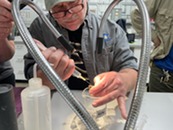
CAMP biologists have just completed their first 2024 inoculation! Bernard Sietman (pictured) is extracting glochidia from the federally endangered Snuffbox (Epioblasma triquetra) to artificially inoculate Logperch. In a couple weeks, CAMP will have newly metamorphosed baby Snuffbox, which will live in the lab for about a year before they're moved to a secondary grow out location nearby. |
Check out our CAMP website!
|
|
 |
|
Special thanks to Minnesota's Environment and Natural Resources Trust Fund for funding this project. |
|
|