|
Sept. 20, 2023
In this issue, find reminders about how to get your deer sampled for chronic wasting disease, the youth deer season, early antlerless season, a citizen science trail camera project and other seasonal deer hunting information.
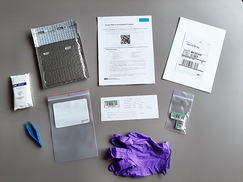
How to get your deer sampled for chronic wasting disease
Minnesota deer hunters, you have multiple options for getting your deer tested for chronic wasting disease.
CWD sampling options include requesting a mail-in kit before hunting or utilizing kits obtained but not used last year. Hunters may participate in the partner sampling program. Hunters can also make an appointment to have their deer sampled at Minnesota DNR area wildlife offices, and contact information is available on the DNR website. Additionally, deer hunters are required to have their deer 1 year or older sampled for CWD in all CWD management and surveillance zones during the opening weekend of the firearms A season (Nov. 4-5).
Make sure you know the DPA number of the area you’re planning to hunt prior to buying a license and take time to understand the CWD regulations and sampling options for that particular area. We also have a DPA lookup tool on the DNR’s make a plan for deer season webpage to help in checking if a DPA has carcass movement restrictions, or has deer feeding or attractant bans in place.
|
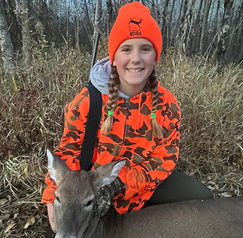
Statewide youth deer season returns Oct. 19-22
Minnesota’s youth deer season will take place statewide Thursday, Oct. 19, through Sunday, Oct. 22. The season coincides with statewide teacher workshops, so many Minnesota students don’t have school during the youth season.
To participate, youth must be 10-17 years old and have a deer license. Participant numbers are not limited and there is no special permit, so parents should purchase or obtain a regular deer hunting license for each youth who will be hunting. Youth may not tag antlerless deer or legal bucks taken by another individual. Crossbows are allowed for licensed youth hunters. An adult parent, guardian, or mentor must accompany youth ages 10-13.
All hunters and mentors, regardless of whether they are participating in youth deer season, must follow blaze orange/pink clothing requirements. Fabric or synthetic ground blinds on public land must have a blaze orange safety covering on top of the blind that is visible from all directions, or a patch made of blaze orange that is at least 144 square inches (12x12 inches) on each side of the blind.
Adults may not hunt, unless they are in an area open during the early antlerless season and have the corresponding license. Complete youth season details are available on the Minnesota DNR youth deer season page.
Photo courtesy of Janelle Hahn
|
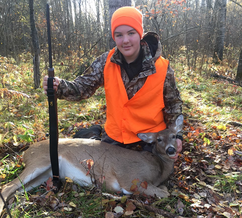
Early antlerless-only deer season is Oct. 19-22
Hunters can participate in an early antlerless-only deer season from Thursday, Oct. 19, through Sunday, Oct. 22. The season increases opportunities for hunters in deer permit areas where deer populations are above population goals or where there is an increased risk of chronic wasting disease. Permit areas open during the hunt are 214, 215, 218, 219, 221, 222, 223, 225, 227, 229, 236, 277, 341, 342, 605, 643, 645, 646, 647, 648, 649, 661 and 701.
The Minnesota DNR offers this opportunity to hunters in an effort to manage local deer herds. The bag limit is three antlerless deer and deer taken during the early antlerless-only season do not count against the statewide bag limit or the permit area bag limit. Youth may not tag antlerless deer or legal bucks taken by another individual. Fabric or synthetic ground blinds on public land must have a blaze orange safety covering on top of the blind that is visible from all directions, or a patch made of blaze orange that is at least 144 square inches (12x12 inches) on each side of the blind.
Before participating, hunters should review the specific license and permit requirements available on page 88 of the Minnesota Hunting and Trapping Regulations.
Photo courtesy of Jacob Niehaus
|

Share your trail camera photos
The Offal Wildlife Watching Project with the University of Minnesota Extension aims at better understanding what Minnesota wildlife species are attracted to and eat the organ meats (offal) in gut piles left from hunters field dressing deer and how offal affects wildlife food webs.
The project asks volunteer hunters to set up camera traps on the offal they leave in the field to capture images of wildlife visitors for one complete month. The project also relies on volunteers to help classify and identify wildlife in our many thousands of captured images each hunting season at Zooniverse.org.
The project is currently seeking more deer hunter participants from throughout Minnesota. Hunter participants are welcome to use their own trail cameras or borrow camera equipment to use and get via mail from project staff. Prospective participants can find more information and register at offal@umn.edu. Questions can be directed to Program Coordinator Grace Milanowski at offal@umn.edu or 612-626-0109. You can also follow the project on Facebook, Instagram and X (formerly Twitter).
|
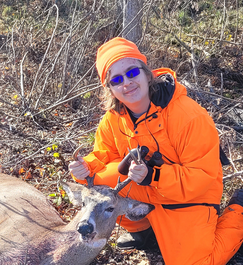
Deer season quick reminders
With deer seasons approaching, here are a few quick reminders.
- During youth deer season, parents often wonder what license a child needs for youth deer season. The license is the same license the youth would get for the regular firearms season, and the youth can use this license during the regular season if they don’t fill it during the youth season. For bag limits and other details, check the youth deer season page.
- This year, there was a change related to party hunting and youth. Youth may not tag antlerless deer or legal bucks taken by another individual.
- Finally, there was a change requiring fabric or synthetic ground blinds on public land to have a blaze orange safety covering on top of the blind that is visible from all directions, or a patch made of blaze orange that is at least 144 square inches (12x12 inches) on each side of the blind. Blaze clothing requirements remain the same this year.
For more information, check the Minnesota hunting regulations, including page 8 that lists what’s new this year.
“My son Cajun's first buck” photo courtesy of Todd Follett
|
All about the habitat
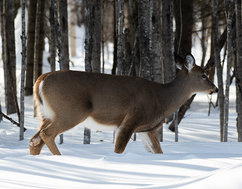
Ever wonder what we can do to manage winter severity’s impact on deer populations? The best way: habitat improvements.
In the northeast part of the state, the Minnesota DNR planted more than 63,000 conifer and oak trees across multiple sites through the Conservation Partners Legacy Grant program (with help from North St. Louis Soil and Water Conservation District). These trees are critical for creating snow shelters and travel corridors for deer in their wintering areas along the St. Louis River.
The DNR and its partners have also done a lot of on-the-ground work to improve existing habitat in the northeast, including hand-cutting competing vegetation near planted conifers, prescribed burning to enhance blueberry and acorn production, using tree cages to protect seedlings and saplings for future winter cover, and removing invasive species.
So what about work private landowners can do on their land? Check out the DNR’s private land habitat page. You can also check out a recording of our outdoors skills webinar all about creating more wildlife habitat in your woodlands.
Photo courtesy of Alex Lamoreaux, iNaturalist
|
|