|
Jan. 19, 2023
In this issue, find out how you can share your thoughts about deer populations and learn more about the deer feeding ban, aerial elk surveys, planning for moose habitat improvements, and hunting skills webinars.
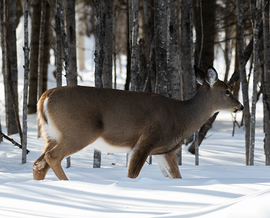
Please share your thoughts about deer populations
Beginning Monday, Jan. 23, we’re asking for public input on deer population goals in 23 deer permit areas in eastern and south-central Minnesota.
Opportunities for input will include an online questionnaire, a webinar and two in-person public meetings. We’re excited to hear your thoughts about deer population trends where you live, work and recreate.
The targeted DPAs this year are:
- DPAs 152, 155, 156, 157, 159, 172, 183, 221, 222, 225, 248, 249, 604 in the East Central Uplands goal block; and
- DPAs 219, 223, 224, 227, 229, 235, 236, 285, 338, 605 in the Sand Plain/Big Woods goal block.
The DNR establishes deer population goals — how much of a population increase or decrease is desired in a particular DPA — as part of managing the state’s wild deer.
Population goals established in this process will provide direction for deer management in DPAs for a 10-year period, with a midpoint review at the five-year mark. Goal blocks and the DPAs that comprise them are established based on similar habitat, land uses, deer populations and deer hunter distribution.
Find all the details, including about a webinar coming up on Monday, Jan. 23, on the DNR’s deer goal setting page.
Photo courtesy of Alex Lamoreaux, iNaturalist
|
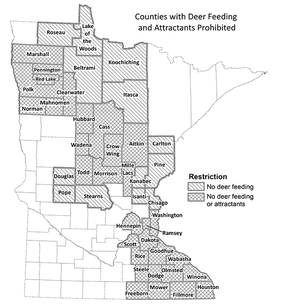
Reminder about deer feeding and attractant bans
Here’s a reminder that deer feeding and attractant bans are in place across the state to prevent concentrations of wild deer in areas with a higher risk for disease. These bans are precautionary steps the DNR took after deer that tested positive for chronic wasting disease were found both in the wild and on deer farms.
Feeding bans encompass wider areas because food sources can concentrate deer and allow for close contact — one of the mechanisms for CWD spread. Find more information on the deer feeding and attractant ban page.
|
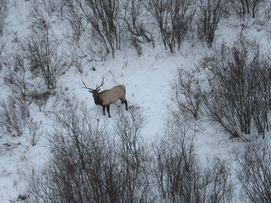
DNR to fly elk surveys in northwestern Minnesota
The DNR will soon be conducting aerial elk surveys. DNR staff will survey the Kittson County and Grygla elk herds in northwestern Minnesota and the border elk herd in both Minnesota and Manitoba.
The surveys are typically conducted each year during the winter, weather permitting, and are expected to be completed in two weeks.
Aerial survey information is used to monitor elk populations and help the DNR make decisions about future elk management and harvest regulations.
DNR pilots will fly surveys during daylight hours at an altitude of approximately 200 to 300 feet.
The DNR is also asking for help from those who have recently seen elk in their area. People are encouraged to contact their local DNR office with sighting information:
- Karlstad area wildlife office, 218-436-2427
- Thief Lake Wildlife Management Area, 218-633-7671
- Thief River Falls area wildlife office, 218-219-8587
You can also document observations online using the DNR elk sightings tool.
|
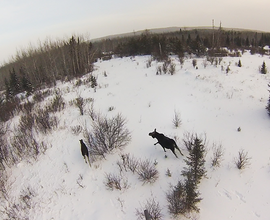
Moose habitat planning effort receives America the Beautiful Challenge grant
A federal grant award will fund collaborative planning by the DNR to further large-scale moose habitat restoration in northeast Minnesota.
The award from the National Fish and Wildlife Foundation, through the America the Beautiful Challenge, will provide $443,600 to the DNR for the planning effort, with a goal of an implementation plan for moose habitat restoration on three areas of 10,000 to 50,000 contiguous acres each.
Tribal, federal, county and non-governmental partner organizations helped develop the planning approach and signed letters of support for the DNR’s grant application, which was one of 55 chosen nationwide from more than 500 applications.
The patchwork of tribal, federal, state, county and private land in northeastern Minnesota makes large-scale habitat restoration particularly challenging. The grant will fund a series of workshops with tribal, federal, state, county and non-governmental partner organizations in 2023 and 2024 to identify the challenges facing large-scale moose habitat restoration, find strategies to address the challenges, identify areas for large-scale habitat restoration and create an implementation plan for the restoration. The implementation plan will also identify potential sources of funding to complete the agreed upon large-scale habitat restoration.
|
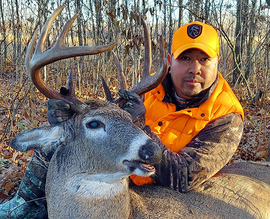
Plan for fall hunting seasons
Know someone who needs to take firearms safety or get practicing for archery season for when fall rolls around again? Check out our recorded skills webinars on those topics. Click firearms safety and archery at our Minnesota Outdoor Skills and Stewardship page to access the webinars.
Photo courtesy of Bee Xiong
|
|