|
July 18, 2022
Newsletter for Strategic Land Asset Management (SLAM)
This staff newsletter provides information and updates on the department's Strategic Land Asset Management (SLAM) program.
In This Issue
‘Just a beautiful complex': Minnesota maps new hunting and wildlife areas full of benefits, April 7, 2022, Star Tribune
Bois Forte Band Gets 28,000 Acres of Land Back in Northern Minnesota, June 7, 2022, Native News Online
DNR partners to purchase additional shoreline on leech lake for habitat conservation, June 9, 2022, Bemidji Now
DNR gifted with 729 acres of land along St. Croix River, June 28, 2022, KARE 11 News
DNR receives land donation along St. Croix River in Chisago County, July 7, 2022, Isanti-Chisago County Star
A decades-long land acquisition helps conserve Minnesota's "Big Woods" forests
Written by Mollie Gudim, information officer, Lands and Minerals Division
Minnesota’s lands and waters are a haven for rare and critical species and a hotbed for scientific research. At the DNR, investigation and conservation of our state’s diverse natural ecosystems – especially related to plant and animal life – are central to sustainably managing state lands.
Generous and nature-minded families can assist the conservation of high-quality biological communities by gifting their land to the DNR’s Scientific and Natural Areas (SNA) Program.
The priority of each acquisition or conservation easement is to maintain the state's ecological and geological diversity – with particular emphasis on sustaining native plant communities and rare features.
In the state’s central region near Long Lake, Wood-Rill SNA is a standout example of an acquisition helping to conserve – and in some spots, regrow – the “Big Woods" Sugar Maple Forest. A significant amount of this primeval forest type, largely unaffected by humans, has been lost across most of Minnesota.
Protecting natural lands like these ensure that habitats aren’t developed and biodiversity is not displaced, keeping critical ecosystems intact while also satisfying historical curiosity. The dominant canopy trees at Wood-Rill range anywhere between 130 to 300 years old.
Like the 90-foot-plus red and white oak trees here, Wood-Rill SNA has quite a long history of how it came to be. Bruce and Ruth Dayton put together this special place, acquiring piece by piece between 1946 and 1960. Always leading with their hearts for nature conservation, the Daytons were very enthusiastic about protecting the area’s ecological value. They began by placing conservation easements and then ultimately bestowed their land upon the DNR in the mid-nineties. In 2021, DNR added the final acres from the Dayton estate to the SNA, bringing the total size of Wood-Rill SNA to 141 acres of protected forestlands.
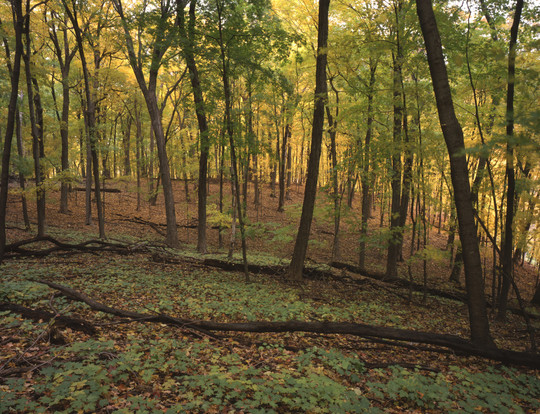 Large, downed trees are scattered on the forest floor in various stages of decay
“We're working on a management plan for the entire property, including a restoration plan for this newest addition, said Kris Hennig, NR specialist for EWR. “As best we can, we’ll restore some of the slightly degraded forests in this area. There's a lot of exposed soil where the home was, and in places like the demolished driveway or barn, we hope to plant trees.”
On top of planting trees to stabilize the soil, the restoration plan includes seeding for native forest wildflowers and grasses for secondary cover until some forest trees are established. “The long-term trajectory is to regrow the Big Woods forest and to create more deciduous hardwood forests for rare birds,” Hennig said.
Wood-Rill offers a unique type of bird watching. The red-shouldered hawk relies on large tracts of mature hardwood forests for food, water, nesting and perching sites. The closed canopy deciduous forests are an ideal habitat for these unique birds of prey.
Beyond habitat conservation, SNAs are important hosts for research and monitoring – including plant and animal surveys and data collection on rare species habitat – to help maintain biological diversity and productivity of natural lands. Researchers visit Wood-Rill SNA to understand Minnesota’s old growth forests and the impacts of deer browse on native plant or forest communities.
“Relatively undisturbed areas like this create a really unique and valuable resource for understanding Minnesota’s wilderness,” Hennig said.
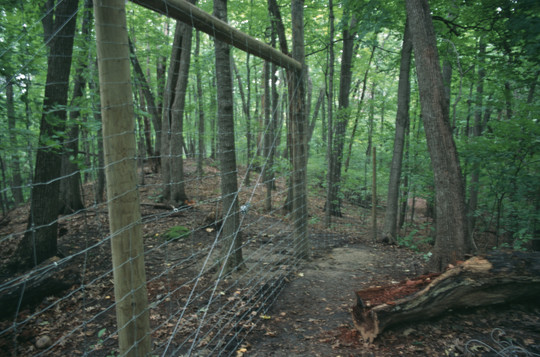 Exclosures used to study effects of deer and earthworms on ground-layer
From funding for research and restoration projects to choosing a name for its big woods and small streams, the Daytons were actively involved in preserving this natural land. Now, everyone who explores the area’s deep woods and steep hills, sedge meadows and black ash swamps, feels the impact of the Wood-Rill SNA. Whether a researcher, a recreationist, or a natural resource advocate, we can all learn valuable lessons from the ancient trees and from the forest, older still.
Kris Hennig worked closely with Lands and Minerals Division staff to move this project forward. Holly Bernardo, who is now with the Minnesota Biological Survey, was the SNA regional supervisor at the time. Additionally, Russ Smith worked with the contractors for the building demolition on the newest addition to Wood-Rill SNA.
Take a short virtual hike of Wood-Rill
 Wood-Rill Scientific and Natural Area Virtual Hike
Minnesota’s Scientific and Natural Areas
The department’s SNA Program administers 192,000 acres of land, including nearly 170,000 acres of peatlands, within 67 of Minnesota’s 87 counties. The SNA Program prioritizes acquiring lands that will:
- protect rare animal habitat and plant species
- protect native plant communities or unique geological features
- sustain natural features and public benefits
- provide public access for compatible nature-based recreation and education
- connect SNAs to other protected lands to develop larger conservation areas
Written by Mollie Gudim, information officer, Lands and Minerals Division
Whether we are working together to find sustainable uses for natural lands, conducting research to help understand and enhance ecosystem services, or creating plans to restore habitats and protect biodiversity, nature conservation is a personal philosophy and intentional practice – one that guides many DNR employees to natural resource careers and continues motivating them to achieve their goals. Bill Bleckwenn, for example, has an evergreen love of horticulture and botany, an interest that took root as a young boy and then grew and stemmed its way through positions within Lands and Minerals (LAM) and Ecological and Water Resources (EWR).
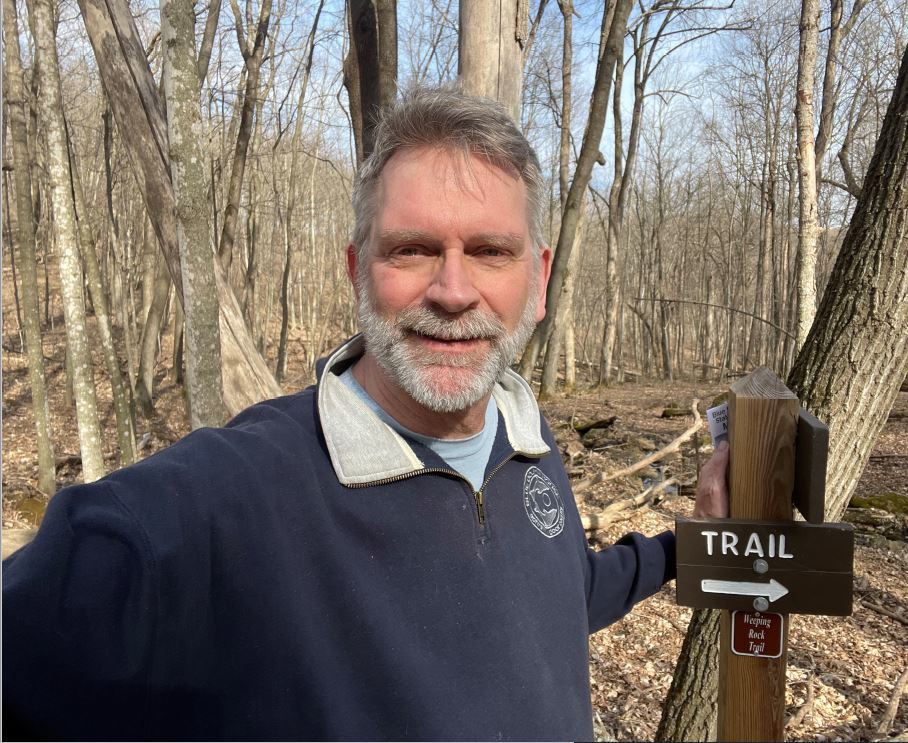 Bleckwenn explores a favorite trail
When he was just 11 years old, Bleckwenn and his family visited a traditional Japanese tea garden in Golden Gate Park in San Francisco, California. The garden’s lush landscaping: Japanese maples, azaleas, and cherry blossoms, captivated Bleckwenn – and his dad. “We got home from vacation and dad said ‘all right, that’s it, we’re building a Japanese garden in our backyard.’ It was a noble effort and my dad got me very involved in designing and building the garden. It was my first time operating a front-end loader,” Bleckwenn said, chuckling at the memory.
The Japanese garden adventure – in California and at home – planted a seed, but four years later on trip to Washington DC is when Bleckwenn’s interest in the art of landscape cultivation and management really began blooming. “Springtime in DC is nature’s great awakening – the blossoming cherry trees, the flowering dogwoods, the redbuds and the spring bulbs – it’s all so stunning,” he said.
The natural world and its processes can teach us a lot about resiliency and creativity, and Bleckwenn has certainly lived that line. For more than two decades, he used his skillset as a landscape architect to improve human and environmental health through planning and designing unique natural spaces. Then, an unexpected push caused a change in direction.
He’d always had a fascination with native plant communities and their ecosystem services. In 2012, he became principal planner for the DNR’s Scientific and Natural Areas (SNA) program. “Working for the DNR taught me that being a designer isn’t as important to me as helping to conserve native plant communities or habitat for endangered or critical species,” Bleckwenn said. The department hired him to draft the statewide conservation plan; at the time, the goal was to use geospatial data to prioritize conservation areas.
“I don’t have a PhD. in conservation biology, so I had to do my research and get creative,” Bleckwenn said. He took a class on Marxan software, a widely used conservation and natural resource planning tool. Marxan provides connectivity and prioritization functions to find and link biodiversity conservation hotspots in marine, terrestrial, and freshwater environments.

Bleckwenn worked closely with the Nature Conservancy, the University of Minnesota, The Conservation Fund, and other partners through Commissioner’s Advisory Committee to map zones of priority conservation.
Studying the map results, Bleckwenn points out belts of hot conservation opportunities across the state, including an area north of the Twin Cities.
“Whether a native prairie, another rare plant community type, or an endangered species, the maps and dataset can help us identify particular targets worthy of conservation,” he said.
In his new role as the statewide SNA acquisition coordinator, Bleckwenn is thinking about how the department can be innovative conservationists. He often asks if acquisition is the only answer. “The maps can facilitate thought about other ways we can meet our conservation goals, such as new types of easements, the natural heritage registry, or maybe even buffering,” he said.
The map and its dataset can also help us understand how native plant communities play a role in mitigating climate change impacts. “Conservation areas encompass a lot of different microclimates and niches. As the climate changes, species will move and try to find suitable places to exist,” Bleckwenn said. “The more extensive our conservation corridors are, and the more variety in landscapes that they have, the more likely it is that species can find a way to migrate and persist.”
Bleckwenn continues working hard, both in work and at home, to support nature’s remarkable capacity to restore and revive. Whether in the woods behind his house or out on a hiking trail, he looks for opportunities to pull invasive species. He and his husband are also expanding their pollinator gardens. No matter at home or in the office, Bleckwenn wants to give back to Minnesota’s natural world: “this state and the land have been very good to me and to all of us – creatures, plants, and humans alike. It’s our job to respect and protect the home we share,” he said.
|
|