|
The DHS communication to APS professionals on July 1, 2026, 2026 Legislative Session Impacts on APS, highlighted reorganization of APS duties within the Minnesota Vulnerable Adult Act. DHS is continuing to support counties on phased implementation for these changes through ongoing communications, training, policy guidance, and planned updates to existing reports in the Social Services Information System (SSIS) to align with the revised timelines and statutory requirements.
As part of the 2026 legislative changes to the Minnesota Vulnerable Adult Act (VAA), the Department of Human Services (DHS) updated policy in the Adult Protection Manual to align with new statutory requirements including Minnesota Statute 626.557 Subd 11j. County social services agency; conflict of interest. This new subdivision of the VAA establishes requirements for county agencies to identify, avoid, document, and manage conflicts of interest in APS practice and provides new authority for the Department of Human Services (DHS) to determine the county agency responsible when a county APS program identifies a conflict and no other county will accept jurisdiction for the report and/or adult protective service decisions for the adult.
Conflict of Interest Definition and Response
The county social services agency employee or designee engaged in APS intake, assessment, investigation, or service interventions must not have as conflict of interest.
A conflict of interest is defined as:
- A personal or family relationship with a party involved in the investigation or assessment.
- A dual relationship with the adult, such as serving as the individual's case manager, guardianship petitioner, guardian, or payee.
- A personal or family financial interest with a provider receiving referrals from the employee.
- Any other circumstance that creates the appearance of a conflict of interest, as determined by the county social services agency.
When a conflict of interest requires reassignment of APS responsibilities to another agency, the conflicted agency must coordinate with another county social services agency to assume jurisdiction as the Lead Investigative Agency (LIA).
If the conflicted agency cannot identify another agency willing to accept jurisdiction, the agency must consult with DHS. DHS may coordinate with another county and reassign jurisdiction based on the agency best able to protect the adult. When directed by DHS, the adult maltreatment report may be returned to MAARC by the conflicted agency for reassignment to another agency. Reassignment of the maltreatment report will occur through the Social Services Information System (SSIS). The reassigned APS agency assumes jurisdiction for the report and is responsible for screening the report, initial disposition and any subsequent case decisions.
Unavoidable Dual Relationships
APS staff in each agency must avoid dual relationships whenever possible. Dual relationships may be unavoidable in smaller agencies where staff perform multiple roles or in smaller communities where personal knowledge of individuals involved in an APS assessment cannot reasonably be avoided. A dual relationship is unavoidable when there is no reasonable alternative to meet the adult’s needs. When a dual relationship cannot be avoided, the agency must establish and implement appropriate safeguards to minimize actual or perceived conflicts of interest and ensure that APS decisions, assessments and service plans remain focused on the adult's safety, rights, and best interests.
Guardianship
Petitioning for guardianship or serving as guardian for an APS client creates a dual relationship and potential conflict of interest.
To minimize the potential conflict, APS should:
- Explore and implement less restrictive alternatives to guardianship.
- Explore other support persons, agencies, or entities qualified to petition for or serve as guardian.
- Petition for or serve as guardian only when the court orders the APS program to petition for guardianship or appoints APS to serve as guardian.
Documentation
For every unavoidable dual relationship, the agency must document in the case record:
- The nature of the dual relationship.
- Why the dual relationship could not be avoided.
- The safeguards or mitigation strategies implemented to manage the conflict.
- How the safeguards support objective decision-making and protect the adult's rights, safety, and well-being.
When guardianship is involved, APS should also document the less restrictive alternatives considered and why they were unsuccessful, explain why APS involvement as petitioner or guardian is necessary, utilize the county guardianship screening committee under Minnesota Statute 524.5-304(g), consult with legal counsel, and coordinate with another agency when conflicts affect APS responsibilities.
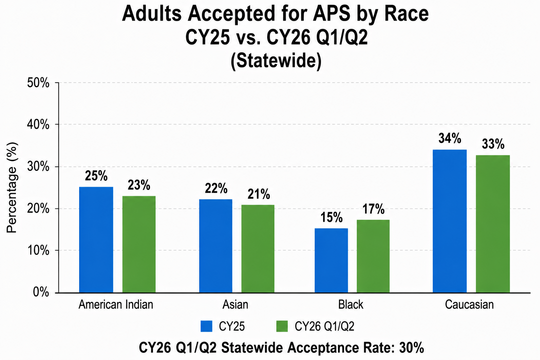
Q3 2025 vs 2026
Adults Accepted for APS by Race 2026 Q1/Q2
This graph shows the percentage of adults referred who were accepted for APS. The numerator is the statewide count of maltreatment reports for adults in the racial demographic accepted for APS and the denominator is the total number of maltreatment reports referred to APS for adults in the racial demographic. The demographic data used was provided by the reporter. The data source is the Social Services Information System (SSIS) data in the DHS data warehouse
"Data is the new oil. It’s valuable, but if unrefined it cannot really be used."
— Clive Humby, Mathematician and Data Architect

MN Adult Protection training courses support equity and consistency in service response and outcomes that safeguard and promote dignity for adults who are vulnerable, regardless of their location in Minnesota. Many of the following training opportunities contribute to APS professionals meeting education requirements under 626.557 Subd. 9e (8 hours annual training specific to adult protection duties).
|
MN Adult Protection Recommended Training Plan
The MN Adult Protection Recommended Training Plan includes important adult protection concepts, statues, and principles. The recommended training plan contributes to onboarding new APS professionals, provides a refresher for current APS professionals, and supports equity and consistency in service response and outcomes that safeguard and promote dignity for adults who are vulnerable, regardless of their location in Minnesota.
Questions? Please connect with the DHS Adult Protection Unit at (651) 431-2609 or dhs.adultprotection@state.mn.us.
MN Adult Protection Learning Management System (LMS) and eLearning Courses
iSpring, the MN Adult Protection learning management system (LMS), is an application that manages and delivers training content. This dedicated MN Adult Protection LMS provides on-demand, self-paced eLearning courses for APS professionals across the state. Content includes foundational eLearning courses, SDM tool courses, Cultural Responsiveness Diversity Information Sheets, and more.
Complete the following steps to access the MN Adult Protection eLearning courses:
- Register for iSpring by selecting the iSpring registration link and filling out the sign-up form
- Select the “Catalog” tab to view the available courses
- To enroll in a course, click a course title and select “Add to My Courses”
- The “My Courses” tab will list all enrolled courses; select a course to begin!
Already registered for iSpring? Select the iSpring login link to access MN Adult Protection eLearning courses.
Available MN Adult Protection eLearning courses address core competency training recommendations in the ACL Voluntary Consensus Guidelines for State APS Systems and align with Minnesota state adult protection policy. eLearning courses include: What is Adult Protection in MN?, MAARC Functions and Duties, APS Intake, MN APS SDM® Trainings; APS Assessment; Engagement Strategies; and more. See the full list of courses on iSpring.
Questions? Please connect with the DHS Adult Protection Unit at (651) 431-2609 or dhs.adultprotection@state.mn.us.
MN Adult Protection Foundations Live Training
Foundations Live training is a 3-hour interactive online training facilitated by MN DHS Adult Protection Unit staff. The course reviews case examples and practical scenarios in order to apply foundational statutory definitions and MN state adult protection policy principles covered in the Adult Protection Foundations eLearning courses. A minimum of six registrants needed for each training to occur.
Click a link below and select the desired date to register for a MN Adult Protection Foundations Live training
***Please note, the Adult Protection Foundations eLearning courses are prerequisite for the MN Adult Protection Foundations Live training
Questions? Please connect with the DHS Adult Protection Unit at (651) 431-2609 or dhs.adultprotection@state.mn.us.
SSIS Essentials eLearning
SSIS Essentials eLearning is a collection of six courses that provide an introduction to basic navigation and functionality of core SSIS functions. SSIS Essentials eLearning is offered through TrainLink. Please visit the SSIS Essentials eLearning website for registration, TrainLink instructions, technical requirements, and more information about each of the courses.
SSIS Adult Protection Worker Training
The SSIS Adult Protection Worker course is a technical training that provides an overview of data entry in SSIS as related to APS. The training is offered in two half-day virtual classes and is designed for new adult protection workers, SSIS Mentors, and those seeking a refresher. Please visit the SSIS Adult Protection Worker Training website for available training dates, registration instructions, and more detailed information about the course.
DHS Adult Protection Resource Specialist (APRS)
DHS Adult Protection Resource Specialist (APRS) staff support adult protection workers and supervisors with policy clarification and case consultation regarding intake, assessment, service intervention, and assessment outcomes for the safety and dignity of adults vulnerable to maltreatment and reported as having experienced maltreatment.
Connect with an APRS today at dhs.adultprotection@state.mn.us or (651) 431-2609.
DHS Adult Protection Newsletters
The DHS Adult Protection Newsletter is a monthly statewide communication from the DHS Adult Protection Unit that shares information specific to adult protection work in Minnesota, answers common questions, and provides updates and information on training opportunities. The DHS Adult Protection newsletter archive, under the "Help With" section, includes 12 months of past newsletters.
Please email DHS Adult Protection at dhs.adultprotection@state.mn.us to request inclusion on the APS mailing list.
Vulnerable Adult Protection Dashboard
The Vulnerable Adult Protection Dashboard provides annual state and county data on the number of reports, allegations, and investigation determinations to explain what happens after reports of suspected maltreatment are made to the Minnesota Adult Abuse Reporting Center (MAARC).

APS Technical Assistance and Resource Center (TARC)
APS TARC provides a variety of free educational opportunities for adult protection professionals including podcasts, webinars, briefs, and toolkits. APS TARC offerings address a wide variety of topics including ethics, frauds and scams, interviews with experts, implicit bias, trauma informed practice, and more. Keep up to date with APS TARC offerings by joining their mailing list, and check out the APS TARC YouTube page for additional content.
|
The DHS Adult Protection Newsletter shares knowledge specific to adult protection work in MN, answers common questions, and provides awareness of DHS Adult Protection training opportunities. The DHS Adult Protection newsletter archive, under the "Help With" section, includes 12 months of past newsletters.
Please contact us with any questions or to sign up for the newsletter at dhs.adultprotection@state.mn.us or (651) 431-2609. For more information, visit us online at DHS Adult Protection: Program Overview

|