|
The Minnesota Department of Human Services finished a comprehensive top-to-bottom review of nearly 5,600 Medicaid providers of high-risk services (PDF) on time on May 31. Completing the effort is a key part of Minnesota’s plan to stop the federal government from withholding up to $2 billion from its Medicaid program.
The five-month review required providers to show they met heightened legal and eligibility standards required to operate and serve vulnerable people.
“More than 1 million Minnesotans deserve to have confidence and trust in the Medicaid providers they depend on for lifesaving and life-affirming care,” said Deputy Commissioner Shireen Gandhi.
A number of providers received disenrollment notices due to submissions of incomplete paperwork and documentation.
“The paperwork is a critical step,” said Gandhi. “This is just not checking the box. DHS uses the information to check requirements are met. And when we go on site what we see must match what was submitted to us.”
Many providers have appealed their disenrollment and can continue billing Medicaid during the appeals process for purposes of continuity of care.
Help for Minnesotans who need new providers
Some provider disenrollments mean some Minnesotans will need to change the way they access Medicaid services.
The state has worked with lead agencies, including counties, Tribes and managed care plans, to make sure they know which providers were disenrolled. These partners will be responsible for ensuring service continuity and helping their clients find new providers if necessary.
In addition, a new webpage to help Minnesotans find care lists resources for people who need to connect to new services. The department is also reaching out directly to Minnesotans who do not have case managers and who receive services from providers who may be disenrolled.
More details about the revalidation effort and other program integrity measures are in a department news release.
Minnesota is pursuing a new initiative that will enable people who are incarcerated to access behavioral health services through Medicaid in the months leading up to their release.
With federal approval, state Medicaid programs can cover certain behavioral health services and medical care for chronic health conditions for incarcerated people for up to 60 days before release.
Primary goals are to reduce overdose deaths, improve public safety and help more people continue getting behavioral health services after release from incarceration. We're seeking federal approval to participate in this demonstration. Research shows that society benefits when people in correctional facilities receive the behavioral health services they need.
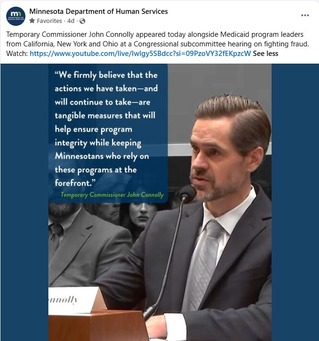
“Providing these services before release fills an important gap and can save lives,” said Temporary Commissioner John Connolly. “Addressing a person’s behavioral health needs before they leave incarceration can help them find stable housing, get a job and rebuild support networks upon reentering their communities – all of which strengthen public safety and lead to better long-term outcomes for communities.”
The first phase of Minnesota’s demonstration will involve three state prisons, four county jails and one Tribal detention center:
- Minnesota Correctional Facility in Faribault
- Minnesota Correctional Facility in Shakopee
- Minnesota Correctional Facility in Stillwater
- Red Lake Detention Center
- Hennepin County Jail
- Scott County Jail
- Stearns County Jail
- Wright County Jail
More information is in a department news release and at mn.gov/dhs/reentry-waiver.
On National Health Care Fraud Takedown Day June 23, Minnesota's Attorney General's Office announced charges against seven defendants for more than $700,000 in Medicaid fraud. Human Services Inspector General James Clark issued the following statement:
“We applaud today’s charges from the Minnesota Attorney General’s Office. The Minnesota Department of Human Services has been working with our partners in law enforcement, sharing credible evidence of fraud when we find it and by supporting the prosecutors who build cases to charge criminals.
"DHS referred two of the cases announced today to the Attorney General’s Office in 2024 and cut off payments to many of these providers two years ago or more.
"My office continues to use its administrative power to shut off money to fraudulent Medicaid providers as soon as we uncover credible allegations of fraud. We’ll continue to provide law enforcement with billing and ownership information, investigative files and other relevant documentation. And as I’ve said before, I fully expect we’ll see more charges in the future.”
Since Jan. 1, 2025, the agency has stopped payment to 695 providers based on credible allegations of fraud and made more than 655 referrals to law enforcement.
>> Follow us on Facebook, Instagram and X (formerly Twitter) for timely updates on DHS news and events.
>> For announcements of hiring events, job postings, internships and more, follow us on LinkedIn and the DHS Careers Facebook page.
For accessible formats of this publication, write to dhs.communications@state.mn.us, or call 651-431-2000 or use your preferred relay service.
|