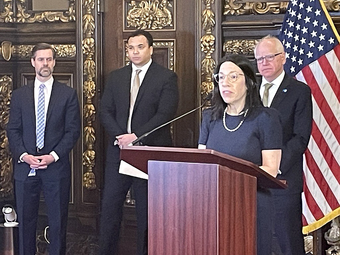
 On Feb. 26, Governor Tim Walz introduced a comprehensive legislative package aimed at preventing, detecting, investigating, and holding accountable those who commit fraud in Minnesota’s state programs.
“Fraud steals from the people of Minnesota and undermines the programs we all rely on,” said Governor Walz. “This package strengthens oversight, improves detection, expands enforcement, and increases penalties to protect every dollar Minnesotans depend on. We’ve followed the experts, audits, and proven roadmaps; now it’s time for the Legislature to act.”
The Governor was joined by Department of Human Services (DHS) Commissioner Shireen Gandhi, DHS Inspector General James Clark, DHS Deputy Commissioner and State Medicaid Director John Connolly, and Bureau of Criminal Apprehension (BCA) Superintendent Drew Evans.
Commissioner Gandhi sees an opportunity to make Minnesota a national model for combatting fraud, waste and abuse. “Governor Walz is leading that effort, and for the past year I have been working to do this, and I will continue to accelerate change within DHS to prevent and fight fraud," she said.
More details are in the Governor's news release.
Work to update Minnesota’s Medicaid claims processing systems using advanced analytics has cleared its first hurdle. The state expects to have a complete pre-payment review process in place by the end of the year.
Over the last three months, Optum has been working with the department to develop an automated system to review fee-for-service Medicaid claims before they are paid, flagging items that need additional review before they are paid.
To guide that work, the company reviewed nearly four years of past Medicaid claims in 14 high-risk services to test software algorithms. Optum also reviewed Minnesota’s policies for paying Medicaid claims. While the first phase of that work is complete, the testing found areas where the state and Optum need to revise some data sets for the system and consider policy updates to improve efficiency.
More information is in a department news release.
Minnesota officials are beginning a massive statewide push to ensure Medicaid providers in 13 high-risk services have the qualifications required by law.
Revalidation of Medicaid eligibility is done for all providers on a regular basis. The process involves a review of the provider’s paperwork and billing and is followed up with an unannounced site visit.
“Performing an unannounced site visit on every provider in 13 high-risk services is a major step forward in ensuring Minnesota’s Medicaid providers are of high-quality and meet the requirements of the law. We’re pulling in resources from multiple state agencies to make this happen as quickly as possible,” said John Connolly, deputy commissioner and state Medicaid director. “Minnesotans need to have confidence that the money being spent on these programs is helping the people it’s intended to help.”
The off-cycle revalidation is a cornerstone of the state’s efforts to convince the Centers for Medicare & Medicaid Services to reverse course on a highly unusual action to withhold over $2 billion in annual Medicaid funding.
More information is in a department news release.
This month, we distributed the first issue of our new Medicaid Program Integrity Update newsletter, designed to increase transparency around our efforts to prevent and fight fraud.
To stay up to date on the latest actions, sign up for our program integrity email list.
And you can always get information on our Medicaid Program Integrity webpage and our fact check page.
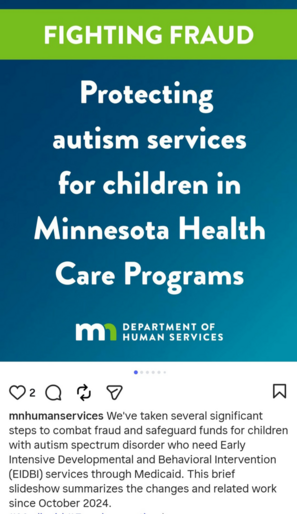
>> Follow us on Facebook, Instagram and X (formerly Twitter) for timely updates on DHS news and events.
>> For announcements of hiring events, job postings, internships and more, follow us on LinkedIn and the DHS Careers Facebook page.
For accessible formats of this publication, write to dhs.communications@state.mn.us, or call 651-431-2000 or use your preferred relay service.
|