|
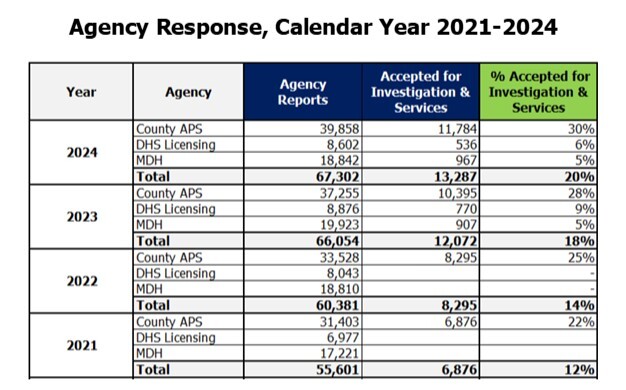
APS agencies across Minnesota are demonstrating improved service outcomes for adults referred by MAARC as vulnerable and maltreated. Newly released 2024 data shows that 52%, or over 4,000, more adults were accepted for APS assessment in 2024 than 5 years ago. The newly updated 2024 Adult Protection Dashboard evidences progress in meeting stakeholder goals to increase the number of adults meeting criteria as vulnerable and maltreated being accepted for APS service interventions with almost 1,400 more adults accepted for APS assessment in 2024 than 2023. Workers managed a 7% annual increase in referrals in 2024 in addition to improving outcomes for adults referred for APS. Increased resources from the Governor and legislature and the dedication by APS professionals to improve the safe3ty of adults in their communities is making a difference!
Additional Adult Protection Dashboard updates include:
- Three PDF documents: 2021-24 MAARC reports statewide, 2021-24 MAARC reports by county agency, and 2021-24 MAARC reports by age, race, and gender.
- Data on demographics of the reported disability of adults referred and accepted for APS has been added to the dashboard.
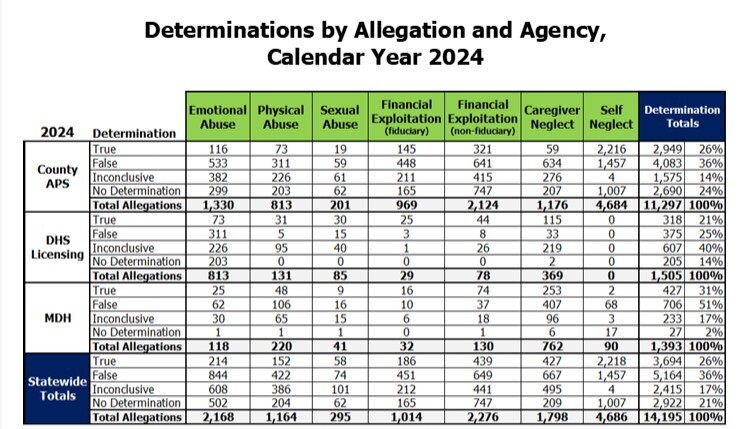
Information on the Adult Protection Dashboard explains what happens after reports are made by the public or mandated reporters to the Minnesota Adult Abuse Reporting Center (MAARC) for an adult who is suspected to be vulnerable and abused, neglected, or exploited. The dashboard data includes: number of reports, agency receiving the referral that must respond, types of allegations, demographics for the adult and response of the responsible agency.
Below are two examples of data from the Adult Protection Dashboard: "Agency Response, Calendar Year 2021-2024" and "Determinations by Allegation and Agency, Calendar Year 2024."
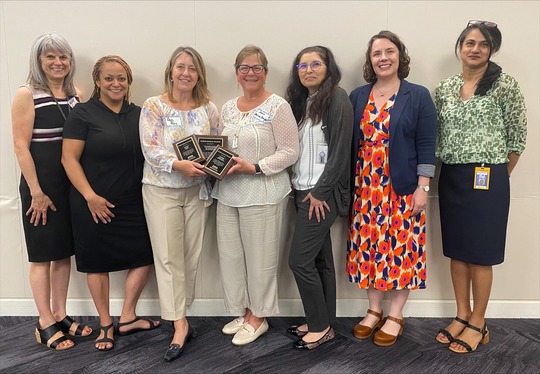 MAARC leaders left to right: Mary McGurran, Aging and Adult Services adult protection manager; Donae Sturdivant, MAARC contract manager; Ann Pung, Customer Elation (MAARC vendor) account services vice president; Joan Barrie-Daigle, Customer Elation account manager; Margie Aranda, Aging and Adult Services MAARC operations manager; Rachel Shands, Aging and Disability Services Administration acting deputy assistant commissioner; Reena Shetty, Aging and Adult Services director and Minnesota Board on Aging executive director.
In the summer of 2015, the Minnesota Adult Abuse Reporting Center (MAARC) went live. It was a groundbreaking one-stop statewide system for the public and professionals to report abuse, neglect or financial exploitation of vulnerable older adults and adults with disabilities.
Created by the 2014 Legislature, the idea for a single reporting system was championed by advocates and DHS. The purpose was to bring better order, coordination, consistency, and accountability to the process for reporting concerns about the abuse, neglect, or financial exploitation of adults who were vulnerable to maltreatment.
This was a partnership between Minnesota counties, DHS Aging and Disability Services and Office of Inspector General, the Minnesota Department of Health’s Health Regulation Division, and MNIT.
Pre-MAARC, 160 different avenues existed for reporting concerns. “It was just common sense to move to a single number for reporting and to add an online reporting option,” said Mary McGurran, adult protection manager in Aging and Adult Services.
MAARC referred more than 67,000 reports last year alone.
About MAARC
MAARC phone lines are open 24/7. The public is encouraged to contact MAARC by calling 1-844-880-1574 if they are concerned that an older adult or adult with a disability is physically, sexually, or emotionally abused; is financially exploited or scammed; or when their care may be neglected by a caregiver or the adult themselves.
Professionals working in human services, health care, education, law enforcement, and other professionals must call the MAARC when they believe an adult who may by vulnerable is being maltreated. Professionals required to report (known as mandated reporters) can use a web reporting form.
Information from the reports is reviewed and referred to the agency responsible to respond, either county social services or state licensing agencies depending on the issues. If the report may also be criminal, law enforcement is notified.
More information is available at mn.gov/dhs/adult-protection.
The updated Lead investigative agency jurisdiction chart has been posted and reflects legislative changes to Vulnerable Adult definitions under 626.5572.13. The chart is effective immediately.
Changes:
- Early Intensive Developmental and Behavioral Intervention (EIDBI) involving the provider are now under the jurisdiction of DHS-OIG; self neglect remains county APS LIA jurisdiction.
- Recuperative Care service, unlicensed service, definition was added; county APS LIA jurisdiction.
Please contact your Adult Protection Resource Specialist (APRS) for consultation on confirming LIA jurisdiction.
The Case closure communication template in SSIS - used to inform adults, and their guardians or health care agents when applicable, of APS assessment outcomes - will no longer be available in SSIS Templates. (Case closure communication is found on page 79 in MN Adult Protection Policy Manual) DHS is currently reviewing the form to ensure alignment with updated SDM assessment and service planning tools. Agencies may choose to use their own case closure letter in the interim.
The Minnesota Department of Human Services (DHS) is collaborating with Evident Change to update the Structured Decision Making® (SDM®) safety assessment.
Over the past four months, a workgroup of DHS staff, county representatives, and statewide stakeholders made recommendations to update the safety assessment. This fall, we will conduct inter-rater reliability (IRR) testing on the updated assessment.
IRR testing measures the extent to which different workers will make the same decision when given the same information. We use IRR testing to examine the reliability of SDM® assessments. IRR testing is not a test of staff skill or knowledge, and individual results will be kept confidential.
The testing webinar is scheduled to take place on September 2, 2025
To register, please use the following link:
https://forms.office.com/r/gsMYQKKPDY
For more information, please refer to the July 8, 2025 communication titled SDM® Safety Assessment Inter-Rater Reliability (IRR) Testing.
Questions? Please contact Denise Hernandez at Evident Change. dhernandez@evidentchange.org
Minnesota Governor Tim Walz proclaimed Wednesday, June 18, 2025 as Elder Abuse Awareness Day in the state of Minnesota.
World Elder Abuse Awareness Day (WEAAD) was launched in 2006 by the International Network for the Prevention of Elder Abuse and the World Health Organization at the United Nations. WEAAD provides an opportunity to raise awareness of the mistreatment and neglect faced by older adults while encouraging communities, organizations, and individuals to recognize the signs of abuse and take action to protect the rights of seniors.
Thank you for all you do to help support Minnesotans!
|
We are happy to report that iSpring, the MN Adult Protection learning management system, is back online and access to APS training courses are available once again. Technical difficulties caused iSpring to be temporarily unavailable.

Final Determination – Past 60 Days
Are extension notices required every 60 days if a final disposition is not complete?
Yes, if an APS assessment is not completed within 60 calendar days, the agency must provide notice to the adult, or their guardian or health care agent, if applicable. The notice must include the reason for the delay and a revised projected completion date. This requirement continues every 60 days until the final disposition for determination of responsibility for maltreatment and adult protective services is completed. Workers should refer to the Minnesota Adult Protection Policy Manual, which outlines specific guidance for extension notices, including when and how they must be issued.
How are 60 days counted?
60 days from the date the agency completed initial disposition and accepted report for APS Assessment.
Is there a limit to how long the assessment can be extended?
No, there is no set limit. If assessment activities remain incomplete, additional notices must be sent every 60 calendar days following the same process outlined in policy.
When is it appropriate not to send a notice to the adult?
The notice may be withheld if sending the notice could harm the adult or hamper the assessment and/or fact gathering to determine responsibility for maltreatment.
Questions? For more information, contact the DHS Adult Protection Unit at (651) 431-2609 or dhs.adultprotection@state.mn.us.
|
MN Adult Protection training courses support equity and consistency in service response and outcomes that safeguard and promote dignity for adults who are vulnerable, regardless of their location in Minnesota. Many of the following training opportunities support APS professionals meeting education requirements under 626.557 Subd. 9e (8 hours annual training specific to adult protection duties).
DHS Adult Protection Resource Specialist (APRS)
DHS Adult Protection Resource Specialist (APRS) staff support adult protection workers and supervisors with policy clarification and case consultation regarding intake, assessment, service intervention, and assessment outcomes for the safety and dignity of adults vulnerable to maltreatment and reported as having experienced maltreatment.
Connect with an APRS today at dhs.adultprotection@state.mn.us or (651) 431-2609.
MN Adult Protection Learning Management System and eLearning Courses
The MN Adult Protection Learning Management System is back online!
The MN Adult Protection learning management system (LMS), iSpring, is an application that manages and delivers training content. This dedicated MN Adult Protection LMS provides on-demand, self-paced eLearning courses for APS professionals across the state. Content includes foundational eLearning courses, Cultural Responsiveness Diversity Information Sheets, and more.
Complete the following steps to access the MN Adult Protection eLearning courses:
- Register for iSpring by selecting the iSpring registration link and filling out the sign-up form
- Select the “Catalog” tab to view the available courses
- To enroll in a course, click a course title and select “Add to My Courses”
- The “My Courses” tab will list all enrolled courses; select a course to begin!
Already registered for iSpring? Select the iSpring login link to access MN Adult Protection trainings.
Questions? Please connect with the DHS Adult Protection Unit at (651) 431-2609 or dhs.adultprotection@state.mn.us.
MN Adult Protection Recommended Training Plan
The MN Adult Protection Recommended Training Plan introduces new adult protection professionals to important adult protection concepts, statues, and principles, and supports equity and consistency in service response and outcomes that safeguard and promote dignity for adults who are vulnerable, regardless of their location in Minnesota.
The recommended training plan contributes to successful onboarding for new APS professionals, as well as help APS professionals meet statutorily required education requirements, 8 hours annual training specific to adult protection duties (626.557 Subd. 9e).
Questions? Please connect with the DHS Adult Protection Unit at (651) 431-2609 or dhs.adultprotection@state.mn.us.
MN Adult Protection Foundations eLearning Courses
Foundations eLearning courses address core competency training recommendations in the ACL Voluntary Consensus Guidelines for State APS Systems and align with Minnesota state adult protection policy. MN Adult Protection Foundations eLearning courses include:
- What is Adult Protection in Minnesota?
- Adult Protection Services Populations Served and Eligibility
- MAARC Functions and Duties
- Lead Investigative Agencies (LIA) and Jurisdictions for Maltreatment Response
- EPS Intake
- APS Intake
- MN APS SDM® Intake Assessment Training for Workers or MN APS SDM ® Intake Assessment for supervisors
- Assessment Response
- APS Assessment
- APS Coordination and Data Sharing
- Completing Protective Services and Case Closure
- Engagement Strategies
- Completing Final Disposition and Appeals
*Please note, the Adult Protection Foundations eLearning courses are prerequisite for the MN Adult Protection Foundations Live Training
MN Adult Protection Foundations: Live Training
MN Adult Protection Foundations: Live Training* is a 3-hour interactive online training facilitated by MN DHS Adult Protection Unit staff. The course reviews case examples and practical scenarios in order to apply foundational statutory definitions and MN state adult protection policy principles covered in the Adult Protection Foundations eLearning courses.
*Please note, the Adult Protection Foundations eLearning courses are prerequisite for the MN Adult Protection Foundations Live Training
Click a link below to register for a MN Adult Protection Foundations: Live Training
Questions? Please connect with the DHS Adult Protection Unit at (651) 431-2609 or dhs.adultprotection@state.mn.us.
Vulnerable Adult Protection Dashboard
The Vulnerable Adult Protection Dashboard provides annual state and county data on the number of reports, allegations, and investigation determinations to explain what happens after reports of suspected maltreatment are made to the Minnesota Adult Abuse Reporting Center (MAARC).
SSIS Essentials eLearning
SSIS Essentials eLearning is a collection of six courses that provide an introduction to basic navigation and functionality of core SSIS functions. SSIS Essentials eLearning is offered through TrainLink. Please visit the SSIS Essentials eLearning website for registration, TrainLink instructions, technical requirements, and more information about each of the courses.
SSIS Adult Protection Worker Training
The SSIS Adult Protection Worker course is a technical training that provides an overview of data entry in SSIS as related to APS. The training is offered in two half-day virtual classes and is designed for new adult protection workers, SSIS Mentors, and those seeking a refresher. Please visit the SSIS Adult Protection Worker Training website for available training dates, registration instructions, and more detailed information about the course.

APS Technical Assistance and Resource Center (TARC)
APS TARC provides a variety of free educational opportunities for adult protection professionals including podcasts, webinars, briefs, and toolkits. APS TARC offerings address a wide variety of topics including ethics, frauds and scams, interviews with experts, implicit bias, trauma informed practice, and more. Keep up to date with APS TARC offerings by joining their mailing list, and check out the APS TARC YouTube page for additional content.
|
The DHS Adult Protection Newsletter shares knowledge specific to adult protection work in MN, answers common questions regarding adult protection work in MN, and provides awareness of DHS Adult Protection training opportunities. The DHS Adult Protection newsletter archive includes 12 months of past newsletters. Please contact us with any questions or to sign up for the newsletter at dhs.adultprotection@state.mn.us or (651) 431-2609
For more information, visit us online at DHS Adult Protection: Program Overview

|




