|
Modifications were made to the extended placement review screens in the 23.1 SSIS release, following clarification from the Administration on Children, Youth and Families with the U.S. Department of Health and Human Services that the director of the responsible county social services agency or Initiative tribe must review and approve extended QRTP placements.
In SSIS, the extended placement review screens are used to verify the director’s review, including checking the box confirming the director reviewed the required documentation and there is record of the review, as well as entering the review date and review status. Record of the director’s review including name, signature, and date must be in the agency’s paper or electronic file. The director cannot delegate these reviews to other designees. However, the EPR approval screen in SSIS can be completed by a designee. If you have questions about the changes email, Liz Bosneag (elizabeth.d.bosneag@state.mn.us) or the SSIS Help Desk.
A child’s pre and post adoption identity need to be separated in SSIS. Once an adoption is finalized- ALL workgroups in SSIS must be closed, even if there is no name or social security number change. If the child/youth is receiving Children’s Mental Health (CMH), Developmental Disabilities (DD), or Child Welfare (CW) services after the adoption is finalized, a new workgroup must be opened using the post-adoptive identity. It is very important workers do not provide these services using the child’s pre‐adoptive identity name.
Here are the steps to open services post-adoption in SSIS:
1. Close Adoption/Guardianship Workgroup.
2. Open New Intake Workgroup with program area of DD/CMH/CW.
3. Enter the child as a New Participant with his/her new legal name.
Do not use Add Existing Client to find child’s previous legal name.
Do not merge the pre- and post- identity child name.
4. Open New Case Management Workgroup in appropriate program area using a new case.
If your agency has questions about pre- and post- adoption identity, email the SSIS Help Desk. If you notice a pre-adoption identity is being used post adoption, email the SSIS Help Desk to determine how to best separate them.
The Extended Foster Care Best Practice Guide will replace all former Extended Foster Care bulletins and will complement Minnesota Statutes 260C.451. This guide was written with input from counties and Tribes as well as youth. See Extended Foster Care Best Practice Guide (DHS-7591A-ENG).
If you provide services to youth experiencing foster care, you play a truly important role in changing the outcomes for these young people. To provide that life-changing support, you must build trust, apply culturally responsive and trauma-informed practices, connect them to resources, create goals and help them reach their full potential by being their own person. From learning about and accessing resources to understanding how to best connect with and build trust with youth, this video has a plethora of resources that will help you be the best support person you can be. Watch STAY in MN: How Counties, Tribes and CBOs can support youth in the foster care system in Minnesota on YouTube.
If you have been separated from your family and were placed in the foster care system in Minnesota, you likely have experienced trauma, fear and many inequities. You are not alone! In this video, youth talk about their experiences navigating the system and the many hardships they faced. They also provide advice for other young people on what to be aware of, how to advocate for yourself and how to take advantage of the many resources that are available to you. Watch How youth experiencing foster care in Minnesota can navigate the system—advice from youth leaders on YouTube.
The fifth cohort of the National Youth in Transition Database (NYTD) outcomes survey is nearing the end of the collection of baseline surveys. To be eligible, a youth’s 17th birthday must be no later than Sept. 30, 2023, and the youth must be in care on or within 45 days after their birthday.
Please ensure eligible youth are given the opportunity to take the survey in a timely manner (within 45 dalys after their birthday). Agencies receive financial penalties for not complying with federal timelines. The most recent MNYTD bulletin provides information on the survey and other data collection requirements. Contact Kim Lemcke (kim.lemcke@state.mn.us) with questions.
For information related to MNYTD data entry in SSIS. Please visit the SSIS home page (state.mn.us) page and under Worker Documentation scroll to the adolescent services. Please review the following eLearning related to the Continuous Placement to review information about the extended foster care data entry.
For coordination of needed changes to fiscal interfaces, agency mentor(s) and/or agency IT staff are asked to email the SSIS Help Desk at least two weeks prior to making updates/changes to:
- Firewalls
- Passwords
- Changing out an agency server
Advance notice allows for better assistance and planning as SSIS plays a large part in this process.
Agency mentor(s) and/or agency IT staff are asked to email the SSIS Help Desk as soon as possible prior to making updates/changes to:
- Agency accounting system vendor
- Chart of Account (COA) structure
- Vendor number/structure
Fiscal interfaces are used for payment batches as well as vendor import. If there is no communication between SSIS and an agency accounting system, payment batches and vendors will not be updated.
This notification information should also be used for any changes made to the OpenLink server, including both username and password. Please email the SSIS Help Desk prior to making changes or if you have questions on this process.
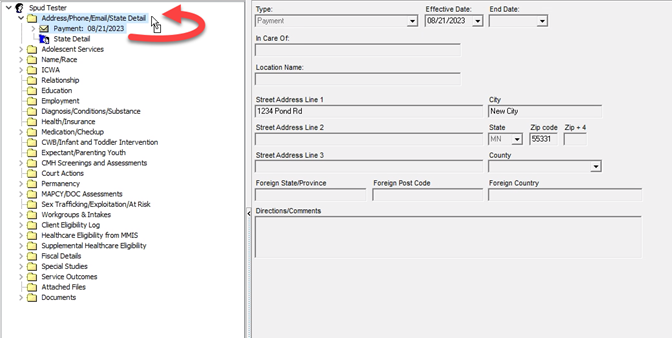
Click on an existing client address. Drag and drop it to the Address/Phone/Email/State Detail folder and a duplicate of the existing address will be created as a second entry. Address fields, including address type, can then be edited and comments can be added. This is helpful when entering the required Physical Location address for foster care providers.
The SSIS Resource page is a valuable resource available to all Tribal/agency and statewide SSIS users. Mentors are encouraged to share these resources.
Visit the SSIS Resource page often to view new eLearning opportunities.
Current eLearning resources include:
Child Protection Permanency
- Continuous placement
- Placement/locations/absence
- Removal/adoption/PGLPC history
- MAPCY assessment and Approval function
Fiscal
- Service Arrangements
- Service Agreements
- Payments; and more!
SSIS users are invited to join the SSIS Business Section at DHS as they present fall’s SSIS coffee talks. Registration is required for each session and will remain open until the webinar begins. Presentation recordings and materials will be posted to the Minnesota Child Welfare Training Academy website seven to ten business days following each event.
SSIS Tips and Tricks
Tuesday, September 26, 9:00 a.m.
Register here
SSIS Open Discussion
Tuesday, October 24, 9:00 a.m.
Register here
Topic ideas and/or questions are appreciated in advance and can be directed to Heide Moris, SSIS Mentor Program Coordinator.
Training opportunities for new SSIS users or those seeking a refresher are now available to SSIS users. Courses are great for those new to SSIS or those seeking a refresher. Click the topic below for course descriptions, schedules and registration information.
SSIS webinar materials and previous recordings can be found on the MCWTA site.
|