
Reminder: DHS and tribal nation contracts administer and manage HCBS programs
Co-written with the DHS Office of Indian Policy
There are 11 federally recognized Indian tribal nations in Minnesota. Three tribes currently administer and manage long-term services and supports (LTSS). DHS recognizes that each tribal nation is a separate sovereign nation that is unique and distinct from all other federally recognized tribes. DHS is committed to strengthening our relationship with tribal nations.
Tribal nation administration and management of home and community-based service (HCBS) programs means DHS can contract with federally recognized tribal nations that have a reservation in Minnesota to operate federally approved and other state-level programs. Each tribal nation member can choose between tribal management and county/health plan management of HCBS programs because they are dual citizens.
The tribal health care system is an important part of the entire Minnesota health care system. DHS has a contract model that supports tribal authority to administer and manage HCBS programs. This means tribal nations can perform activities outlined in Minn. Stat. §256B.0911. The model allows the tribal health care system to coordinate HCBS and other available services, while recognizing tribal sovereignty.
When a managed care organization (MCO) and county service area geographically overlap with a tribal service area, the MCO or county must let eligible people choose their HCBS manager at the initial and annual reassessments. They can choose to receive tribal, county or MCO management of their services. MCOs are also responsible for:
- Accepting tribal assessments and support plans as described in the MCO contract.
- Forwarding information from the MCO provider network to tribal nations for authorization of services from non-tribal providers.
It is important to remember that lead agencies (counties, tribal nations and MCOs) all fall under the same jurisdiction when administering long-term consultation services, provided by Minn. Stat. §256B.0911.
The following tribal nations currently administer and manage HCBS and LTSS:
- Leech Lake Band of Ojibwe
- Red Lake Nation
- White Earth Nation.
Minnesota tribal nations may establish the tribal lead agency contract with DHS when they are interested in managing HCBS and LTSS.
For more information on tribal administration contracts, go to CBSM—Tribal administration and management of HCBS programs.
Finding opportunities for efficiencies with LTSS
LTSS is a complex system involving multiple, separately managed eligibility entities. Coordinated administrative steps throughout the process ensure people have access to the resources they need. The complexity involved with coordinating these steps sometimes create potential inefficiencies. In 2021, the Legislature appropriated funds for DHS to review the policies, business practices and administrative workflows associated with LTSS. The primary aim was to find ways to improve and streamline the eligibility, assessment and support planning process. Individual goals include:
- Improved efficiencies and workflows for LTSS administrative tasks.
- Higher capacity for lead agencies to meet growing demand.
- Best practices that can be implemented statewide.
.
DHS awarded the contract for this work to Public Consulting Group (PCG) for this project (funded by the HCBS spending plan under Section 9817 of the American Rescue Plan Act). PCG is meeting with up to 21 lead agencies to examine their eligibility, assessment and support planning process. Currently, the following lead agencies/tribal nations are taking part in this project. (More lead agencies may be added.):
- Anoka
- Atkin
- Beltrami
- Chisago
- Crow Wing
- DVHHS (Cottonwood and Jackson)
- McLeod
- MnPrairie (Dodge, Steele and Waseca)
- Morrison
- Olmsted
- Otter Tail
- Ramsey
- Scott
- Sherburne
- Washington
- White Earth Nation.
Expected outcomes:
- Each participating lead agency/tribal nation will receive a report that includes mapping the workflow of administrative tasks, notes highlighting processes that created efficiencies and recommendations about other process improvement.
- Surveys will be distributed to participants and their families to provide a complete picture of the eligibility, assessment and support planning process. Analysis of the survey results is the first step in developing a consumer guide to improve understanding of how to navigate the LTSS application processes.
The survey will ask assessment participants to share their perspective of the process and what they think would have been helpful to know before applying and taking part in their assessment. The guide, which DHS will publish in several languages, will give clarity to the major steps in the eligibility, assessment and support planning processes.
If you know someone who might be interested in sharing their experience, contact Beth Wielinski or call 651-431-6383.
- PCG will provide an aggregate report of findings to state leadership and the public by November 2023.
|

MnCHOICES tips and tricks: Industry advice
Generate or find PMI numbers to add a person in the revised MnCHOICES application
Sometimes, lead agencies say they need to complete an expediated assessment but they do not have the person’s social security number (SSN) or patient master index (PMI) number. A user needs an SSN or PMI to create a person record in the revised MnCHOICES. Lead agency economic assistance divisions or departments typically generate PMIs for applicants in MAXIS.
For expedited assessments, DHS suggests two methods to obtain a person’s PMI:
-
PMI number process for expedited assessments: Lead agencies should prioritize PMI generation for expediated assessments by establishing a protocol that identifies which staff member(s) will process these PMIs. A lead agency must train the staff member(s) to perform this function. This can be an intake worker, a case aide or other designated employee role positioned to assist intake for this purpose. After creating the PMI, a staff member can create a person record in MnCHOICES. Accurately communicating the PMI to the staff who enter the person into the revised MnCHOICES application is important. Errors in PMI number could delay services for an eligible person.
Note: An SSN is not required when creating a PMI in MAXIS. MAXIS generates a PMI as soon as a staff member enters the data.
-
Provide MAXIS read-only access: DHS worked with MAXIS to create limited access for intake workers, certified assessors and case aides. This allows only certain panels to be seen (INSW role). A user can search for a person and find their PMI. With the PMI, agency staff can add a new person to the revised MnCHOICES database.
Note: Once a PMI is created in MAXIS it is available for review.
|

Do you have a technical or workflow question that you would like help with? If so, submit your question on the MnCHOICES Help Desk Contact Form, DHS-6979 and choose “Other” under the QUESTION TYPE. We will answer one question per issue.
|
You asked, we answered...
CFSS eligibility in revised MnCHOICES application
Question: We understand that determination of eligibility is part of the revised MnCHOICES and that Community First Services and Supports (CFSS) is launching after the revised MnCHOICES application. Do you have instructions for us?
Answer:
The revised MnCHOICES application includes a CFSS-to-PCA conversion worksheet. Until CFSS is implemented, lead agency staff must use the "CFSS-to-PCA Conversion worksheet” to convert home care ratings and added time from the MnCHOICES assessment result to current personal care assistance (PCA) rules. To do this:
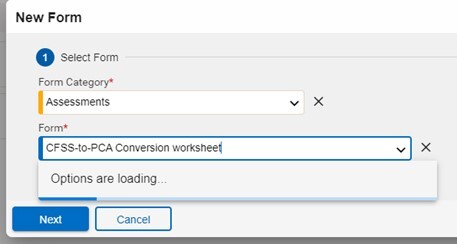
- In the dialogue box, choose “Assessments” under form category and “CFSS-to-PCA conversion worksheet” under form.
- Follow the instructions in the form to complete the CFSS-to-PCA conversion worksheet.
When the MnCHOICES assessment results have CFSS home care ratings of P, Q or R, a staff member must use the “CFSS-to-PCA conversion worksheet.” The worksheet includes instructions, a CFSS-to-PCA conversion section and a PCA home care rating part. Include the conversion worksheet with the assessment summary when giving it to the person.
Staff who use the support plan to plan PCA services: Use the support plan section “Services that support me: PCA services and providers are available to choose from.” The revised MnCHOICES application already has PCA rates in the system. Include the “CFSS-to-PCA conversation worksheet” when giving a copy of the support plan to the person.
The revised MnCHOICES application will eventually include CFSS eligibility. When the CFSS program launches, the following will be true:
- Certified assessors will not need the conversion form, because the revised MnCHOICES application will run CFSS eligibility.
- The CBSM support plan page will include roles and steps for CFSS.
- Staff who plan services will be able to choose CFSS services and providers in “Services that support me” in the support plan.
Learn more about CFSS in these TrainLink courses:
- Community First Services and Supports (CFSS) for lead agencies (CFSS_LA) — Both modules (“Overview of CFSS for lead agencies” and “CFSS service delivery plan approval”)
- MnCHOICES Assessment Step 2, Module 7 (“Waivers & public programs”).
|

End of the federal public health emergency and wind down of current COVID-19 waivers
On Jan. 11, 2023, the federal government extended the COVID-19 public health emergency for an additional 90 days, until April 11, 2023. On Jan. 30, federal officials said they plan to end the public health emergency on May 11, 2023.
To read the official declaration of this renewal, go to: COVID-19: Renewal of determination that a public health emergency exists.
The end of the public health emergency will start the phasing out of several exceptions and modifications to DHS programs and services. DHS continues to plan for the end of the public health emergency and figure out how those changes will affect people who use long-term services and supports. DHS will update lead agencies about upcoming changes and give direction to phase out these temporary changes before the end of the public health emergency.
For more information, go to: End of the federal public health emergency and wind down of current COVID-19 waivers.
|

121-day temporary admission
DHS released an Oct. 6, 2022, eList, that announced a new policy that allows people who were admitted to certain settings for 121 or fewer days and receiving HCBS at the facility to return to the community and keep their HCBS waiver services without an assessment. The MnCHOICES team has received questions about this policy. Here are two clarifications:
-
Policy clarification: When a person is due for reassessment between 30 and 121 days, a new (initial) assessment is needed because this policy does not apply when the annual reassessment is otherwise due. This allows an eligibility update to be completed when more time might be needed to act on the assessment.
- The policy for a person younger than 65 years old who a nursing facility (NF) admits is still in place. They must receive an assessment within 80 calendar days of admission.
Updated policy for change-in-condition reassessments
DHS sent out policy updates in a March 17, 2023, eList, about reassessments for changes in condition. Effective April 3, 2023, lead agencies no longer will conduct change-in-condition reassessments. Lead agencies may do the following to address some short-term changes after an assessment if a person already has an assessed need for supports:
- Realign resources within the person’s current support plan, document changes and ensure the assessor receives the information at the person’s annual reassessment time.
- Use a 45-day temporary increase for state plan personal care assistance (PCA) services (refer to PCA manual — 45-day temporary increase for PCA services.)
If the person experiences a change in need that cannot be addressed using the above strategies, the lead agency may conduct an early reassessment.
For a person on Alternative Care (AC) or Elderly Waiver (EW), the lead agency also may use a functional needs update. A functional needs update is a remote assessment used by lead agencies to document a change to a person’s assessed need(s) any time during the service agreement year.
For more information, refer to the functional needs update section on CBSM — Assessment applicability and timelines.
MnCHOICES Lead Agency Transfer and Communication Form, DHS-6037, update
DHS has revised the MnCHOICES Lead Agency Transfer and Communication Form, DHS-6037 (PDF) in preparation for the revised MnCHOICES launch. Lead agencies must complete and attach this form to a person’s MnCHOICES file when they move to another lead agency or organization.
The next step is to complete a transfer within the MnCHOICES application: TrainLink can help! Look for the MnCHOICES Micro-learning course (MNCH901) to view the “Location_and_staff_assignments” module. It explains how to transfer a person’s MnCHOICES file to another location. Also, the help center soon will have a smart guide with step-by-step instructions on how to assign, change a person’s location, make a transfer and discharge a person’s MnCHOICES file.
|

Visit the Disability Services Division training archive for ongoing educational courses and other training opportunities. Navigate to TrainLink to find additional training courses offered by DHS.
Are you a new MnCHOICES mentor?
DHS recommends all new MnCHOICES mentors complete the MnCHOICES New Mentor Training (MnCH9000) course. Modules include:
- What is a MnCHOICES mentor.
- MnCHOICES mentor skills.
- The role of the MnCHOICES Help Desk.
- MnCHOICES CountyLink.
- MnCHOICES assessment mentor’s role, includes information on MnCHOICES certified assessor training (MnCAT) Step 3.
MnCHOICES micro-learning course
Access all the MnCHOICES Micro-learning modules in the TrainLink Disability Service Division learning center MnCHOICES micro-learning course (MNCH901). A user can access the modules here if they are not available in the MnCHOICES Help Center. The course also allows agency supervisors, managers, directors and other workers who do not have MnCHOICES access to watch demos on specific functions in the system. These modules are short videos demonstrations in real time that show how to perform a single function or a short sequence of actions.
Learn about tribal nation sovereignty
The “Why Treaties Matter” exhibit in now online. Visitors will see how Dakota and Ojibwe treaties with the U.S. government affected the lands and lives of the indigenous peoples of the place now called Minnesota and why these binding agreements between nations still matter today.
Assessors can earn two continuing learning unit (CLU) credits toward recertification by touring the exhibit online.
In the TrainLink recertification module:
- Include “Why Treaties Matter website exhibit” as the subject.
- Enter "2" for CLUs.
- Copy a part of this article in the description.
|
Sign up to receive email notifications when forms are changed or added to eDocs.
Visit the Community-Based Services Manual (CBSM) often for a list of policies and pages we've recently updated. For a list of changes, visit the What’s New page.
|