|
The 2020 Evaluation of the SDM Tool found that 570 adults meeting vulnerability criteria under the Vulnerable Adult Act and potentially sexually abused were not accepted for APS. That means that 58% of adults referred for APS who met policy criteria did not receive assessment and service interventions from APS to stop, reduce risk, and prevent maltreatment to support the adult’s safety, dignity, and healing. APS's role as LIA is for trauma-informed engagement in assessment for safety and service planning to stop, reduce risk, and prevent reoccurrence through service interventions. We can rely on our partnering systems to address the criminal side of sexual abuse through law enforcement and the court system, as well as rely on the expertise of crime and sexual assault victim advocates, but APS's role for adults who are vulnerable can be critical to safety and healing for the adult.
Older adults and persons with disabilities are at greater risk for sexual assault.
Role of adult protection:
- Getting immediate medical attention for the adult who is vulnerable
- Wrapping safety around the adult who is vulnerable during the sexual assault nurse examiner (SANE) medical examination by finding a trusted support person to be with the adult or accompanying the adult to the hospital
- Assessing the current safety, strengths and needs of the adult and engage the adult and their supports in planning and interventions to reduce future risks using the Structured Decision Making® and Standardized Tools
- Understanding and using trauma informed practices by supporting control, choice and autonomy of the adult who is vulnerable
- Working with victim advocates for protection orders and other approaches to keep the adult safe from the person alleged responsible
- Coordinating with law enforcement to avoid re-victimization
- Helping the adult who is vulnerable connect with the crime victim advocate
- Helping the adult who is vulnerable and their support person(s) understand how to help protect themselves from further maltreatment through education and safety planning
- Intervening to implement necessary services identified through the assessment. This is critical when the person alleged responsible was a caregiver who should no longer have access to the adult
- Identifying who is assisting and supporting the adult who is vulnerable with food, clothing, shelter, transportation, medication management, and schedule appointments
Things to consider:
-
Coordinate with law enforcement and engage experts when the allegation may be criminal or the interview is challenging due to the adult’s capacity or ability to communicate https://minnesotachildrensalliance.org/about/
-
Incidents which are not criminal, or are determined to not meet the preponderance standard, may still impact the adult’s safety and dignity and need APS assessment and intervention
-
Sex and sexual abuse are not easy to talk about. Assessment may take time and multiple visits to build trust Consider approaches appropriate for the adult’s gender, gender identity, race, ethnicity, age and ability and partner with community experts or professionals
The goal of APS is to support adults who are vulnerable to live with safety and dignity, consistent with their own culture, values, and goals and for the people concerned about them to have resources so they can offer support.

Minnesota Adult Protection policy includes the Lichtenberg Financial Decision Tracker as an essential tool for APS in completing assessments alleging financial exploitation. The Lichtenberg Older Adult Nest Egg website has the tracker and other tools available for assessing risk for financial vulnerability. These tools are free and accessible following completion of the online training.
The Financial Decision Tracker (formerly known as the Lichtenberg Financial Decision Screening Scale (LFDSS)) is a brief 10-item interview to examine a specific financial decision made by the older adult to assess their financial judgement, vulnerability to theft and scams, and whether financial predation may have taken place. The Tracker asks the client about choice, rationale, understanding, and appreciation of a financial decision in the context of the client’s values. These decisional abilities determine the fidelity, integrity and autonomy of the decision. Exploitation, undue influence, psychological vulnerability and reduced awareness can impair decisional ability. Tool is geared toward professionals who often work with older adults making significant financial decisions, including attorneys, financial planners, psychologists, bankers, investment brokers, insurance agents, accountants, law enforcement officers, and Adult Protective Services case workers.
The Friends and Family Interview is a 14-question interview to seek understanding an older adult’s recent financial decisions by interviewing a trusted relative, friend or professional acquaintance of the old adult. The risk scoring system indicates risk perception, or how concerned the relative or friend is about the older adult’s financial decision-making and vulnerability to financial exploitation. This tool is best used in conjunction with the Tracker or the Vulnerability Assessment.
There are additional tools; Financial Vulnerability Survey Pro which is geared toward attorneys, medical staff, financial screeners, senior housing managers and other professionals working with older adults and wanting to assess their risk of being financially exploited and Financial Vulnerability Assessment for mental health professionals who are well-trained in administering standardized test, including psychologists, psychiatrists, physicians, therapists, counselors, nurse practitioners and pastoral counselors.
|
DHS Deaf and Hard of Hearing Services Division is offering a free video chat on Wednesday, March 8 from 10:00am-12:00pm for social workers and health care providers about hearing loss basics.
Adult Protection professionals are likely to work with someone who has a hearing loss at some point, and this event will help attendees better serve clients with hearing loss by covering topics such as:
- How hearing loss impacts people
- How to communicate effectively
- How differences among people with hearing loss impacts communication
- How assistive technology can help
- What services and resources are available for people who have hearing loss
Register for the free March 8th video chat through an online registration form. You will receive a Zoom video conference link when you register. Please register by March 1, 2023. This training qualifies as continuing education (CE) for social workers and nurses.
For additional information about the event, please visit the DHS Deaf and Hard of Hearing Services Division event webpage.

What should I do if I get MAARC questions from law enforcement partners?
If your agency receives a question about MAARC law enforcement notification, please encourage your partner to reply to any secure MAARC email notification, or use the contact information MAARC has established for law enforcement, dhs.maarc.adultprotection@state.mn.us for response.
DHS MAARC operations works with law enforcement agencies to establish the notification method preferred by the agency and details associated with required immediate law enforcement notification for suspected civil maltreatment which may also be criminal.
DHS also offers online mandated reporter training for law enforcement and other mandated reporters in support of their duties as mandated reporters.
|
The SSIS 23.1V release includes an enhancement to allow only Program Type 610-Adult Protective Services field option to be selected in Adult Protection Intake or Assessment Workgroup. An adult who is the subject of an Adult Maltreatment Report (AMR) referred by MAARC is required to have an Adult Protection Intake or Assessment Workgroup under Program Type 610. This system change supports policy established by the MN legislature to serve adults who meet APS program criteria as vulnerable and potentially maltreated using the tools and policy required under the Vulnerable Adult Act (VAA). This change also supports tracking outcomes and resources needed for adults referred to APS.
If the adult referred by MAARC is not accepted for APS because the adult does not meet policy criteria as vulnerable and suspected of experiencing maltreatment, or if the report was not accepted for APS based on the agency’s prioritization guidelines, but the agency identifies a service need for the person subject to the report, the agency may offer services under another program type. Close the APS intake under 610-Adult Protective Services as Screened out maltreatment report and create a NEW intake for the program type in which the person is being served. i.e. 600-Adult Services (General), 400-Adult Mental Health, 300-Chemical Dependency (General), etc. The AMR will not be accessible in the new program type. Information from the AMR or APS intake activities necessary for the new program referral will need to be case noted in the new intake.
Data help policy makers and the public understand the nature and scope of an issue. In the case of adult protection, data provide a basis to understand if vulnerable adults are treated fairly and justly in our state. Data can impact program evaluation, benchmarks for quality and performance outcomes, budget planning and resource allocation, and inform evidenced based prevention and remediation/service response for vulnerable adults who have been maltreated.
“Without data, you're just another person with an opinion."
― W. Edwards Deming
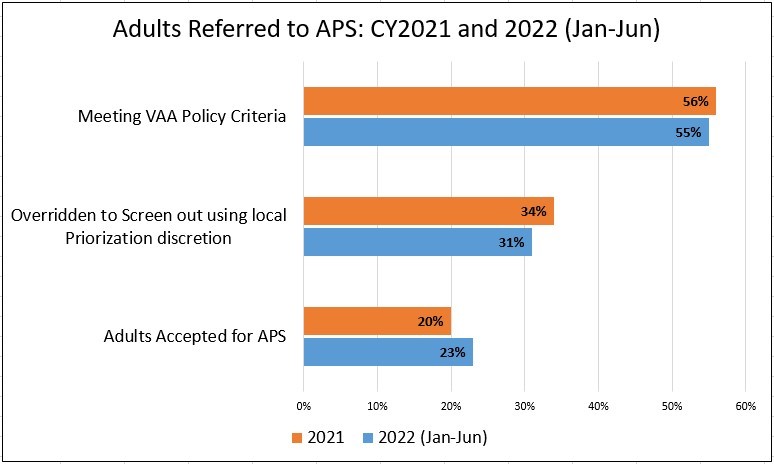
The image below shows a comparison between calendar year 2021 and the first six months of 2022 for adults referred to APS who met VAA policy criteria, overridden to screen out using local prioritization guidelines, and adults accepted for APS.
DHS Adult Protection Resource Specialist (APRS)
DHS Adult Protection Resource Specialist (APRS) staff support APS workers and supervisors with policy clarification and case consultation regarding intake, assessment, service intervention, and assessment outcomes for the safety and dignity of adults vulnerable to maltreatment reported as having experienced maltreatment.
Connect with an APRS today at dhs.adultprotection@state.mn.us or (651) 431-2609.
Vulnerable Adult Protection Dashboard
The Vulnerable Adult Protection Dashboard provides annual state and county data on the number of reports, allegations, and investigation determinations to explain what happens after reports of suspected maltreatment are made to the Minnesota Adult Abuse Reporting Center (MAARC).
MN APS Foundations
MN APS Foundations is offered by the MN DHS Adult Protection Unit and provides basic introduction to the MN adult protection system for new APS professionals, or APS professionals seeking a refresher. The course focuses on fundamental elements such as APS statutes, definitions, MAARC, MN APS Operational Plan, lead investigative agencies (LIAs), and APS case overview from intake to case closure. Attendees will need to complete both days to receive a certificate of completion.
APS Foundations training dates are intended to precede SSIS Adult Protection Worker Training offerings, so APS professionals have the option to attend policy-focused training (APS Foundations) and systems-focused training (SSIS Adult Protection Worker Training) sequentially.
Upcoming APS Foundations Dates (registration is for both days):
Feb 21 & 23, 2023 (Tu & Th), 8:30a - 12:30p each day | Click Here to Register
Mar 28 & 30, 2023 (Tu & Th), 8:30a - 12:30p each day | Click Here to Register
Jun 20 & 22, 2023 (Tu & Th), 8:30a - 12:30p each day | Click Here to Register
MN APS Foundations supports equity and consistency in service response and outcomes that safeguard and promote dignity for vulnerable adults regardless of their location in Minnesota, and the course addresses core competency training recommendations in the ACL Voluntary Consensus Guidelines for State APS Systems.
Please contact us at dhs.adultprotection@state.mn.us if you have any questions.
SSIS Essentials eLearning
SSIS Essentials is a collection of six eLearning courses designed to provide caseworkers with an introduction to basic navigation and functionality of core SSIS functions. SSIS Essentials eLearning is offered through TrainLink. New workers are encouraged (not required) to take the online SSIS Essentials eLearning courses prior to taking SSIS Adult Protection Worker training.
Please visit the SSIS Essentials eLearning website for registration and TrainLink instructions, technical requirements, and more detailed information about each of the six SSIS Essentials courses.
SSIS Adult Protection Worker Training
The SSIS Adult Protection Worker course is a technical training designed to provide an overview of data entry as related to Adult Protective Services (APS) into SSIS. The training is offered in two half-day virtual classes and is designed for new adult protection workers, SSIS Mentors, and those seeking a refresher. New workers are encouraged to take the online SSIS Essentials eLearning courses prior to SSIS Adult Protection Worker Training. More information can be found on the SSIS Adult Protection Worker Training website.
Upcoming SSIS Adult Protection Worker Training:
- Feb 27 and Mar 2, 2023 (Mon and Thurs) 9:00 a.m. to 12:30 p.m.
- Apr 10 and 13, 2023 (Mon and Thurs) 9:00 a.m. to 12:30 p.m.
- Jun 26 and 29, 2023 (Mon and Thurs) 9:00 a.m. to 12:30 p.m.
Please visit the SSIS Adult Protection Worker Training website for registration instructions, additional resources, and more detailed information about the course.

National Adult Protective Services Training Center (NATC)
The National Adult Protective Services Training Center (NATC) provides free training for APS professionals nationwide. NATC course topics include: APS Overview; Ethics, Values, and Cultural Responsiveness; Voluntary Case Planning; Trauma-Informed Practices; Case Documentation; and many more. To access, create a free account and click "Find Courses" to view available courses. Check out the NATC LMS User Guide if you need help creating an account or navigating the website.
The NATC is operated by NAPSA and is supported by the ACL. NATC training offerings are supplemental to MN APS Foundations training for APS professionals, and are one method to meet the MN APS statutory requirement of 8 hours annual training specific to adult protection duties.
|

APS Technical Assistance and Resource Center (TARC)
APS TARC provides a variety of no-cost educational opportunities for APS professionals including webinars, briefs, and toolkits that align with APS Core Competencies in national standards. APS TARC offerings address a wide variety of topics including APS supervision, frauds and scams, interviews with experts, APS investigation, impacts of COVID-19 on APS, and more. Keep up to date with APS TARC offerings by joining their mailing list.
|
Additional Practice Resources
Find information on adult protection policy, procedure, resources, and training information for mandated reporters and APS on the DHS Adult Protection: Policies and Procedures web page. Specific training resources for APS workers are included under the "Adult protection worker resources and training" drop down. These resources support APS workers meeting education requirements under 626.557 Subd. 9e.
The DHS Adult Protection Newsletter shares knowledge specific to adult protection work in MN, answers common questions regarding adult protection work in MN, and provides awareness of DHS Adult Protection training opportunities. Please contact us with any questions or concerns at dhs.adultprotection@state.mn.us or (651) 431-2609
For more information about DHS Adult Protection, please visit us online DHS AP: Program Overview

|