|
Adult Protection state policy, training, and quality assurance activities in 2023 will continue to focus on Minnesota's APS Operational Plan goals. Activities will focus on Goal 1 (Adults who are vulnerable to maltreatment and referred to APS have equitable access to protective services) and Goal 5 (Tribal, state, and county partnerships in program management and evaluation of outcomes for adults who are vulnerable are enhanced). The following approaches will be used to meet these goals:
- Working with Evident Change, including the APS Core Team experts from counties and tribal nations. A request will be coming for up to 20 volunteers to participate.
- Exploring discretionary overrides with the APS Partnership Group/SDM Advisory Group to better define APS's role when there is a case manager or other service provider, and exploring considerations for improving service engagement when the adult/support person are from a racial, cultural, or ethnically diverse community in order to ensure APS meets our ethical obligation to do no harm to the adult who is vulnerable during intake, assessment, and investigation.
- Trainings, communications, and regional meetings focused on intake decisions, service engagements, and successful interventions.
- Identifying barriers to successful outcomes for adults referred to APS through coordination with partners, including Regional Meetings.
- Data for counties to evaluate intake and service outcomes, provided through the APS Newsletter and Quarterly Administrator Meetings for APS supervisors and directors.

Where do I fit in?
Change is difficult. As the Minnesota Adult Protection continues to improve program outcomes of support for adults in our state who are vulnerable to maltreatment, it is important to evaluate where each of us stand with changes in policy or practice. We need to take moments in our daily work to evaluate where we are today and where we want to be in the future. It is also important to surround ourselves with people who share like-minded visions to support adults who are vulnerable to live in safety and dignity, consistent with their own culture, values, and goals and seek resources that help us reach our mission to support adults who are vulnerable in Minnesota with services to stop and minimize risks for abuse, neglect, and financial exploitation. I know each of you reading this right now share that mission!
How do we feed our curiosity and take the assumptions out of our work?
It is natural to be curious. We are curious about the world around us, practice, systems, resources and client’s lives. Being a curious person helps us see the broad picture for the people we are working with and our organizations. We are curious about policy and the tools we have in place to do our jobs. We are curious about the intersection of policy and practice and how we can collaborate to ensure adults who are vulnerable are protected from further maltreatment. Curiosity improves approaches and improves the outcome. We often make assumptions that we speak the same language when we work in the same program. These assumptions can lead to confusion. Assumptions are based off of our experiences, beliefs and opinions which are influenced by our culture, social and societal beliefs. We can work through our assumptions by seeking out clarification.
Am I on solid ground?
The Marigold Effect is an interesting concept. Marigolds put the greater good ahead of their own needs. These people bring out the best in others and are encouraging. Marigolds gain strength as a group. Weeds are people that meet basic expectations, they are not harmful, but they do not provide value. Weeds consume a lot of time. Walnut trees are draining, negative and stand in the way of positive change. They produce results (walnuts) but are toxic in their environments. Take a moment to reflect on the marigold, weed and walnut tree. Where are you right now and where do you want to be?
|
Two new APS courses are being added to the SSIS Essentials series: SSIS APS Essentials 104A: Exploring APS Intakes and SSIS APS Essentials 104B: Exploring APS Assessments. These courses are specific to APS professionals and replace SSIS Essentials 104: Creating an Intake.
To access these two new courses, please visit the TrainLink Home Page and sign into TrainLink using your Unique ID.
- Scroll down the TrainLink Home Page and select "Children’s Services" under Learning Centers
- Sign On to TrainLink using your unique ID (button on top right of page)
- Select Course Catalog
- Search for "104A" or "104B"
- Click "Select" button next to the course name to view the course detail
- Click "Start Course" button to begin course (top right of page)
Please note: completion of course 104A is a prerequisite for accessing course 104B
The official SSIS release, promotion, and launch of these courses will occur in early 2023. If you have any issues with the course or comments about the course, please contact Jason Dalrymple, eLearning Designer & Developer, at jason.dalrymple@state.mn.us.

Adult Protection: A closer look at self-determination and choice
When screening an intake, do we take self-determination and choice into consideration?
No, self-determination and choice are not factors when determining whether someone meets the criteria as an adult who is vulnerable.
The factors that determine vulnerable adult status are:
- The adult has a physical, mental, or emotional impairment;
- The adult is unable to adequately provide for their own necessary food, shelter, health, or supervision without assistance;
AND
- Because of this condition, the adult has an impaired ability to protect themself from maltreatment.
When making a final determination, do we take self-determination or choice into consideration?
No, self-determination and choice have no bearing on whether abuse, neglect, or exploitation did or did not occur. Focus on the facts. Maltreatment is not a choice.
When does Adult Protection consider self-determination and choice?
Self-determination and choice enter the equation when APS is working on engagement with the adult who is vulnerable and providing interventions and service planning to stop, prevent, and reduce risk of further maltreatment. Engagement helps APS take into account the adult's voice, perspective, level of understanding of their situation, and their ability to problem solve and identify supports already in place. If a specific engagement technique is not effective, then other options for engagement should be explored. Conversations with the adult who is vulnerable regarding interventions is key to stopping, preventing, and reducing risks of maltreatment. Adults who are vulnerable have a choice regarding whether or not to engage in the interventions; but, that does not impact adult protection’s identification of what interventions would be most appropriate. Safety planning pulls our engagement efforts and identification of interventions together. Safety planning is one of our final engagement efforts to help document adult protection's recommended interventions, the available choices, and decisions made by the adult who is vulnerable to address their safety needs.
Please connect with the DHS Adult Protection Unit at dhs.adultprotection@state.mn.us or (651) 431-2609 if you have any questions.
|
Data help policy makers and the public understand the nature and scope of an issue. In the case of adult protection, data provide a basis to understand if vulnerable adults are treated fairly and justly in our state. Data can impact program evaluation, benchmarks for quality and performance outcomes, budget planning and resource allocation, and inform evidenced based prevention and remediation/service response for vulnerable adults who have been maltreated.
“Without data, you're just another person with an opinion."
― W. Edwards Deming
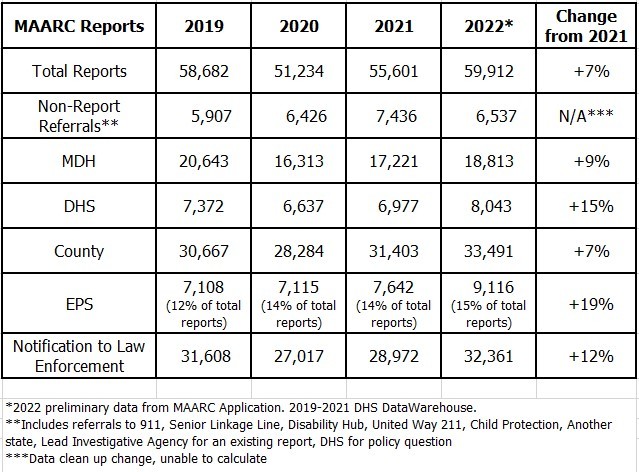
The image below shows MAARC report totals and breakdowns for 2019 through 2022, including the percent change for each measure from 2021 to 2022.
DHS Adult Protection Resource Specialist (APRS)
DHS Adult Protection Resource Specialist (APRS) staff support APS workers and supervisors with policy clarification and case consultation regarding intake, assessment, service intervention, and assessment outcomes for the safety and dignity of adults vulnerable to maltreatment reported as having experienced maltreatment.
Connect with an APRS today at dhs.adultprotection@state.mn.us or (651) 431-2609.
Vulnerable Adult Protection Dashboard
The Vulnerable Adult Protection Dashboard provides annual state and county data on the number of reports, allegations, and investigation determinations to explain what happens after reports of suspected maltreatment are made to the Minnesota Adult Abuse Reporting Center (MAARC).
MN APS Foundations
MN APS Foundations is offered by the MN DHS Adult Protection Unit and provides basic introduction to the MN adult protection system for new APS professionals, or APS professionals seeking a refresher. The course focuses on fundamental elements such as APS statutes, definitions, MAARC, MN APS Operational Plan, lead investigative agencies (LIAs), and APS case overview from intake to case closure. Attendees will need to complete both days to receive a certificate of completion.
APS Foundations training dates are intended to precede SSIS Adult Protection Worker Training offerings, so APS professionals have the option to attend policy-focused training (APS Foundations) and systems-focused training (SSIS Adult Protection Worker Training) sequentially.
Upcoming APS Foundations Dates (registration is for both days):
Feb 21 & 23, 2023 (Tu & Th), 8:30a - 12:30p each day | Click Here to Register
Mar 28 & 30, 2023 (Tu & Th), 8:30a - 12:30p each day | Click Here to Register
Jun 20 & 22, 2023 (Tu & Th), 8:30a - 12:30p each day | Click Here to Register
MN APS Foundations supports equity and consistency in service response and outcomes that safeguard and promote dignity for vulnerable adults regardless of their location in Minnesota, and the course addresses core competency training recommendations in the ACL Voluntary Consensus Guidelines for State APS Systems.
Please contact us at dhs.adultprotection@state.mn.us if you have any questions.
SSIS Essentials eLearning
SSIS Essentials 101-106 is a collection of eLearning courses designed to provide caseworkers with an introduction to basic navigation and functionality of core SSIS functions. SSIS Essentials eLearning courses are offered through TrainLink. APS professionals are encouraged (not required) to take the online SSIS Essentials eLearning courses prior to taking SSIS Adult Protection Worker training.
Please visit the SSIS Essentials eLearning website for registration and TrainLink instructions, technical requirements, and more detailed information about each of the six SSIS Essentials courses.
SSIS Adult Protection Worker Training
The SSIS Adult Protection Worker course is a technical training designed to provide an overview of data entry as related to Adult Protective Services (APS) into SSIS. The training is offered in two half-day virtual classes and is designed for new adult protection workers, SSIS Mentors, and those seeking a refresher. New workers are encouraged to take the online SSIS Essentials eLearning courses prior to SSIS Adult Protection Worker Training. More information can be found on the SSIS Adult Protection Worker Training website.
Upcoming SSIS Adult Protection Worker Training:
- Jan 9 and 12, 2023 (Mon and Thurs) 9:00 a.m. to 12:30 p.m.
- Feb 27 and Mar 2, 2023 (Mon and Thurs) 9:00 a.m. to 12:30 p.m.
- Apr 10 and 13, 2023 (Mon and Thurs) 9:00 a.m. to 12:30 p.m.
- Jun 26 and 29, 2023 (Mon and Thurs) 9:00 a.m. to 12:30 p.m.
Please visit the SSIS Adult Protection Worker Training website for registration instructions, additional resources, and more detailed information about the course.

National Adult Protective Services Training Center (NATC)
The National Adult Protective Services Training Center (NATC) provides free training for APS professionals nationwide. NATC course topics include: APS Overview; Ethics, Values, and Cultural Responsiveness; Voluntary Case Planning; Trauma-Informed Practices; Case Documentation; and many more. To access, create a free account and click "Find Courses" to view available courses. Check out the NATC LMS User Guide if you need help creating an account or navigating the website.
The NATC is operated by NAPSA and is supported by the ACL. NATC training offerings are supplemental to MN APS Foundations training for APS professionals, and are one method to meet the MN APS statutory requirement of 8 hours annual training specific to adult protection duties.
|

APS Technical Assistance and Resource Center (TARC)
APS TARC provides a variety of no-cost educational opportunities for APS professionals including webinars, briefs, and toolkits that align with APS Core Competencies in national standards. APS TARC offerings address a wide variety of topics including APS supervision, frauds and scams, interviews with experts, APS investigation, impacts of COVID-19 on APS, and more. Keep up to date with APS TARC offerings by joining their mailing list.
|
Additional Practice Resources
Find information on adult protection policy, procedure, resources, and training information for mandated reporters and APS on the DHS Adult Protection: Policies and Procedures web page. Specific training resources for APS workers are included under the "Adult protection worker resources and training" drop down. These resources support APS workers meeting education requirements under 626.557 Subd. 9e.
The DHS Adult Protection Newsletter shares knowledge specific to adult protection work in MN, answers common questions regarding adult protection work in MN, and provides awareness of DHS Adult Protection training opportunities. Please contact us with any questions or concerns at dhs.adultprotection@state.mn.us or (651) 431-2609
For more information about DHS Adult Protection, please visit us online DHS AP: Program Overview

|