The National Adult Maltreatment Reporting System (NAMRS) has released the sixth annual Adult Maltreatment Report | 2021 based on 2021 data.
NAMRS is a voluntary data reporting system collecting data from state adult protective services systems. All states, territories, and district contributed data to this report - there are 56 APS programs in the United States, one in each of the 50 states, the District of Columbia, and every U.S. territory. The 2021 report also features a special chapter on the potential impact of COVID-19.
NAMRS is the only comprehensive national reporting system for state APS programs. This report provides an overview of adult maltreatment as reported to APS programs across the country, using NAMRS data submitted for FFY 2021 (October 1, 2020, through September 30, 2021) unless otherwise noted.
|
As announced in the previous newsletter, APS Foundations course offerings will resume in October, 2022. APS Foundations will be offered online over two days, typically Tuesday and Thursday, from 8:30am - 12:30pm each day.
The registration links are now updated and accurate in the "Training and Events" section below.
Please contact us at dhs.adultprotection@state.mn.us if you have any questions.

WCCO aired a story on September 8, 2022 about hoarding titled Breaking down the psychology behind hoarding. The 8 minute video includes an interview with a person experiencing hoarding and Wade Crandall, MA, LPCC, Clinical Site Director from Nystrom & Associates, discussing the condition.
Hoarding cases are arguably one of the most difficult types of cases for APS professionals. Working to understand and empathize with folks experiencing this condition and these challenges can be helpful for APS professionals to best address these complex situations.
Thank you for all you do help Minnesota's adults who are vulnerable.
|
Adult Protective Service Technical Assistance Resource Center (APS TARC) provides a variety of free educational opportunities for APS professionals including webinars, briefs, and toolkits that align with APS Core Competencies in national standards.
APS TARC recently announced a revised APS Training Toolkit with the latest information and resources covering all things APS Training. The focus is on nationally available, no or low-cost curriculum and training materials, webinars, videos, etc.
Keep up to date with APS TARC offerings by joining their mailing list.
An APS program in Region 9* received a MAARC report of potential self-neglect from a community business that the adult frequents. APS contacted the reporter for additional information to establish vulnerable adult status. With the additional information provided, APS opened an Assessment with No Determination. APS workers met with the adult who is vulnerable in their home and learned that the adult was behind on rent and needed to move out by the end of the month. Additionally, the adult reported they did not have any gas (gas stove in the home) or cable because they could not afford it, and they identified a niece who occasionally helps out financially.
APS made contact with the landlord and section 8 to clarify the adult’s housing situation. APS also contacted the niece for collateral information. Upon speaking with APS professionals, the niece reported a willingness to become the adult’s Power of Attorney, and agreed to meet with APS professionals and the adult who is vulnerable two days later at the adult’s home. At this meeting, the adult completed Power of Attorney paperwork and APS arranged a notary at the home to notarize the Power of Attorney paperwork at the meeting. APS professionals also assisted the adult in completing an MA-LTC application and discussed possible housing options. APS professionals completed a MnChoices referral as well and are now working on setting up tours of assisted living facilities in the area the adult is looking to live.
The ability to open an Assessment with No Determination felt like a positive in this situation, not having the accusation of the adult who is vulnerable being neglectful of themselves really helped with rapport building and the adult’s openness to seeing what APS can offer. It seems a benefit to be able to generally inform the adult that we received a report with some concerns and that we just want to check in with them to see if there is anything they are struggling with or any services they may be interested in.
Thank you, Region 9 APS, for this example of person-centered service - putting the needs of adults vulnerable to maltreatment at the center of your practice!
*To ensure anonymity of those involved in the example above, Region 9 is being referenced rather than the specific county’s name.

Do you have a story to share of how your APS program or an individual worker improved the safety and dignity or an adult who is vulnerable to maltreatment, or whose engagement with the adult or their supports in assessment, planning, and service interventions stopped, reduced risk, or prevented maltreatment or reoccurrence?
We would love to share your examples of how APS makes a difference. Send your idea to dhs.adultprotection@state.mn.us
|

DHS Adult Protection Resource Specialist (APRS) staff support APS workers and supervisors with policy clarification and case consultation regarding intake, assessment, service intervention, and assessment outcomes for the safety and dignity of adults vulnerable to maltreatment reported as having experienced maltreatment. Connect with your APRS today at dhs.adultprotection@state.mn.us or (651) 431-2609.
What SDM Assessment Tools are required for Assessment with No Determination?
Regardless of the outcome of the assessment, No Determination - Adult Protection Services Needed or No Determination - Adult Protection Services Not Needed, the following tools are required:
- Intake Assessment Tool
- Initial Safety Assessment
- Strengths and Needs Assessment
- Safety Plan
- Final Safety Assessment
Minnesota Adult Protection Structured Decision Making and Standardized Tools- Guidelines and Procedures Manual outlines when, during the assessment, to complete the SDM tools (page 14-15).
Complete the above SDM tools when No Determination – investigation not possible is entered as the final determination for Assessment with No Determination, until updates are made within SSIS.
Please connect with APRS staff at dhs.adultprotection@state.mn.us or (651) 431-2609 if you have any questions!
|
Data help policy makers and the public understand the nature and scope of an issue. In the case of adult protection, data provide a basis to understand if vulnerable adults are treated fairly and justly in our state. Data can impact program evaluation, benchmarks for quality and performance outcomes, budget planning and resource allocation, and inform evidenced based prevention and remediation/service response for vulnerable adults who have been maltreated.
“Without data, you're just another person with an opinion."
― W. Edwards Deming
The Vulnerable Adult Protection Dashboard provides annual state and county data on the number of reports, allegations, and investigation determinations to explain what happens after reports of suspected maltreatment are made to the Minnesota Adult Abuse Reporting Center (MAARC).
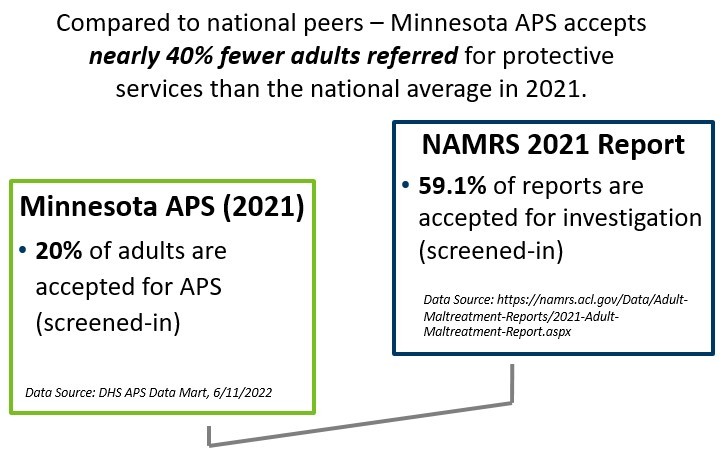
The image below shows a comparison between 2021 screen-in data from Minnesota APS and the National Adult Maltreatment Reporting System (NAMRS). Compared to national peers in 2021, Minnesota APS accepts nearly 40% fewer adults referred for protective services than the national average. (MN APS Data Source: DHS APS Data Mart, 6/11/2022; National APS Data Source: NAMRS 2021 Report).
APS Foundations
APS Foundations provides a basic introduction to the MN adult protection system for new APS workers and supervisors, or APS workers and supervisors seeking a refresher. The course focuses on fundamental elements such as APS statutes, definitions, MN Adult Abuse Reporting Center (MAARC), MN APS Operational Plan, lead investigative agencies (LIAs), and the Adult Protection Service Cycle and Time Frames, from intake to case closure.
APS Foundations is offered online over two days, typically Tuesday and Thursday, from 8:30am - 12:30pm each day. Attendees will need to complete both days to receive a certificate of completion.
APS Foundations training dates are intended to precede SSIS Adult Protection Worker Training offerings, so APS professionals have the option to attend policy-focused training (APS Foundations) and systems-focused training (SSIS Adult Protection Worker Training) sequentially.
Upcoming APS Foundations Dates (registration is for both days):
Oct 18 & 20, 2022 (Tu & Th), 8:30a - 12:30p each day | Click Here to Register
Dec 13 & 15, 2022 (Tu & Th), 8:30a - 12:30p each day | Click Here to Register
Jan 3 & 5, 2023 (Tu & Th), 8:30a - 12:30p each day | Click Here to Register
Feb 21 & 23, 2023 (Tu & Th), 8:30a - 12:30p each day | Click Here to Register
Mar 28 & 30, 2023 (Tu & Th), 8:30a - 12:30p each day | Click Here to Register
Jun 20 & 22, 2023 (Tu & Th), 8:30a - 12:30p each day | Click Here to Register
APS Foundations supports equity and consistency in service response and outcomes that safeguard and promote dignity for vulnerable adults regardless of their location in Minnesota, and the course addresses core competency training recommendations in the ACL Voluntary Consensus Guidelines for State APS Systems.
Please contact us at dhs.adultprotection@state.mn.us if you have any questions.
SSIS Essentials eLearning
SSIS Essentials is a collection of six eLearning courses designed to provide caseworkers with an introduction to basic navigation and functionality of core SSIS functions. SSIS Essentials eLearning is offered through TrainLink. New workers are encouraged (not required) to take the online SSIS Essentials eLearning courses prior to taking SSIS Adult Protection Worker training.
Please visit the SSIS Essentials eLearning website for registration and TrainLink instructions, technical requirements, and more detailed information about each of the six SSIS Essentials courses.
SSIS Adult Protection Worker Training
The SSIS Adult Protection Worker course is a technical training designed to provide an overview of data entry as related to Adult Protective Services (APS) into SSIS. The training is offered in two half-day virtual classes and is designed for new adult protection workers, SSIS Mentors, and those seeking a refresher. New workers are encouraged to take the online SSIS Essentials eLearning courses prior to SSIS Adult Protection Worker Training. More information can be found on the SSIS Adult Protection Worker Training website.
Upcoming SSIS Adult Protection Worker Training:
- Oct 31 and Nov 3, 2022 (Mon and Thurs) 9:00 a.m. to 12:30 p.m.
- Jan 9 and 12, 2023 (Mon and Thurs) 9:00 a.m. to 12:30 p.m.
- Feb 27 and Mar 2, 2023 (Mon and Thurs) 9:00 a.m. to 12:30 p.m.
- Apr 10 and 13, 2023 (Mon and Thurs) 9:00 a.m. to 12:30 p.m.
- Jun 26 and 29, 2023 (Mon and Thurs) 9:00 a.m. to 12:30 p.m.
Please visit the SSIS Adult Protection Worker Training website for registration instructions, additional resources, and more detailed information about the course.

National Adult Protective Services Training Center (NATC)
The National Adult Protective Services Training Center (NATC) provides free training for all APS professionals nationwide. Simply create a free account and click "Find Courses" to access any of the training courses. Check out the NATC LMS User Guide if you need help creating an account or navigating the website.
NATC's library of free e-learnings for APS professionals includes a duration suggestion for each course (typically between 30-60 minutes), a knowledge check at the end of each course, and links to additional resources following each course. Course topics include: APS Overview; Ethics, Values, and Cultural Responsiveness; Voluntary Case Planning; Trauma-Informed Practices; Case Documentation; and many, many more!
The NATC is operated by the National Adult Protective Services Association (NAPSA) and is supported by the Administration for Community Living (ACL). NATC training offerings are supplemental to the DHS APS Foundations training for new workers, and are one method to meet the Minnesota APS requirement of 8 hours annual training specific to adult protection duties as required under the Vulnerable Adult Act.
|

APS Technical Assistance and Resource Center (TARC)
APS TARC provides a variety of no-cost educational opportunities for APS professionals including webinars, briefs, and toolkits that align with APS Core Competencies in national standards. APS TARC offerings address a wide variety of topics including APS supervision, frauds and scams, interviews with experts, APS investigation, impacts of COVID-19 on APS, and more. Keep up to date with APS TARC offerings by joining their mailing list.
|
Additional Practice Resources
Find information on adult protection policy, procedure, resources, and training information for mandated reporters and APS on the DHS Adult Protection: Policies and Procedures web page. Specific training resources for APS workers are included under the "Adult protection worker resources and training" drop down. These resources support APS workers meeting education requirements under 626.557 Subd. 9e.
Our goal for the DHS Adult Protection Newsletter is to share knowledge specific to adult protection work in Minnesota, answer common questions regarding adult protection work in Minnesota, and provide awareness of DHS Adult Protection training opportunities. Please contact us with any questions or concerns at dhs.adultprotection@state.mn.us or (651) 431-2609
For more information about DHS Adult Protection, please visit us online DHS AP: Program Overview

|