A new FREE training option is now available for all APS professionals nationwide. The National Adult Protective Services Training Center (NATC) is operated by the National Adult Protective Services Association (NAPSA) and is supported by the Administration for Community Living (ACL). You can access NATC trainings (https://natc.totaragovcloud.com) by simply creating a free account and clicking "Find Courses" to access any of the initial 24 courses. Check out the NATC LMS User Guide if you need help creating an account or navigating the website.
NATC's library of free e-learnings for APS professionals includes a duration suggestion for each course (typically between 30-60 minutes), a knowledge check at the end of each course, and links to additional resources following each course. Course topics include:
- APS Overview
- Ethics, Values, and Cultural Responsiveness
- Voluntary Case Planning
- Trauma-Informed Practices
- Case Documentation
- And many, many more!
NATC is supplemental to the DHS APS Foundations training for new workers. The NATC training offerings are one method to meet the Minnesota APS requirement of 8 hours annual training specific to adult protection duties as required under the Vulnerable Adult Act.
|

Do you have a story to share of how your APS program or an individual worker improved the safety and dignity or an adult who is vulnerable to maltreatment, or whose engagement with the adult or their supports in assessment, planning, and service interventions stopped, reduced risk, or prevented maltreatment or reoccurrence?
We would love to share your examples of how APS makes a difference. Send your idea to dhs.adultprotection@state.mn.us
|

The SAGE LGBTQ+ Elder Hotline connects LGBTQ+ older people who want to talk with friendly responders who are ready to listen. LGBTQ+ elders or caregivers for LGBTQ+ elders can call the free SAGE Hotline at 877-360-LGBT(5428). Hotline responders:
- Are certified in crisis response
- Offer support without judgment
- Answer questions factually and confidentially
- Provide information about community support resources such as healthcare, transportation, counseling, legal services, and emotional support programs
The SAGE LGBTQ+ Elder Hotline is available 24 hours a day, 7 days a week, in English and Spanish, with translation in 180 languages. The hotline is managed by SAGE's partner United Way Worldwide.
|

DHS Adult Protection Resource Specialist (APRS) staff support APS workers and supervisors with policy clarification and case consultation regarding intake, assessment, service intervention, and assessment outcomes for the safety and dignity of adults vulnerable to maltreatment reported as having experienced maltreatment. Connect with your APRS today at dhs.adultprotection@state.mn.us or (651) 431-2609.
A report was received with an allegation of caregiver neglect or financial exploitation that meets the policy guidance for Assessment with No Determination, what does our agency do now?
Assessment with No Determination should be assessed as Self-Neglect. Once APS determines which allegation(s) are most appropriate for the situation, document the new allegations in case notes in the intake workgroup and complete the SDM intake assessment based on the new allegations being screened. If the screened-in allegation is different than the allegation in the MAARC report, update the allegation in the assessment workgroup. (Adult Protection Manual page 46, and SSIS Maltreatment Module pages 18-19)
- Intake decisions should be consistent with the most protective response when screening information to establish vulnerable adult status is inconsistent or unavailable.
- Make sure to remove the original allegation(s) and person alleged responsible from the assessment workgroup.
Can I use our County Prioritization Guidelines and a discretionary override now that I am screening for self-neglect instead of caregiver neglect or financial exploitation?
APS is to engage the person and their supports in assessment, service planning, and interventions to stop, prevent, or reduce risk of maltreatment and conduct investigations for determination of responsibility for maltreatment when determination will improve the safety of an adult who is vulnerable through background study disqualification, or through coordination of a criminal investigation.
When an incident of alleged maltreatment meets policy guidance for the adult to be accepted for APS under Assessment with No Determination, the use of a county-based discretionary override to screen-out, or not accept the person for APS, using a county prioritization for self-neglect conflicts with the purpose of the statutory option for Assessment with No Determination.
If use of a County Prioritization Guideline results in screening-out an allegation that would otherwise be screened-in by the agency if it were screened as caregiver neglect or financial exploitation, the agency should select the most protective screening response for the adult who is vulnerable to be accepted for APS.
Agencies are encouraged to review their prioritization guidelines for alignment with APS mission, values, and guiding principles if the agency’s guidelines result in decisions to not accept adults for services when they are self-neglecting, but would result in acceptance of the client for the same incident if categorized as financial exploitation or caregiver neglect.
Please connect with APRS staff at dhs.adultprotection@state.mn.us or (651) 431-2609 if you have any questions!
|
Data help policy makers and the public understand the nature and scope of an issue. In the case of adult protection, data provide a basis to understand if vulnerable adults are treated fairly and justly in our state. Data can impact program evaluation, benchmarks for quality and performance outcomes, budget planning and resource allocation, and inform evidenced based prevention and remediation/service response for vulnerable adults who have been maltreated.
“Without data, you're just another person with an opinion."
― W. Edwards Deming
The Vulnerable Adult Protection Dashboard provides annual state and county data on the number of reports, allegations, and investigation determinations to explain what happens after reports of suspected maltreatment are made to the Minnesota Adult Abuse Reporting Center (MAARC).
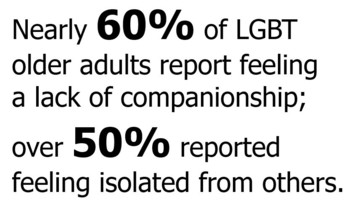
The image below highlights two statistics from SAGE "The facts on LGBTQ+ aging" pdf. Nearly 60 percent of LGBT older adults report feeling a lack of companionship; over 50 percent reported feeling isolated from others. Understanding the communities we serve helps APS provide positive service outcomes for adults who are vulnerable and reported as experiencing maltreatment.
Data source: https://www.sageusa.org/resource-posts/the-facts-on-lgbt-aging/
APS Foundations
APS Foundations provides a basic introduction to the adult protection system in Minnesota for new APS workers and supervisors, or APS workers and supervisors seeking a refresher. The course focuses on fundamental elements such as APS statutes, definitions, MN Adult Abuse Reporting Center (MAARC), lead investigative agencies (LIAs), and the Adult Protection Service Cycle and Time Frames, from intake to case closure.
APS Foundations supports equity and consistency in service response and outcomes that safeguard and promote dignity for vulnerable adults regardless of their location in Minnesota, and the course addresses core competency training recommendations in the ACL Voluntary Consensus Guidelines for State APS Systems.
APS Foundations is offered online over two days in the same week, typically Tuesday and Thursday, from 9:00am - 2:30pm each day. Attendees will need to complete both days to receive a certificate of completion.
APS Foundations training dates are intended to precede SSIS Adult Protection Worker Training dates as much as possible so that APS workers have the option to attend policy-focused training (APS Foundations) and systems-focused training (SSIS Adult Protection Worker Training) sequentially.
Upcoming APS Foundations Dates (registration is for both days):
***APS Foundations is under construction***
APS Foundations courses are on hold while we work on a content update this summer. New content will include changes to the Vulnerable Adult Act (VAA) from the 2022 legislative session, enhanced content on equity and cultural humility in APS, and Minnesota's new APS Vision, Mission, Values. Watch the APS Newsletter for updates on sign-up through TrainLink this summer; anticipate mid-September, 2022 for next sessions.
Anticipate mid-September, 2022 for next sessions
Please contact us at dhs.adultprotection@state.mn.us if you have any questions.
SSIS Essentials eLearning
SSIS Essentials is a collection of six eLearning courses designed to provide caseworkers with an introduction to basic navigation and functionality of core SSIS functions. SSIS Essentials eLearning is offered through TrainLink. New workers are encouraged (not required) to take the online SSIS Essentials eLearning courses prior to taking SSIS Adult Protection Worker training.
Please visit the SSIS Essentials eLearning website for registration and TrainLink instructions, technical requirements, and more detailed information about each of the six SSIS Essentials courses.
SSIS Adult Protection Worker Training
The SSIS Adult Protection Worker course is a technical training designed to provide an overview of data entry as related to Adult Protective Services (APS) into SSIS. The training is offered in two half-day virtual classes and is designed for new adult protection workers, SSIS Mentors, and those seeking a refresher. New workers are encouraged to take the online SSIS Essentials eLearning courses prior to SSIS Adult Protection Worker Training. More information can be found on the SSIS Adult Protection Worker Training website.
Upcoming SSIS Adult Protection Worker Training:
- Sept 19 and 22, 2022 (Mon and Thurs) 9:00 a.m. to 12:30 p.m.
- Oct 31 and Nov 3, 2022 (Mon and Thurs) 9:00 a.m. to 12:30 p.m.
- Jan 9 and 12, 2023 (Mon and Thurs) 9:00 a.m. to 12:30 p.m.
- Feb 27 and Mar 2, 2023 (Mon and Thurs) 9:00 a.m. to 12:30 p.m.
- Apr 10 and 13, 2023 (Mon and Thurs) 9:00 a.m. to 12:30 p.m.
Please visit the SSIS Adult Protection Worker Training website for registration instructions, additional resources, and more detailed information about the course.

National Adult Protective Services Training Center (NATC)
The National Adult Protective Services Training Center (NATC) provides free training for all APS professionals nationwide. Simply create a free account and click "Find Courses" to access any of the training courses. Check out the NATC LMS User Guide if you need help creating an account or navigating the website.
NATC's library of free e-learnings for APS professionals includes a duration suggestion for each course (typically between 30-60 minutes), a knowledge check at the end of each course, and links to additional resources following each course. Course topics include: APS Overview; Ethics, Values, and Cultural Responsiveness; Voluntary Case Planning; Trauma-Informed Practices; Case Documentation; and many, many more!
The NATC is operated by the National Adult Protective Services Association (NAPSA) and is supported by the Administration for Community Living (ACL). NATC training offerings are supplemental to the DHS APS Foundations training for new workers, and are one method to meet the Minnesota APS requirement of 8 hours annual training specific to adult protection duties as required under the Vulnerable Adult Act.
|

APS Technical Assistance and Resource Center (TARC)
APS TARC provides a variety of no-cost educational opportunities for APS professionals including webinars, briefs, and toolkits that align with APS Core Competencies in national standards. APS TARC offerings address a wide variety of topics including APS supervision, frauds and scams, interviews with experts, APS investigation, impacts of COVID-19 on APS, and more. Keep up to date with APS TARC offerings by joining their mailing list.
|
Additional Practice Resources
Find information on adult protection policy, procedure, resources, and training information for mandated reporters and APS on the DHS Adult Protection: Policies and Procedures web page. Specific training resources for APS workers are included under the "Adult protection worker resources and training" drop down. These resources support APS workers meeting education requirements under 626.557 Subd. 9e.
Our goal for the DHS Adult Protection Newsletter is to share knowledge specific to adult protection work in Minnesota, answer common questions regarding adult protection work in Minnesota, and provide awareness of DHS Adult Protection training opportunities. Please contact us with any questions or concerns at dhs.adultprotection@state.mn.us or (651) 431-2609
For more information about DHS Adult Protection, please visit us online DHS AP: Program Overview

|