|
The pause in the launch of the revised MnCHOICES application gave agencies a chance to pause in their preparations.
For many of you, this pause allowed you to shift your agency focus to other priorities and competing interests. At DHS, we have continued to work with our vendor to build and test the revised MnCHOICES application to ensure all functions are coordinated and working as designed. This new application, when released, will provide features and functionality that will support and enhance your assessment and support planning work. We created opportunities to hear what is important to you and what concerns you. This feedback will guide us as we complete our work. We will, as part of this pause, continue to look for opportunities to collect feedback and include agencies in testing of the new system.
Starting in June the MnCHOICES system will be governed by two new groups that work in collaboration with each other: the MnCHOICES System Governance Group and the MnCHOICES Input Group
More about these groups:
System Governance Group
The System Governance Group approves and prioritizes projects and system change requests for MnCHOICES. This group is part of the formal governance structure.
Input Group
The Input Group identifies work that needs to be completed within MnCHOICES and recommends specific actions to the System Governance Group. The Input Group is a staff workgroup who are close to the day-to-day operations of MnCHOICES.
As we collectively wait for launch, your assessment and support planning work continues. DHS is committed to ensuring Minnesotans receive:
- Equitable access when they request an assessment
- A timely assessment
- Support plans in a timely manner, meeting all federal and state requirements
- The services they need.
As we wait for our next steps, we leave you with this grounding thought: “When I think about what gives me hope for the human race, it’s not this old version of ‘kindness.’ When I think about what gives me hope, it’s our tolerance, our ability to tolerate the ambiguity of human connection and our resilience to grow and adapt in our methods of caring for one another.” – From Complications of Kindness by Rebekah Taussig, author of Sitting Pretty: The View from My Ordinary Resilient Disabled Body

Institutional setting survey results
DHS sent out a survey on institutional setting transitions to lead agency (county and tribal nation) leadership on March 14. The intent of the survey was to collect information to better understand discharge processes and assessment timelines for people transitioning from an institution back to the community and in need of long-term services and supports. DHS will use the survey data to inform policy and decision-making.
These are the highlights of the survey data:
Overall, 58 lead agencies participated in the survey with a even representation between regions and sizes of agencies.
Designated staff
- 60% of the agencies report they have staff designated to respond to assessment requests for people seeking discharge from an institution
- 38% do not have staff designated for discharge
- 2% had no answer.
Lead agencies that have staff dedicated to this task have an average of three FTEs assigned.
Established form of communication with institutions
When a person requires an assessment to transition back to the community:
- 74% of agencies noted they have an established form of communication
- 24% do not
- 2% had no answer.
Here are some examples of communication efforts or cooperative relationships established with institutions:
- Intakes are assigned to staff to expedite the assessment process
- The agency has a form the facility uses to discharge a person from the hospital to the agency (i.e. intake workers)
- The agency meets with the hospitals, home care agencies, nursing homes (i.e. weekly, quarterly) to review mutual clients and receive updates on agency information, etc.
- Team of certified assessors who are assigned to certain facilities
- Institutions have built relationships with lead agency intake workers and check in with them.
- Case managers follow a person when they enter an institution for a short-term stay. These case managers are also certified assessors and may complete an assessment when needed.
Lead agencies shared the following examples of the barriers or challenges they experience in providing a timely assessment when a person needs to transition from an institution back to the community:
- Volume of referrals
- Lack of placement options
- Issues with coordination with county of location
- Timing issues (20-day timeline and reassessment) and adequate notice
- MA-LTC financial approval is taking 30 to 45 days
- Not all case managers are certified assessors and caseload size and 20-day timeline make scheduling a MnCHOICES assessment with a certified assessor a barrier
- Institution discharge coordination issues, i.e. communication comes too early — at immediate discharge.
- The person’s location for discharge is unknown/unclear
- The lead agency is not notified by institution about the discharge or without discharge planning with the waiver worker.
Lead agencies shared the following ideas on how to improve a person’s timely transition from an institution back to the community:
- Create a modified assessment that captures needed information
- Need a transition facility between hospital and home
- Funding is needed to pay rent for a time
- The ability to suspend the service agreement in MMIS and keep the waiver open and complete a modified assessment
- Expedited processes: SMRT, MA
- Hospital education on adequate notice. For example, notifying the county or tribal nation a few weeks before a person is discharged from the Anoka Regional Treatment and the IRTS facilities
- Allow the assessment to be good for longer than 60 days
- Caseload recommendations from DHS to assist lead agencies in educating their boards on the issues relating to agency capacity
- It would be helpful if all counties followed the process of assessing clients based on COR.
This is the compiled average number of assessment requests in a month by institution type:
- Hospitals: 2.46
- Other settings for psychiatric, behavioral health or substance abuse: 2.35
- Behavioral health hospital: 1.04.
The chart below displays the days reported from request for an assessment by an institution to an assessment. The categories include most days, fewest days and average days for each institution type.
|
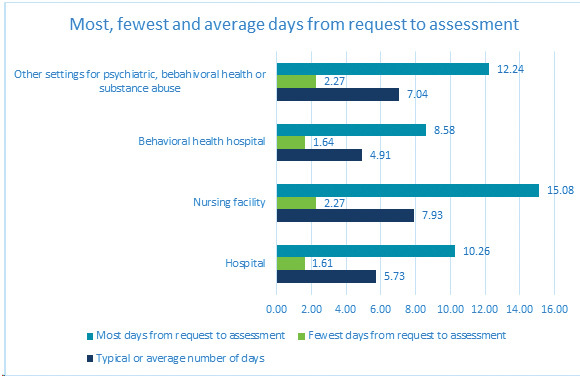 Most, fewest and average days from request to assessment from institutional placement into the community. Other settings for psychiatric, behavioral health or substance abuse:
most 12.4; fewest 2.27; average 7.04.
Behavioral health hospital: most 8.58; fewest 1.64; average 4.91.
Nursing facilities: most 15.08; fewest 2.27; average 7.93 . Hospitals: most 10.26; fewest 1.61; average 5.73

We need your help!
We would like to feature great ideas and best practices from you, the users. Do you have a workflow, technology tip or trick, or best practice that you would like to share with other MnCHOICES users? If so, submit your ideas on the MnCHOICES Help Desk Contact Form, DHS-6979 and choose “Other” under the QUESTION TYPE for a chance to be featured in our newsletter.
Trying to log into TrainLink using MnCAT Step 3 secret links
Mentors from time to time report that when they paste the secret link of MnCAT Step 3 and then log in, they lose their ability to access the secret link or TrainLink prompts them to log in again. To aovid this issue, use the following workaround:
- Paste the secret link in the browser URL window and click enter
- In the TrainLink window click on the Course Content tab
- You will be prompted to log in. Enter your TrainLink ID
- The Course Content tab displays, and the user may start the course.
Recertification CLUs in MnCH8020
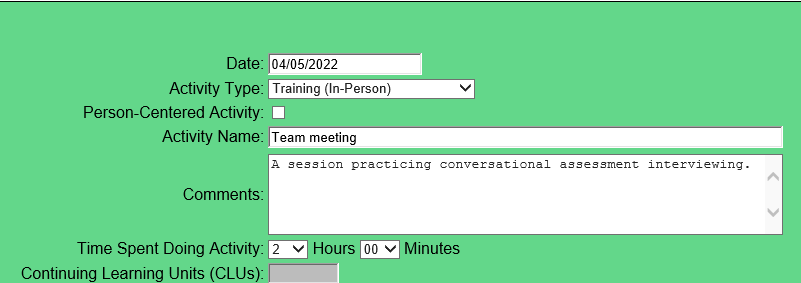
Certified assessors who enter their recertification continued learning units (CLUs) in MnCH8020 recertification module should include a description of the training in the comment text box.
Your comments need to show how the training meets the recertification requirements:
- Improves the practice of a MnCHOICES certified assessor
- Enhances the assessor’s knowledge, skill or ability to: Conduct person-centered needs assessment interviews and/or develop person-centered community support plans
- Enriches the assessor’s capacity to participate as a valued member of the agency’s multidisciplinary team.
Because recertification records are subject to audit by DHS, you must complete this field. It demonstrates you have met the recertification requirements.
|
Need MAXIS access for certified assessors?
Certified assessors are allowed to have MAXIS access, with a read-only role. Assessors use this access to monitor eligibility or other activities to aid their MnCHOICES assessment work.
If your agency determines a certified assessor needs access to MAXIS, provide the following information in the Systems, Securiy and Access Management (SSAM) Access request for MAXIS.
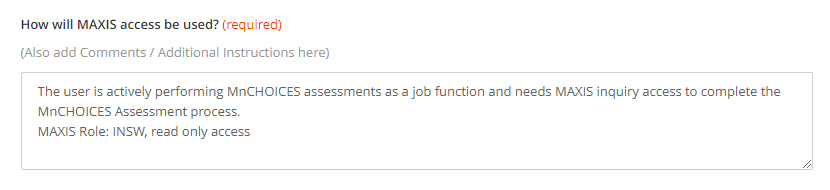
In the “How will MAXIS access be used?” text box, write: “The user is actively performing MnCHOICES assessments as a job function and needs MAXIS inquiry access to complete the MnCHOICES assessment process. MAXIS role: INSW, read-only access.”
Including this information will help the SSAM team to process your request quickly.
|

Do you have a technical or workflow question that you would like help answering? If so, submit your question on the MnCHOICES Help Desk Contact Form, DHS-6979 and choose “Other” under the QUESTION TYPE. We will answer one question per issue.
|
You asked, we answered . . .
Question: When working with the DD Screening document, where do I put the related conditions diagnosis code in MMIS?
Answer: As of Oct. 1, 2021, lead agencies must use Field 12 for the person’s primary diagnosis code. The diagnosis code for related conditions (F78.a9 or F78.a1) must go in Field 13.
Screening documents are often entered with the related conditions code in Field 12 instead of Field 13. This creates edit 224, which is not forcible, and routes the document to DHS for approval. Please review Field 12 and Field 13 when completing screening documents to ensure the diagnosis codes are in the correct field. When the diagnosis codes are entered correctly, you will not have to wait for DHS to review and approve the screening document.
Question: Does the person’s primary diagnosis qualify them for DD services?
Answer: If there is a primary diagnosis code entered in Field 12 that doesn’t support the person having a developmental disability, DHS will follow up with you by adding a comment on the DHS Comments screen in MMIS to request additional information. It is helpful to enter other diagnostic information in the Case Manager Comments screen in MMIS to support the diagnosis code entered.
The lead agency must convey the requirements for the DD diagnostic evaluation. A primary physician can review the functioning level of the person and assign a ICD-10 diagnosis code.
DD screening documents and edits
Please use the DD Waiver scenarios and the DD Screening Document Edits documents to assist in entry of screening documents.
We have noticed recently lead agencies are leaving the time-limited payment (TIME LTD PMT) and payment authorized (PMT AUTHORIZED) fields blank. Please review screening documents to ensure an “N” is entered in the TIME LTD PMT field and a “01” is entered in the PMT AUTHORIZED field. When entered correctly, you will not have to wait for DHS to review and approve the screening document.

MnCHOICES assessments must not be delayed or deferred when an assessment is requested or recommended
Minn. Stat. 256B.0911, subd. 3a requires that people who request an assessment, services planning or other assistance to support community-based living – including people who need an assessment to determine waiver or Alternative Care program eligibility – must be visited by a long-term care consultation team within 20 calendar days after an assessment was requested or recommended.
A MnCHOICES assessment should not be delayed or deferred until their eligibility pieces are in place.
A MnCHOICES assessment can help the person, and others important to them, to better understand their support needs and identify their strengths, goals and preferences.
Here are two examples:
- If the person isn’t eligible for Medical Assistance, there is an opportunity to refer the person to other programs, resources and/or services.
- Although a MnCHOICES assessment does not determine eligibility for the Early Intensive Developmental and Behavioral Intervention (EIDBI) Benefit:
- A person with autism may receive a MnCHOICES assessment to determine eligibility for services regardless of an EIDBI referral, assessment and determination process.
- If a person qualifies for Medicaid-funded services, they may also be eligible for the EIBDI Benefit.
If a person requests a MnCHOICES assessment, the lead agency is required by state statute to complete one. The person and/or family should be informed of the timelines and the possibility that a second assessment will be needed; however, they ultimately have the right to request the assessment be completed.
To meet statute, the lead agency must complete the assessment within 20 days of the request. If the person does not open to a program within 90 days from the initial assessment, an eligibility update may be completed. An eligiblity update allows an additional 60 days for the assessment to be acted upon.
|

“The capacity to learn is a gift; the ability to learn is a skill; the willingness to learn is a choice.” ― Brian Herbert, author.
Visit the Disability Services Division training archive for ongoing educational courses and other training opportunities. Navigate to TrainLink to find additional training courses offered by DHS.
Interested in learning more about assistive technology?
MN-NEAT’s mission is to educate people and professionals about assistive technology and how it can improve quality of life. Their website offers:
-
Ask the experts events page which includes an upcoming webinars list and recordings of past webinars. On July 14, 2022, they offered a course on adaptive recreation and outdoor activities.
-
Assistive technology page with examples of technology for the kitchen, living room, office, bedroom and bathroom.
DHS suite of brain injury videos
More than 100,000 Minnesotans live with the effects of brain injury. Falls are the leading cause of brain injury in Minnesota. The DHS YouTube channel offers a suite of videos on brain injuries. The purpose of these videos is to provide education on brain injuries and how to accommodate people with a traumatic brain injury.
Action you may take: Share these videos with professionals who work with people with traumatic brain injuries (i.e. certified assessors, care coordinators and case managers).
The suite includes a video on brain injury basics and then a series of modules on accommodating the symptoms of brain injury including attention, impulsivity, memory, mental flexibility, planning and organization, processing, initiation and self awareness.
On-demand training
The National Association of State Head Injury Administrators offers a suite of on-demand training modules, Neuopsychological Screening: Using Brain injury and cognitive screening to inform treatment planning across settings, presented by Dr. Kim Gorgram of the University of Denver.
Who should sign up?
These modules are for master’s-level service providers, social workers, vocational rehabilitation counselors, addictions professionals, community rehabilitation program staff, evaluators, school staff, mental health counselors, etc.
Modules 1 through 3: For any master’s-level clinician who wants to learn more about behavioral health, explore screening batteries and learn how to report and implement results into treatment planning.
Module 4: For a master’s-level clinician who will be supervising other clinicians, who wants to learn how to oversee those implementing neuropsychological screeners. You must first complete modules 1-3.
Consultation: For anyone who needs live, virtual consultation; for those interested in setting up program-wide implementation; those who have additional questions; or those who need supervision.
Participants will receive a certificate of completion and a virtual badge to promote the completion of the course.
The course description provides the costs for the modules, a registration section and whom to contact for more information.
|
Sign up to receive email notifications when forms are changed or added to eDocs.
Visit the Community-Based Services Manual (CBSM) often for a list of policies and pages we've recently updated. For a list of changes, visit the What’s New page.
|