|
The Minnesota Departments of Human Services, Aging and Adult Services, and the Department of Commerce are partnering with the Dr. Marti DeLiema, from the University of Minnesota Department of Social Work, in an application to the federal Administration for Community Living for an Elder Justice Innovation Grant to identify outcomes for vulnerable adults and adults over age 65 from a new Minnesota law, Safe Seniors Financial Protection Act.
The Safe Seniors Financial Protection Act became law in Minnesota in 2018. The Act is age and disability based and allows financial services providers such as banks and credit unions as well as brokers and investment advisors to delay financial transactions requested by vulnerable adults, or any adult over age 65, when financial exploitation or fraud are suspected. The delay is intended to allow time for a trusted person named by the adult, law enforcement and prosecutors and adult protective services to intervene and investigate . The Act, which allows the transaction to be delayed for up to 15 days with notice to proper parties, is based on the North American Securities Administration Association (NASAA) Senior Model Act which has been adopted in over 30 states. The goal of the Safe Seniors Act is to protect vulnerable adults and people over age 65 from losing assets by preventing financial exploitation and fraud.
This project, if awarded, holds great promise in learning who is impacted by this law by developing demographics for older adults whose financial transactions are involuntarily delayed, determining the amount of money impacted, learning if the impacted transaction was ultimately determined to be criminal or financial exploitation, and ultimately understanding if the Act is an effective tool in preventing financial exploitation of vulnerable and older adults. Results from this project has implications for age groups not impacted by the Model Act as well as for adult protection stakeholders beyond Minnesota.
Minnesota Association of County Social Service Administrators (MACSSA) and the Minnesota Department of Human Services (DHS) Adult Protective Unit will create an ongoing APS Partnership Workgroup.
Both MACSSA and DHS appreciate the importance of a strong working relationship between the state, counties, and where appropriate, Tribal Nations. All recognize the usefulness of a long-term group dedicated to strengthening partnerships and improving system outcomes in a way that aligns with Minnesota APS's new Vision, Mission, and Values.
The new APS Partnership Workgroup’s contribution will center on activities that achieve greater understanding of system and administrative challenges, as well as create a clearer path to achieve Minnesota APS's vision. All work is rooted in open and respectful dialogue and a shared desire to improve APS results for Minnesotans.
Scope of authority:
- Coordinating listening activities to better understand diverse, internal APS perspectives.
- Accessing existing state and county APS data related to protection of vulnerable adults in MN.
- Coordinating communications and activities between the group and MACSSA’s Adult Services Committee.
There will be five to seven MACSSA representatives and three to five DHS representatives on the APS Partnership Workgroup. MACSSA member selection will strive for a balance of perspectives, positions, and skills. DHS members will be delegated by the Aging and Adult Services Division Director and will be selected based on their positions at the agency in relationship to the adult protection functions.
The APS Partnership Work Group will build its working values from the framework provided by APS vision, mission, and core operating principles established in spring of 2022.
Data help policy makers and the public understand the nature and scope of an issue. In the case of adult protection, data provide a basis to understand if vulnerable adults are treated fairly and justly in our state. Data can impact program evaluation, benchmarks for quality and performance outcomes, budget planning and resource allocation, and inform evidenced based prevention and remediation/service response for vulnerable adults who have been maltreated.
“Without data, you're just another person with an opinion."
― W. Edwards Deming
The Vulnerable Adult Protection Dashboard provides annual state and county data on the number of reports, allegations, and investigation determinations. The dashboard explains what happens after reports of suspected maltreatment of a vulnerable adult are made to the Minnesota Adult Abuse Reporting Center (MAARC).
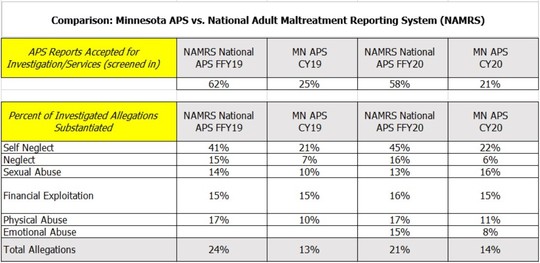
The image below compares data between Minnesota APS and national data from the National Adult Maltreatment Reporting System (NAMRS) for 2019 and 2020. There are two categories identified: APS Reports Accepted for Investigation/Services (screened in) and Percent of Investigated Allegations Substantiated.
APS Foundations
APS Foundations provides a basic introduction to the adult protection system in Minnesota. APS Foundations focuses on fundamental elements of Minnesota's adult protection system such as statutes and definitions, Minnesota Adult Abuse Reporting Center (MAARC), Lead Investigative Agencies (LIAs) and jurisdiction, the Adult Protection service cycle and time frames from intake to case closure, and much more.
APS Foundations is intended for new adult protection workers and supervisors, or adult protection workers and supervisors seeking a refresher. APS Foundations supports equity and consistency in service response and outcomes that safeguard and promote dignity for vulnerable adults, regardless of their location in Minnesota, and addresses core competency training recommendations in the ACL Voluntary Consensus Guidelines for State APS Systems.
APS Foundations is offered online and consists of four 2 hour sessions over four consecutive weeks (8 hours total). Attendees will need to complete all four sessions to receive a certificate of completion. APS Foundations dates are set up to precede SSIS Worker Training dates as much as possible. Therefore, APS workers have the option to attend policy (Foundations) and systems (SSIS) trainings sequentially.
Upcoming APS Foundations Cohorts (registration is for all four dates of a cohort):
- Additional APS Foundations cohort dates will be added soon
Please contact us at dhs.adultprotection@state.mn.us if you have any questions.
SSIS Adult Protection Worker Training
The SSIS Adult Protection Worker course is a technical training designed to provide an overview of data entry as related to Adult Protective Services (APS) into SSIS. The training is offered in two half-day virtual classes and is designed for new adult protection workers, SSIS Mentors, and those seeking a refresher. More information can be found on the SSIS Adult Protection Worker Training website.
Upcoming SSIS Adult Protection Worker Training:
- Jun 6 and 9, 2022 (Mon and Thurs) 9:00 a.m. to 12:30 p.m.
- Additional SSIS Adult Protection Worker Training dates will be added soon
Please visit the SSIS Adult Protection Worker Training website for registration instructions, additional resources, and more detailed information about the course.
SSIS Essentials eLearning
SSIS Essentials is a collection of six eLearning courses designed to provide caseworkers with an introduction to basic navigation and functionality of core SSIS functions. SSIS Essentials eLearning is offered through TrainLink. New workers are encouraged (not required) to take the online SSIS Essentials eLearning courses prior to taking SSIS Adult Protection Worker training.
Please visit the SSIS Essentials eLearning website for registration and TrainLink instructions, technical requirements, and more detailed information about each of the six SSIS Essentials courses.

APS Technical Assistance and Resource Center (TARC)
APS TARC provides a variety of no-cost educational opportunities for APS professionals including webinars, briefs, and toolkits that align with APS Core Competencies in national standards. APS TARC offerings address a wide variety of topics including APS supervision, frauds and scams, interviews with experts, APS investigation, impacts of COVID-19 on APS, and much much more. Keep up to date with APS TARC offerings by joining their mailing list.
|
Additional Practice Resources
Find information on adult protection policy, procedure, resources, and training information for mandated reporters and APS on the DHS Adult Protection: Policies and Procedures web page. Specific training resources for APS workers are included under the "Adult protection worker resources and training" drop down. These resources support APS workers meeting education requirements under 626.557 Subd. 9e.
Our goal for the DHS Adult Protection Newsletter is to share knowledge specific to adult protection work in Minnesota, answer common questions regarding adult protection work in Minnesota, and provide awareness of DHS Adult Protection training opportunities. Please contact us with any questions or concerns at dhs.adultprotection@state.mn.us or (651) 431-2609
For more information about DHS Adult Protection, please visit us online DHS AP: Program Overview

|




