|
Minnesota Governor Tim Walz issued a proclamation that March, 2022 is Social Work Month in the state of Minnesota.
Thank you for your dedication to improving equity and well-being in our society and for your work to support adults who are vulnerable in meeting their basic rights to safety and dignity.
|
|
 |
The 2022 legislative session is underway! First heard in the 2021 legislative session, HF 1432/SF 2317 is back this session and is on the move. You can read the bill using the HF 1432/SF2317 links. On the House side, HF 1432 was heard in the February 23, 2022 House of Representatives Human Services Finance and Policy Committee and the A22 Amendment to HF 1432 was heard in the March 8, 2022 House of Representatives Judiciary Finance and Civil Law Committee (see below for more details on the A22 amendment to HF 1432). Next steps are for the bill and amendment to be heard in a Senate committee.
DHS and the Minnesota Association of County Social Service Administrators (MACSSA) partnered for additional policy changes proposed through an amendment. The amendment includes:
- Allows county social service agencies to offer assistance to the reporter or the person subject to the report when the report is not accepted for APS.
- Clarifies APS data sharing authorities that exist for data sharing between APS, tribal nations, and case managers under Minnesota Statutes, chapter 13 for protection of vulnerable adults.
- Creates an APS assessment track to support dignity, choice, and service engagement for the vulnerable adult when investigation will not protect the vulnerable adult.
- Updates VAA language to be consistent with the modernization of the guardianship statute and removes “ward or protected person” and replaces it with “person subject to guardianship or conservatorship.”
MACSSA Position Statement on 2022 VAA Redesign proposal. Keep tuned to the Adult Protection Newsletter or your professional associations for updates.
Trauma
What is Trauma? “Individual trauma results from an event, series of events, or set of circumstances experienced by an individual as physically or emotionally harmful or life threatening with lasting adverse effects on the individual’s functioning and mental, physical, social, emotional, or spiritual well-being” (Substance Abuse and Mental Health Services Administration, 2020)
By the nature of abuse, neglect or exploitation APS clients are at risk for experiencing trauma. APS clients who have a history of having experienced loss, illness, family or intimate partner violence, war, substance abuse, behavioral health challenges, racism, gender bias, foster care, prison, or other potentially traumatic events earlier in life are at risk for having experienced trauma. We know that trauma impacts our work, our clients and ourselves.
Secondary Trauma
Secondary trauma is trauma experienced by an individual who has had direct contact with another individual who suffered trauma, or trauma as a result of the personal and/or professional situation that impacts the individual’s current state of mind, health, and productivity. It is common for APS workers and APS supervisors to experience secondary trauma at some point during their career.
Recognition and Workforce Impacts
How can we recognize and respond to our own secondary trauma? Here are some tips: interact with your colleagues on a day-to-day basis to assist in identifying secondary trauma; be aware of emotions connected to your work and clients; validate your colleague’s feelings and emotions when they are expressed; and know the symptoms of secondary trauma. When making service decisions, acknowledge differences and challenges in engagement, assessment, and service interventions for clients who have experienced trauma. Use colleagues, supervisors, advocates, MDTs, and services and sources trusted by the client to support your work. Self-care is not just a catch phrase, it is necessary work we can do for ourselves to help manage the secondary trauma we may experience at work. We can support our clients, each other, and ourselves when we are aware of trauma and its impacts.
Impacts and Symptoms
A non-exhaustive list of potential impacts from trauma that APS clients may experience include: an inability to cope with normal stress, challenges in trust of workers and services, difficulties in regulating their own behavior, and impairment in memory or executive cognitive functioning.
A non-exhaustive list of potential symptoms of secondary trauma that adult protection professionals may encounter include: burn out, compassion fatigue, physical health issues, and increased conflicts with colleagues.
Service Rationing
APS managers, workers, and supervisors experiencing secondary trauma are also at risk of unintentionally “service rationing.” Service rationing is making prioritization decisions based on how challenging the client is to work with in order to managing stress and gain satisfaction from work with clients. For example, screening out challenging clients with multiple needs from their own trauma and prioritizing clients who are more compliant and accepting of APS.
Adult Protective Services and Trauma
APS workers are responsible to assess, stop, and prevent maltreatment for people who are vulnerable. Effective APS requires using trauma informed practices. Using trauma informed approaches can support APS clients to heal from maltreatment. Trauma informed care also promotes safety and dignity for people who are vulnerable.
Trauma informed approaches include: helping clients identify and implement what makes them feel safe; acknowledging past experiences and affirming the client’s rights; helping clients and persons alleged responsible for maltreatment to understand what to expect from APS during assessment and investigation; giving choices; and being trustworthy and transparent in interviews and during assessment, investigation, service planning, and interventions.
It is also important to acknowledge that APS workers are not invincible. We are humans who must manage work and personal issues that arise in life. It is likely that there are times when good workers in APS are lost as a result of secondary trauma. With diligent efforts and validation of secondary trauma, we can work to reduce the effects of secondary trauma with understanding and a team approach.
Additional resources
Data help policy makers and the public understand the nature and scope of an issue. In the case of adult protection, data provide a basis to understand if vulnerable adults are treated fairly and justly in our state. Data can impact program evaluation, benchmarks for quality and performance outcomes, budget planning and resource allocation, and inform evidenced based prevention and remediation/service response for vulnerable adults who have been maltreated.
“Without data, you're just another person with an opinion."
― W. Edwards Deming
The Vulnerable Adult Protection Dashboard provides annual state and county data on the number of reports, allegations, and investigation determinations. The dashboard explains what happens after reports of suspected maltreatment of a vulnerable adult are made to the Minnesota Adult Abuse Reporting Center (MAARC).
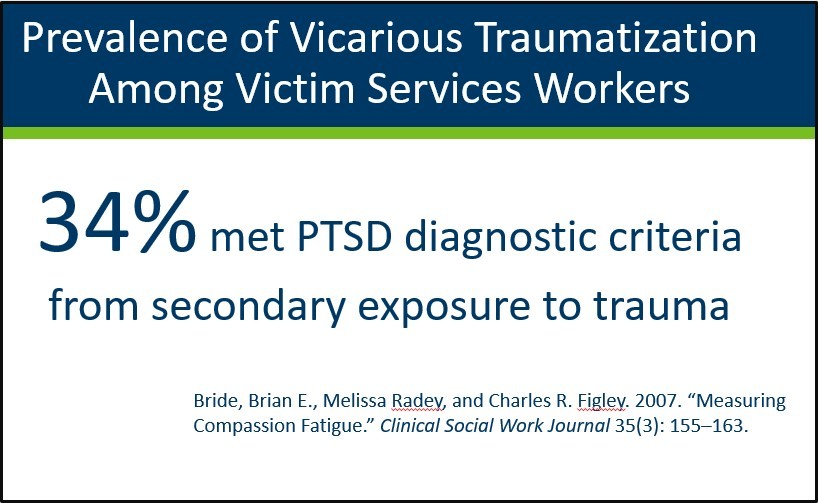
As shown in the image below, according to the 2007 article "Measuring Compassion Fatigue" by Brian Bride, Melissa Radey, and Charles Figley in the Clinical Social Work Journal, the prevalence of vicarious traumatization among victim services workers includes 34 percent met PTSD diagnostic criteria from secondary exposure to trauma.
APS Foundations
APS Foundations provides a basic introduction to the adult protection system in Minnesota. APS Foundations focuses on fundamental elements of Minnesota's adult protection system such as statutes and definitions, Minnesota Adult Abuse Reporting Center (MAARC), Lead Investigative Agencies (LIAs) and jurisdiction, the Adult Protection service cycle and time frames from intake to case closure, and much more.
APS Foundations is intended for new adult protection workers and supervisors, or adult protection workers and supervisors seeking a refresher. APS Foundations supports equity and consistency in service response and outcomes that safeguard and promote dignity for vulnerable adults, regardless of their location in Minnesota, and addresses core competency training recommendations in the ACL Voluntary Consensus Guidelines for State APS Systems.
APS Foundations is offered online and consists of four 2 hour sessions over four consecutive weeks (8 hours total). Attendees will need to complete all four sessions to receive a certificate of completion. APS Foundations dates are set up to precede SSIS Worker Training dates as much as possible. Therefore, APS workers have the option to attend policy (Foundations) and systems (SSIS) trainings sequentially.
Upcoming APS Foundations Cohorts (registration is for all four dates of a cohort):
- May 12, 19, 26, and Jun 2, 2022 (Thurs) 10:00 a.m. to 12:00 p.m. | Click Here to Register
- Additional APS Foundations cohort dates will be added soon
Please contact us at dhs.adultprotection@state.mn.us if you have any questions.
SSIS Adult Protection Worker Training
The SSIS Adult Protection Worker course is a technical training designed to provide an overview of data entry as related to Adult Protective Services (APS) into SSIS. The training is offered in two half-day virtual classes and is designed for new adult protection workers, SSIS Mentors, and those seeking a refresher. More information can be found on the SSIS Adult Protection Worker Training website.
Upcoming SSIS Adult Protection Worker Training:
- Apr 11 and 14, 2022 (Mon and Thurs) 9:00 a.m. to 12:30 p.m.
- Jun 6 and 9, 2022 (Mon and Thurs) 9:00 a.m. to 12:30 p.m.
Please visit the SSIS Adult Protection Worker Training website for registration instructions, additional resources, and more detailed information about the course.
SSIS Essentials eLearning
SSIS Essentials is a collection of six eLearning courses designed to provide caseworkers with an introduction to basic navigation and functionality of core SSIS functions. SSIS Essentials eLearning is offered through TrainLink. New workers are encouraged (not required) to take the online SSIS Essentials eLearning courses prior to taking SSIS Adult Protection Worker training.
Please visit the SSIS Essentials eLearning website for registration and TrainLink instructions, technical requirements, and more detailed information about each of the six SSIS Essentials courses.

APS Technical Assistance and Resource Center (TARC)
APS TARC provides a variety of no-cost educational opportunities for APS professionals including webinars, briefs, and toolkits that align with APS Core Competencies in national standards. APS TARC offerings address a wide variety of topics including APS supervision, frauds and scams, interviews with experts, APS investigation, impacts of COVID-19 on APS, and much much more. Keep up to date with APS TARC offerings by joining their mailing list.
|
Additional Practice Resources
Find information on adult protection policy, procedure, resources, and training information for mandated reporters and APS on the DHS Adult Protection: Policies and Procedures web page. Specific training resources for APS workers are included under the "Adult protection worker resources and training" drop down. These resources support APS workers meeting education requirements under 626.557 Subd. 9e.
Our goal for the DHS Adult Protection Newsletter is to share knowledge specific to adult protection work in Minnesota, answer common questions regarding adult protection work in Minnesota, and provide awareness of DHS Adult Protection training opportunities. Please contact us with any questions or concerns at dhs.adultprotection@state.mn.us or (651) 431-2609
For more information about DHS Adult Protection, please visit us online DHS AP: Program Overview

|