After nearly two years with most of us working remotely, some of us may be feeling isolated or disconnected from our colleagues. While technology enables us to talk and see each other’s faces from time to time, it’s not the same as running into a colleague in the hallway, chatting with a friend over lunch or laughing with a co-worker while working on a project together in the office.
As we continue to adapt to new ways of doing business, I want us to remain connected. Not only is it vital for our working relationships but our individual mental health. Check out these and other opportunities, and consider one or more as a way to get involved with our colleagues.
-
Strategic Anti-Racism Team: StART is looking for 12 new team members and 30 anti-racism trainers. Check out the DHS Today article for more details.
-
Employee Resource Groups: They offer a great opportunity to engage with our colleagues. This one pager and document provide some basic background and guidelines. This webpage gives you a list of the groups and chairs of each if you are interested.
-
Children and Family Services Employee Engagement Group: The group represents and connects with all Children and Family Services divisions for the development and implementation of employee engagement efforts. The group is currently seeking three additional representatives from the Child Care, and Economic Assistance and Employment Supports Divisions. If you are interested, contact the Children and Family Services Employee Engagement Ambassador Tamara Moore at Moore@state.mn.us.
-
Division Equity Teams: If you haven’t already, check out the links below and reach out to team chairs to learn about getting involved. And, watch for a number of events and activities the teams host periodically. These are great learning opportunities as well as a way to get to know each other better.
-
Communities of Practice Teams: We have a number of Community of Practice Teams in our department. They offer us an opportunity to connect with others who are doing like work and share valuable lessons to do our work more effectively. Recently, the Communications Community of Practice launched to collaborate on standards and best practices for a variety of communications, and provide support to colleagues to communicate better. All who communicate on behalf of the department are welcome to attend the second Thursday of each month from 2:30-3:30 p.m. For more information, contact the Communications Community of Practice Leadership Team:
In addition to these formal opportunities, some divisions have made efforts to engage in informal activities to keep connected, including:
- Getting “together” for virtual coffee breaks and lunches, and playing after-work interactive games online
- Sharing and describing via show and tell (e.g. something inspirational, a favorite room in their home, their pet, an object of a particular color or shape)
- Wearing a silly hat or sweater on a particular day when the work unit meets virtually
- Assigning one person each week to give inspirational thoughts or discuss ways to uplift each other
- Creating a group via MS Teams to connect regularly
- Creating a chat group during virtual conferences to keep staff connected with others attending
- Sending regular emails to colleagues to stay connected
- Providing updates from each work unit in division newsletters
- Starting meetings with fun activities, including Bingo Lingo (colleagues play a bingo board made up of different DHS acronyms and lingo), Where in the World am I? (Colleagues share a photo of themselves and then others guess where they have been) and scavenger hunts (colleagues have a list of items to collect from their home or yard to then share with the group).
Finally, the Minnesota Department of Health recently shared the #StayConnectedMN Toolkit (state.mn.us) with a host of ideas for connecting with our communities and each other. Here’s an example of one of the tips: Being part of the change that we want to see can be a healing endeavor, especially when you have experienced collective trauma like racism or heterosexism. Look for outlets in local cultural newspapers or radio programs… .
I encourage all of us to explore ways we can get and stay connected with each other, and for anyone at any level within Children and Family Services to lead, participate in and generate ideas to spread the coordination work, the time commitment and the fun around.
Tikki Brown
Assistant commissioner
|
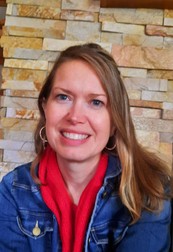
Erika Martin is a Research Team supervisor in the Economic Assistance and Employment Support's Division. She’s worked for the Department of Human Services since 2007. “I left for about 18 months in 2010 to work for the Minnesota Department of Health, but came back to DHS in 2012,” she says.
Before joining DHS, Martin spent time working for both Hennepin and Ramsey counties. She holds a Bachelor of Science degree in Social Work from Augsburg University in Minneapolis and also studied public policy at the Humphrey School of Public Affairs at the University of Minnesota in Minneapolis.
Outside of work, Martin enjoys spending time with her family and attending her children’s soccer and lacrosse games, “which I didn’t know I enjoyed so much until the pandemic put a stop to them for a while,” she says. “I also love cooking, traveling and being outdoors.”
What is the most interesting aspect of your job?
I love how my current job combines so many threads. There are a lot of technical aspects involved with working with coding and the DHS data warehouse. There’s also a lot of data governance aspects to my job as data becomes more and more of a primary focus and priority to DHS. I enjoy thinking about both how we best use our data to understand and improve our services and how we manage the data that the people of Minnesota have entrusted us to protect.
Before working at DHS, what was the most unusual or interesting job you’ve had?
In high school I taught ballet to junior high school students. The students were very motivated with tons of energy and it was fun to be a mentor to them. It was also a great creative outlet.
What would colleagues be surprised to know about you?
I think a lot of folks assume that data people are tech savvy in other ways. While that’s probably true for many people, it’s not really true for me. In fact, my 12-year-old son had to help me post my first picture on Instagram.
What aspect of your daily routine do you look forward to the most?
Now that I’m working from home, one of my favorite parts of the day is my family’s morning routine. I get started at work early and then still get to be there to make breakfast and help get my two kids off to their school bus. We’ve managed to get into a really good rhythm even though most of us are not morning people.
What’s your best kept secret for success at DHS?
Get to know your colleagues. DHS is full of dedicated people with incredibly diverse experience. This richness is such a great asset to DHS. Learning from your colleagues helps expand your own perspective on the work we do and gives you new and creative ideas for how we can improve services for the people of Minnesota. Now that we’re mostly working in a virtual environment, however, making those connections can be more difficult. I really miss the everyday “water cooler” opportunities to chat with colleagues. I’d like to encourage all of us to make time to connect with each other.
|
The 2022 session of the Minnesota Legislature began on Jan. 31, 2022. With the state’s biennial budget already in place, Gov. Tim Walz has brought forward a supplemental budget this year to address the $7.7 billion surplus identified in the state’s November 2021 budget forecast. Many of the spending proposals included in that supplemental budget would make significant investments in Minnesota children and families.
This year’s supplemental budget proposals that would benefit children and families include:
Child care
- Increasing funding to allow more families to receive child care assistance by expanding eligibility criteria for the Basic Sliding Fee Child Care Assistance Program.
- Changing the Child Care Assistance Program’s definition of “family” to extend benefits to foster care families, relative custodians and guardians.
- Providing additional financial support to child care providers experiencing financial hardships.
- Increasing Child Care Assistance Program rates to the 75th percentile of the 2021 market survey.
Child welfare
- Providing additional investments to support the implementation of the federal Family First Prevention Services Act.
- Creating a new grant program to help individuals retain their Child and Adolescent Needs and Strengths tool certification.
- Increasing funding for the Mille Lacs Band of Ojibwe to support the tribal government’s planning for implementation of Minnesota’s American Indian Child Welfare Initiative.
- Adding staff to the department’s Indian Child Welfare Act Unit to expand and strengthen existing work intended to address the disproportionate overrepresentation of American Indian children in the child welfare system.
- Expanding the Parent Support Outreach Program to schools and community based agencies; expanding Family Group Decision Making; expanding Parent Mentor programs; and increasing the state’s contribution to Family Assessment Response, which all support children remaining safely in their homes and provides more funding to counties and tribal governments.
Food support
- Providing additional funding to Tribal Nations and American Indian organizations to improve access to food security programs within tribal and American Indian communities.
- Providing grant funds to improve and expand food shelf facilities throughout the state via capital improvements.
- Providing additional funding to food shelves, food banks and meal programs to purchase, store, transport and process food to individuals and families.
Housing
- Expanding services under the Homeless Youth Act by increasing supports provided to youth and young adults in need of assistance and increasing the number of housing units for youth experiencing homelessness. This proposal places an emphasis on young parents who are homeless and LGBTQ+ youth who are disproportionately homeless compared to other young people.
- Providing additional funding for the Emergency Services Program to support Minnesota adults, youth and families experiencing homelessness.
- Increasing funding for the Transitional Housing Program to better provide transitional housing and wrap-around support services for individuals and families experiencing homelessness.
For more information about this year’s budget proposals, read the full list of Governor’s budget recommendations.
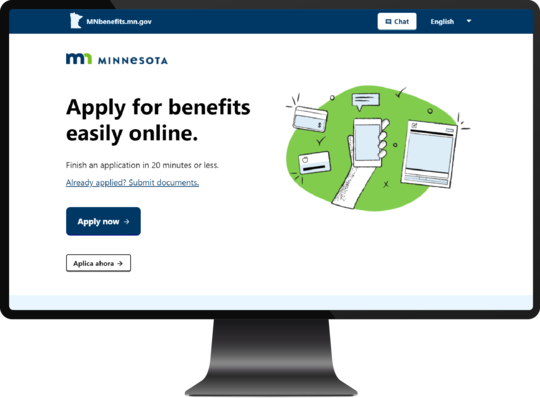 MNbenfits officially replaces ApplyMN
In November 2021, the Minnesota Department of Human Services (DHS) announced the statewide launch of MNbenefits, a faster, more accessible, easier-to-use online application for nine public assistance programs: Food assistance, emergency assistance, child care assistance, housing support and five cash assistance programs.
As of Feb. 1, 2022, MNbenefits has completely replaced DHS’ ApplyMN online application portal. This change means that all online public assistance applications must now be submitted via MNbenefits.
Minnesota continues to be one of the top states for collecting child support
The Child Support Division recently released its 2021 Child Support Performance Report.
The report shows that during Federal Fiscal Year (FFY) 2021, Minnesota’s child support program provided services to 314,332 parents and 220,345 children through 1,406 county and state workers. The program also collected and disbursed $551.4 million during 2021, meaning that for every $1 spent on Minnesota’s child support program, the program collected $3.09 in support of children.
Based on preliminary FFY 2021 data, the report shows that Minnesota as a whole continues to rank among the top five states nationally for the percentage of current, monthly child support collected and the percentage of cases with payments toward past due support.
Child Support Division staff and county child support agencies use the annual performance to share the program’s operations and performance with partners as well as the general public. Some counties also share it with their county leadership to review trends and discuss ideas for improvement.
“The Child Support Performance Report is a nice tool to have to compare year-to-year and county-to-county performance,” says Becker County Child Support Supervisor Jason Ruona. “Personally, it allows me to see how we’re performing as a county and as a state.”
Can you hear me now? Call-in numbers available for Microsoft Teams meetings
By default, Microsoft (MS) Teams does not include meeting call-in numbers for all users. Children and Family Services (CFS) staff who need a call-in option for MS Teams meetings can request one from the Minnesota Service HUB by:
- Searching for and clicking on “Microsoft Enterprise Software”
- Clicking on the blue “Request Now” button on the right-hand side of the page
- Selecting “Teams” from the list of available applications
- Selecting “I want a Teams Meeting Dial-In Number” from the “Application Option” drop-down menu.
After a call-in number is established, new MS Teams meeting invitations will automatically include that call-in number.
MN.IT Central is in the process of renegotiating the Department of Human Services’ enterprise MS Teams license so that all Minnesota state employees will have a call-in number for MS Teams meetings by default. Until that licensing change takes effect and is announced, CFS staff who need a call-in number for MS Teams meetings can use the steps above to request one.
Whether writing about deadlines or upcoming events, it’s important that staff are consistent in how they stylize dates and times.
Here are some key points to remember:
- Use numerals for dates and years. Do not use st, nd, rd, or th with dates.
- Abbreviate the month only if it comes before an exact date, and if the month is longer than five letters.
Example: Aug. 30, March 17, Nov. 12, April 7, Feb. 22, 2022
- If an exact date does not immediately follow the month, spell out the month.
Example: The series will take place in December.
- Avoid commas if only a year and month are given, but use commas to set off a year if the date, month and year are given.
Example: The event is scheduled for Oct. 12, 2018.
Example: The report will be released in January 2019.
- Never capitalize a.m. or p.m. for the time of an event.
Example: 7:30 a.m., 11:45 a.m., 4:15 p.m.
- Avoid zeroes if the time of an event is at the top of the hour, and avoiding using 12 p.m.
Example: 3 p.m. instead of 3:00 p.m.
Example: The event starts at noon (instead of 12 p.m.)
The department recently issued these news releases related to Children and Family Services:
Children and Family Services recently published these documents on the Minnesota Department of Human Services’ website.
Updated fact sheets:
What’s new for children and adults
-
Nicole Davis joined the Minnesota Child Welfare Training Academy as a Northwest Regional trainer in the Detroit Lakes Regional Learning Center.
-
Rachel Ferguson joined the Economic Assistance and Employment Supports Division’s Instructional Design Training Team as a trainer.
-
Jerad Green joined the Children and Family Services Division as director of Equity and Inclusion.
-
Teri Hillman joined the MAXIS/MEC2 help desk as a Transition Support Systems Help Desk advisor.
-
Angela Holmen joined the Economic Assistance and Employment Supports Division’s Supplemental Nutrition Assistance Program Quality Assurance Team as a management evaluation reviewer.
-
Erica Jepson joined the Child Safety and Permanency Division as a Child Welfare subject matter expert in the Social Services Information Systems Business Operations Unit.
-
Erin Kintop joined the Child Safety and Permanency Division’s Foster Care Unit as a Qualified Residential Treatment Program assessment representative.
-
Nikki Kovan, Research, Evaluation and Implementation supervisor for the Child Safety and Permanency Division, accepted a new job with the Minnesota Department of Education.
-
Heather Moore joined the Child Care Services Division as contracts coordinator.
-
Tyler Osterhaus joined the Economic Assistance and Employment Supports Division’s Instructional Design Training Team as an eDeveloper for the Supplemental Nutrition Assistance Program and Minnesota Family Investment Program.
-
Ashley Pearson joined the Economic Assistance and Employment Supports Division’s Instructional Design Training Team as Children and Family Services forms coordinator.
-
Marcia Ryss joined the Child Safety and Permanency Division as a Child Welfare subject matter expert in the Social Services Information Systems Business Operations Unit.
-
Gaylene Spolarich joined Child Care Services Division as Family, Friend and Neighbor project manager.
-
Maria Tracy joined the Economic Assistance and Employment Supports Division’s Supplemental Nutrition Assistance Program Quality Assurance Team as a management evaluation reviewer.
-
Jeanne Ullevig-Martin retired from DHS in December 2021 after 31 years of service.
-
Bharti Wahi joined Children and Family Services as deputy assistant commissioner.
-
Judy Williams joined the Child Safety and Permanency Unit as a Family First Prevention Services Act family preservation specialist.
Send story ideas about new programs and services, recent or upcoming events, and promotions, new hires and retirement announcements (with permission) for the next issue of CFS Update by Feb. 18, 2022, to:
Business Integration: Mark Faxvog, 651-431-2206, or mark.faxvog@state.mn.us
Child Safety and Permanency: Ruth Swanson, 651-431-4671, or ruth.a.swanson@state.mn.us
Child Support: Bruce Erickson, 651-431-4466, or bruce.t.erickson@state.mn.us
Child Care Services: Tiffany Rivera-Prescott, 651-431-3861, or tiffany.rivera-prescott@state.mn.us
Economic Assistance and Employment Supports: Mary Zurn, 651-431-3954, or mary.zurn@state.mn.us
Management Operations: Beth Voigt, 651-431-3833, or beth.voigt@state.mn.us
To view previous issues, visit the CFS Update archive.
|